How a shared love of the humble jackfruit transformed into a movement in Kerala
Chakkakkoottam, a 40,000 member-strong WhatsApp group, has expanded the horizons of individuals who want to cultivate, process and optimise the fruit


Editor's Note: This article is part of the Good Food Movement's series to spotlight India's summer fruits. Here, we analyse both the ways in which their cultivation expands a farmer's horizons, and the challenges of growing them in a changing climate.
Rukhiya Moidu, a teacher from Malappuram in Kerala, was anxiously on the lookout for a solution to a problem of plenty. “I have 10 jackfruits with me. I have no idea what to do with so many… I cannot throw them away while they’re still so fresh,” she said. Rukhiya was speaking at an online meeting where at least 30 others were present to discuss their opinions and concerns about one thing that is the glue holding together this group for 7 years now—the jackfruit.
They’re members of a larger WhatsApp group of 400 people, and this sub-group is just one of 1,400 groups comprising over 40,000 fans of the jackfruit, who call themselves Chakkakkoottam—a collective that began to take shape in 2018. It is a coming-together of those who own jackfruit trees, who trade it, who fashion products out of it, who research it, and just about anyone who loves the fruit.
Rukhiya asked for the contact details of a meeting attendee who owns a successful business that sells value-added products made from the fruit. Another attendee offered advice on ways to preserve it for a longer period. The group was also planning to visit an agricultural engineering institute, not far from Rukhiya's home, to conduct a recce of the facilities for a practical study. They needed volunteers who would bring the fruit to test a dryer machine. At the end of the hour-long session, Rukhiya had found ways to ensure that her jackfruits did not go to waste. She could now rest easy.

Rukhiya has aspirations to start a jackfruit products business of her own, and has already invested in freezer and dryer machines. But she is hesitant to begin without the headstart she can get from a training camp organised by Chakkakkoottam each month in Chalakudy, Thrissur district; it’s a three-day crash course that offers hands-on training to novices like her. “Only after I attend these classes will I feel that I have a Master’s in jackfruits. Otherwise, I fear that I’d be plunging head-first into the deep end, unprepared,” Rukhiya expressed during the meeting.
These weekly meetings are not the only forum where Chakkakkoottam comes to life. The WhatsApp groups buzz with activity as different members send variations of a similar message: “There are a large number of ripe jackfruits in my home which may go to waste. Anybody who needs them, please contact me,” accompanied by a phone number and details of the location. There are entrepreneurs requesting large quantities of the fruit for their business units. And there are members sharing pictures of the recipes they have made with this fruit that they collectively cherish.
Not everyone in the Chakkakkoottam fold is a farmer or an entrepreneur. The community also comprises those with day jobs who have nothing to do with agriculture. What brings them together is a keen interest in fully leveraging the jackfruit trees growing in their backyards. The underlying sentiment is the nostalgia that the taste of the fruit represented in the personal memories of a handful of city-dwellers. Yet what began on an informal note has transformed into a committed cause for the fruit’s conservation.
Also read: At this mango ‘museum’ in Gujarat, 300-plus varieties thrive
The origins of a jackfruit ‘fan club’
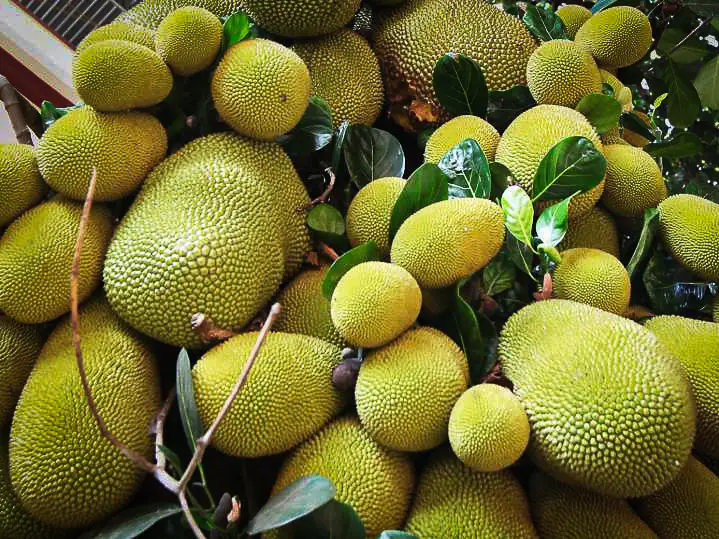
Jackfruit trees grow with minimal effort and offer abundant yields; a single plaavu (jackfruit tree) can produce as many as 250–300 fruits in a year. The labour is in handling the fruit that weighs anywhere between 11–35 kg. Cutting it open and retrieving every seed and every bit of flesh is an arduous effort. In Kerala, this is often an activity of familial bonding, where relatives gather to conquer a jackfruit with knives and sort its pieces into vessels, to be eaten raw or cooked into a stir fry. The plaavu is a common sight in the backyards adjoining Malayali homes. The bounty offered by the tree becomes a problem of excess for people who are neither farmers nor traders, whose relationship with the fruit is limited to occasional consumption.

It was in 2018 that the jackfruit (Artocarpus heterophyllus) was declared the official state fruit by the Kerala government. “Though the jackfruit is one of the most widely produced fruits in the state, we are yet to tap its potential completely,” the then agriculture minister V. S. Sunil Kumar had said in the state assembly, as he announced the landmark decision. The data at the time suggested that 32 crore jackfruits were produced in Kerala every year, of which 30% were getting wasted. An area of 97,536 hectares is devoted to the fruit’s cultivation in the state.
The public discourse spotlighting the fruit’s severely underutilised potential set a new movement in motion. Chakkakkoottam—which translates to ‘Jackfruit Collective’—was born in Kochi out of a casual conversation between Anil Jose and his friend T. Mohandas at the latter’s home, where Mohandas had several plaavus. The friend shared his concerns about the fruits going unused since there is only so much that can be consumed by those at home. This gave Anil the idea of forming a WhatsApp group of friends who enjoy eating jackfruit, who could come together on occasion purely to savour its ripe yellow bulbs.
Not everyone in the Chakkakkoottam fold is a farmer or an entrepreneur.
Chakkakkoottam began to take shape as Anil reached out within his circles to connect with fellow fans of the fruit. The group’s first meeting took place in March 2019 at a home in Kakkanad, Kochi. The purpose of the meeting was simple, but its proceedings were halted by an unexpected hiccup: “There were 16 of us, none of whom knew how to climb a tree to pluck the fruit,” Anil recalls. Finally, a doctor in the group volunteered to do it, and they shared the fruits of their labour—pieces of a ripe jackfruit eaten as is, and steamed parts of a raw one prepped for cooking.
A Malayalam publication carried an article about this gathering and its exclusive interest in jackfruits in the next day’s edition, along with Anil's phone number. “I began receiving phone calls from interested parties at 5 in the morning!” Anil recalls. That year, Chakkakkoottam hosted 20 get-togethers in Kakkanad alone. A Chakkakkoottam gathering in Ramanattukara, Kozhikode had 150 attendees. The single WhatsApp group that they began with mushroomed into hundreds, spread across Kerala. “There are 941 Panchayats in Kerala. Chakkakkoottam has groups present in all of them,” Anil says.
{{marquee}}
From fan club to formal commitment
The typical Chakkakoottam gathering entails a talk delivered by a member with extensive knowledge about jackfruits, the plucking and cleaning of a fruit, and cooking it. He said that the group operates on the principle of “gift economy”, where members can volunteer to host a gathering at their home while others can bring the fruit or its products.
“There are 941 Panchayats in Kerala. Chakkakkoottam has groups present in all of them,” Anil says.
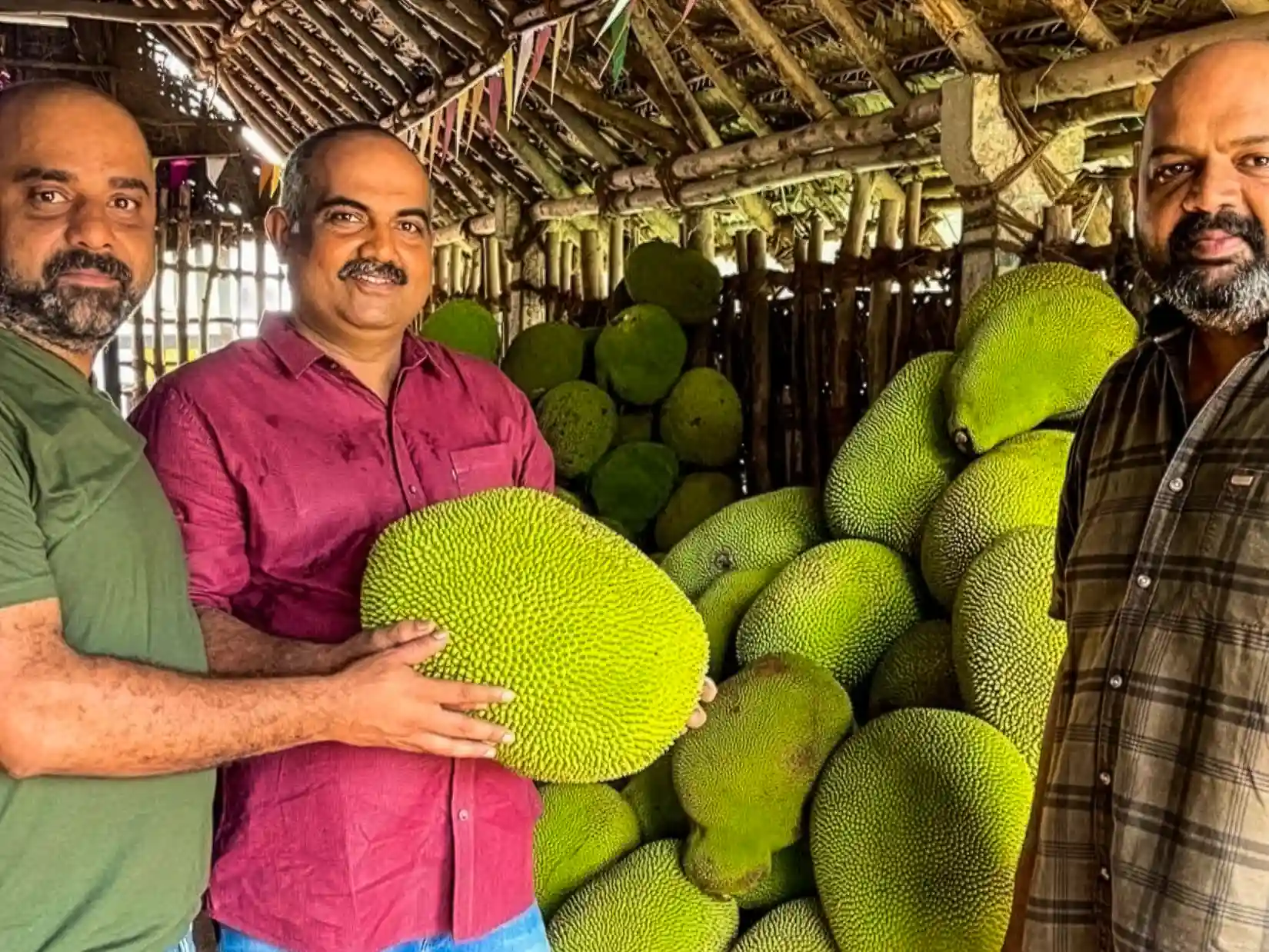
The meetings had come to a halt due to the lockdown enforced during the COVID-19 pandemic. Even then, Chakkakkoottam’s efforts continued at a low-profile scale. A few members drove to various locations and delivered jackfruits free of cost to anyone who requested them. After the lockdown was lifted, there were serious discussions within the group about Chakkakkoottam’s future. They agreed that sharing and consuming jackfruits at occasional gatherings is not doing much to resolve the problem of fruit wastage, arriving at the decision to formally register Chakkakkoottam as a company in 2021. It was founded by R. Ashok along with Anil, Manu Chandran, Vipin Kumar, Sabu Aravind and Ciby Mon. Their entrepreneurship, driven by the objective of maximising the potential of the jackfruit, was endorsed by the Kerala government for "championing the circular economy”.
Steering the operations of the company led them towards a deeper understanding of the fruit’s peculiarities. “It is difficult to determine its ripeness high up on a tree. With coconuts, you can just cut them and let them drop down. They won’t get damaged because of their hard shells. But a jackfruit can get spoiled if it falls from a height,” Anil explains.

Commercial pursuits with a conservation bent
Anil characterises Chakkakkoottam as a movement. “There is no membership form, no fee… We simply want to share the knowledge that we gained from our experience of running the company to others,” he adds.
Only 20% of a jackfruit that weighs 10 kg is likely to be flesh. “A company that will only utilise the flesh of the fruit is accumulating 80% waste,” Anil says. With every complication that the company’s leadership encountered, they could see that Chakkakkoottam had to serve as a knowledge sharing platform.
Steering the operations of the company led them towards a deeper understanding of the fruit’s peculiarities.
For instance, Chakkakkoottam International produces flour out of kothan chakka, a variant of the fruit that is not fully mature and therefore ordinarily ignored by consumers. But the company’s research to identify value-added products led them to find that kothan chakka is dense with nutrients like potassium and pectin, a soluble fiber that helps in improving digestive health. Those involved in the company’s operations share such learnings within the larger community of fans who knew little beyond cooking a stir fry or consuming the ripe fruit.
On a typical day, the company uses 3 tonnes of the fruit to manufacture a range of 38 products. They were exporting to 20 countries, until their operations were put on hold due to the ongoing LPG crisis.
However, the establishment of the company did not mean a deviation from Chakkakkoottam’s core goal of community building. The platform fosters kinship and education at once; its initiatives range from practical training sessions to interactive programs with experts well-versed with the fruit. The group will soon start a farming project where agricultural experts will visit interested members to advise them on the cultivation of jackfruits with methods that can increase the soil’s organic carbon levels.
Also read: In Uttarakhand’s Shama, kiwi cultivation has restored faith in agriculture
‘A platform founded in love’
The group’s consistent engagement with its members also encouraged many of them to venture into their own businesses. Kollam’s Sundaran Balakrishnan is one such member. “Long before I joined Chakkakootam, I had many jackfruit trees and was selling the fruit as a whole,” he says. “I had a feeling that it has the potential for the making of many value-added products.” But he did not have the necessary know-how.
Some time in 2024, it was at Chakkakkoottam’s monthly training camp in Chalakudy where Sundaran learnt that the jackfruit is, in fact, a zero-waste fruit. “We usually throw away the thorns on the exterior of the jackfruit. They can be cut and dried to make dahashamani,” Sundaran explains, referring to a herbal drinking water made in Ayurveda. The rind is useful for making pickles. Over the course of three days, Sundaran said, they learnt how to make over 30 products. The attendees were also taught how to use parts, which are otherwise discarded, for cattle feed, compost and biogas.
Anil characterises Chakkakkoottam as a movement. “There is no membership form, no fee…
The seemingly endless possibilities motivated Sundaran to start a business back home. He is now the busy owner of a store named Chakka Kada (Jackfruit Store), where he produces over 50 products.
Challisserry Chakkakkoottam is another example of how the WhatsApp community has aided members to become independent entrepreneurs. It is a small collective of women who ventured into production and sales of jackfruit products, drawing confidence from the training imparted by the larger community.
Chakkakkoottam’s training camp in Chalakudy is run by food processing trainer Padmini Sivadas who was a resource person at the M. S. Swaminathan Research Foundation in Wayanad. She traveled across Kerala during her years at the foundation and noticed that jackfruits were growing in large numbers but were severely underutilised across the state. “I wondered why they weren’t being promoted widely as a food source. That led me to focus on value addition,” Padmini said. Her background in home science and food technology aided her research.
At the root of it, Chakkakkoottam is invested in conserving a fruit that is indispensable to Kerala’s culture and geography.
She says that many make the mistake of venturing into jackfruit farming under the influence of success stories they see online, thus risking debt. A forum like Chakkakkoottam, she adds, is an important space where members are encouraged to be fully informed before committing their life’s savings to a business. “They should understand which products do well in the market, and which ones have a significant number of takers. If they get educated about these factors, it is possible to run a stable business,” Padmini says.
At the root of it, Chakkakkoottam is invested in conserving a fruit that is indispensable to Kerala’s culture and geography. On World Environment Day last year, Chakkakkoottam’s members were present at the Agriculture Research Station at the Kerala Agriculture University, Thrissur. They hugged the native jackfruit trees there in protest against a plan to cut them down to convert the land into a fodder cultivation area. “We managed to halt the decision with our protest,” Anil says.
He describes Chakkakkoottam as a platform founded in love. “The jackfruit is a social fruit. You cannot consume it all alone. It needs a community.” The WhatsApp group, buzzing with daily messages of generosity, is a testament to this.
Cover Art by Sharath Ravishankar
Also read: Maharashtra’s jamun capital won a GI tag. Its legacy remains a work-in-progress
{{quiz}}


.avif)
Explore other topics
References

What percent of a jackfruit is the flesh?