Editor's Note: To work in ecology science and biodiversity conservation in India is to undertake the work of a lifetime. For many, but especially women, this work is as much a career as it is a calling, with challenges that pertain to the job itself—such as reasoning with authorities—as well as their personal journeys and identities. In this series, the Good Food Movement highlights female scientists, activists and community builders whose visions and labour have ensured forests, wetlands, and species across flora and fauna live another day.
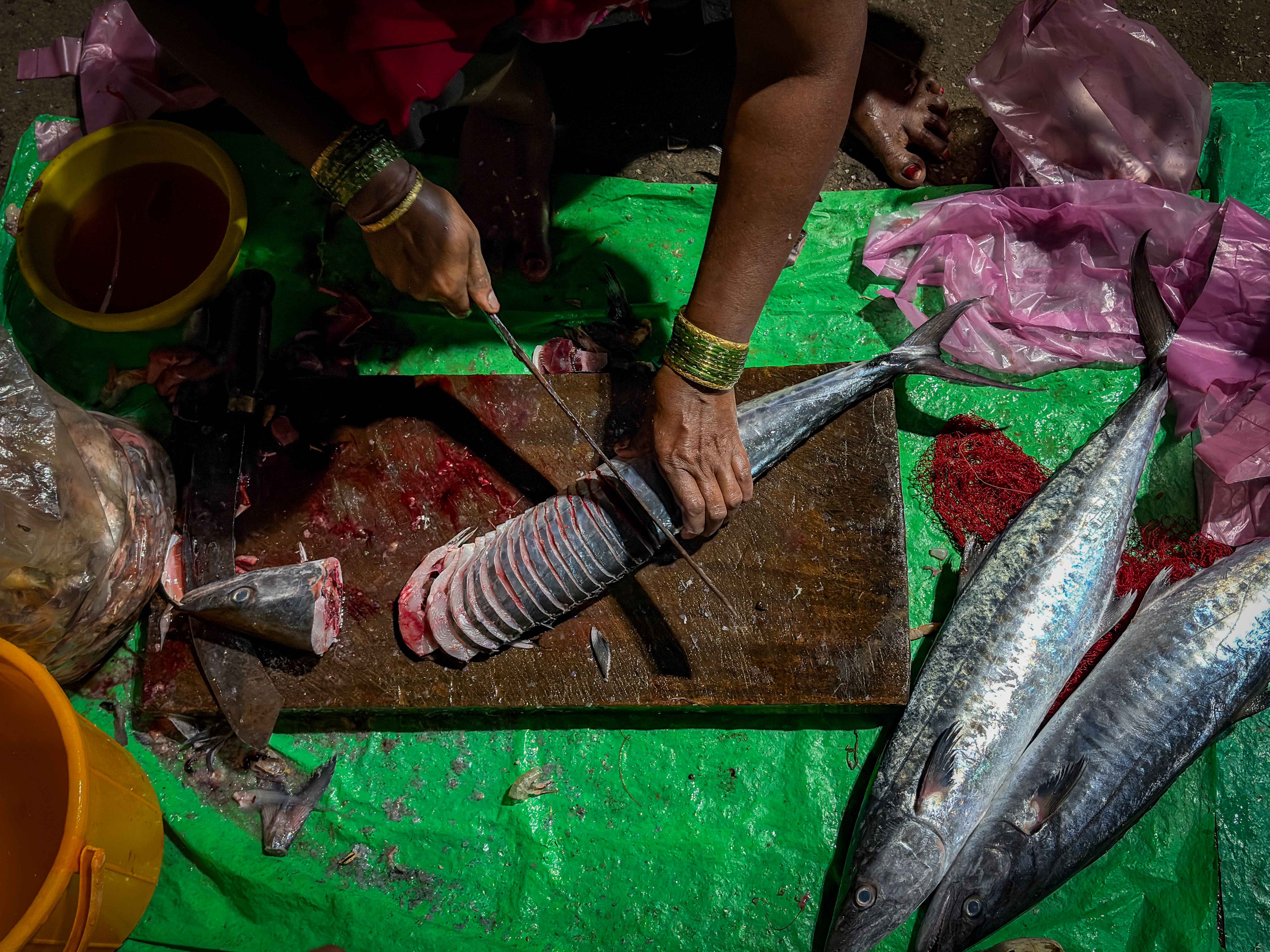
Until a decade ago, Shweta Hule’s mornings were defined by an unchanging routine: she would stand at the jetty in Maharashtra’s Vengurla, waiting for her fisherman husband to arrive at the shore and hand over the day’s catch to her. It’s a familiar routine for those who belong to the local Gabit community, whose women engage in the more informal aspects of the fishing economy such as cleaning and selling, while the men set out to the sea.
This stretch of the southern Konkan region is far lesser known than bustling Goa—only two hours away—though its landscape is equally lush: home to mangroves that glisten evergreen, taking root in the brackish water of the Mandavi Creek that eventually yields to the Arabian Sea. Married into Vengurla 34 years ago, Shweta took notice of the mangroves and the ecology surrounding them. One day a flying fish leaping out of the waters caught her attention; on another, she was mesmerised by egrets and herons. She recognised the mangroves only by their local name, ‘chippi’ or ‘hippali’.
It was after the 2004 Boxing Day tsunami that ravaged the western coast that the woody shrubs entered local consciousness. “At the time, news channels spoke about how regions where mangroves were present suffered lesser destruction,” she recalls. Armed with this awareness and moved to sustain the local ecosystem, Shweta wished for nothing more than to take Vengurla’s children through the mangroves on little boats and point out their uniqueness. It’s a dream that she made come true.
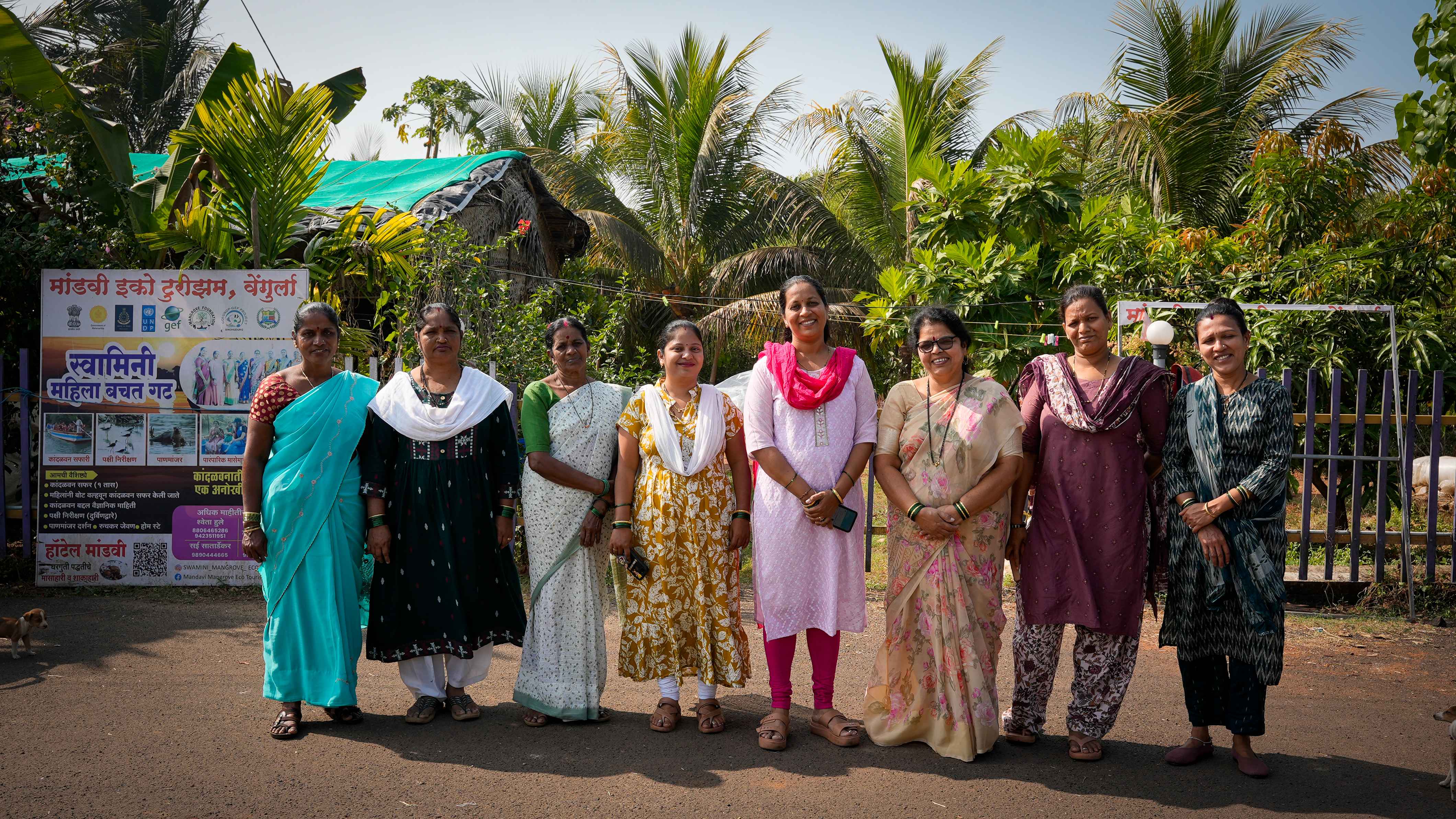
She now leads Swamini, a self-help group comprising eight women—most of whom are wives and daughters of fishermen—that has pioneered community-based ecotourism through mangrove safaris in Vengurla’s Mandavi creek since 2017. Conducted in small, manually rowed boats, these safaris take visitors deep into the estuary, through the dense mangroves, where the women introduce a landscape that they have come to know intimately. They point out different species, explain how different aquatic animals take shelter and breed in root systems, and engage tourists in identifying resident and migratory birds by sight and call.
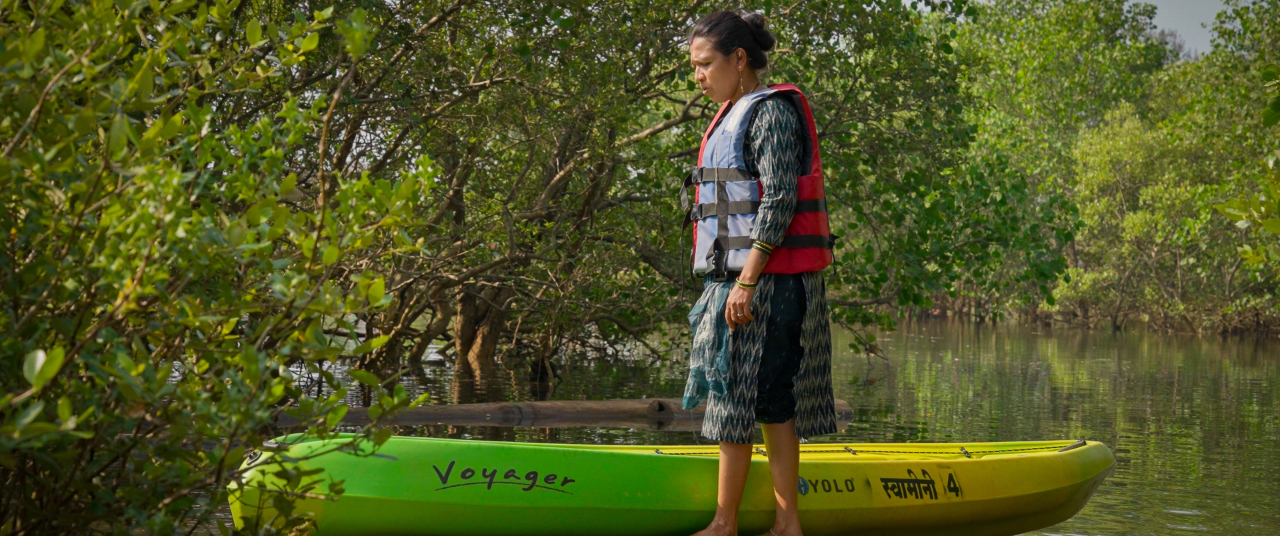
Swamini member Radhika Lone identifies birds with ease on the safari (Photo Credit: Aditya Manoharan).
The group has hosted hundreds of visitors over the years—primarily nature enthusiasts, students, and researchers. Swamini’s work has drawn recognition and felicitation from state bodies like Maharashtra’s Mangrove Cell as well as other associations, such as the Mangrove Society of India and the Ministry of Environment, Forests and Climate Change as environmental changemakers.
Beyond its work in raising ecological awareness, Swamini is also rewriting gender roles in Vengurla’s society; once forbidden to climb onto fishing boats, their courage in starting an all-women mangrove safari was nothing short of revolutionary.
Taking root
Maharashtra has a 700 km-long coastline. As of 2021, over 30,000 hectares of mangroves belonging to 20 different species adorn the belt. Eight of these are found in the Sindhurdurg district, making it one of the most biodiverse regions along the state’s coast.
In the 2010s, Maharashtra’s Forest Department—and its Mangrove Cell in particular—partnered with the UNDP-Global Environment Facility (UNDP-GEF), spawning many alternative sources of income for people whose livelihoods depended on the sea, says N. Vasudevan, the then Principal Conservator of Forests in the Mangrove Cell, and also the Chief Nodal Officer for this project in Sindhudurg.
In 2013, while attending an annual fisherwomen’s meeting in Malvan, Shweta and other fisherwomen were given an opportunity to travel to Kerala for a workshop—a journey that proved to be a turning point. It was during training sessions in Kerala that she witnessed how mangroves sheltered soil and biodiversity. “Women here balanced their household chores and engaged in other small projects to revive the landscape,” she recounts.
Like her, many of the group’s women were curious about the mangroves but had never ventured into the thickets.
Back home, she wanted to undertake a project far different from the typical, smaller-scale ones encouraged by the UNDP (like crab and oyster farming): a mangrove safari. “Though I knew little of mangroves then, I knew this much—to save this beautiful coast, we had to teach people how these forests hold ecosystems together. The coastal regions of Maharashtra and Kerala were similar in terms of parisar [terroir] and weather conditions. If they could start an initiative there, why not us?”
Later that year, Shweta recruited a group of younger women from Vengurla under the banner of a self-help group she had established a few years ago. The endeavour required women who were hardy and passionate about nature—whom Shweta recognised and took on with her keen eye. Like her, many of the group’s women were curious about the mangroves but had never ventured into the thickets. “If we were to become guides for tourists, the first leg of awareness, knowledge and dedication would have to start with us!” she says. This was particularly crucial as most of the women had studied only up to Class 7 or 10 in Marathi medium schools. “We could barely pronounce the complicated Latin and Greek names of the plants around us, let alone spell them,” says 39-year-old Sai Satardekar.
In 2013, Shweta Hule recruited a group of younger women from Vengurla who were passionate about nature (Photo Credit: Aditya Manoharan).
Brimming with enthusiasm, the eight women got in touch with the UNDP co-ordinator for Vengurla at the time, Durga Thigale. Durga and Dhanashree Patil, the Head of Botany at the nearby Balasaheb Khardekar College, became the group’s teachers, projecting images of flora and fauna onto screens and by turning the khadi (a delta region where water from the river and the sea mingles itself) into a diligent classroom. They studied in Shweta’s verandah and quizzed each other. Scientific names and characteristics became a verse they repeated as they went about their days, washing utensils and cleaning fish. Their young children, who accompanied them to workshops and training sessions, imbibed this knowledge and a natural curiosity about mangroves—pointing to trees and identifying them.
Such was their determination that they felt confident enough to officially launch their mangrove safaris in under two months. Durga helped prepare the project report for the UNDP, and aligned Swamini’s vision with funding frameworks. “Eventually, we received funding amounting to nearly Rs. 6 lakh under the UNDP-GEF project. We bought two boats, oars, and life jackets,” Shweta adds.
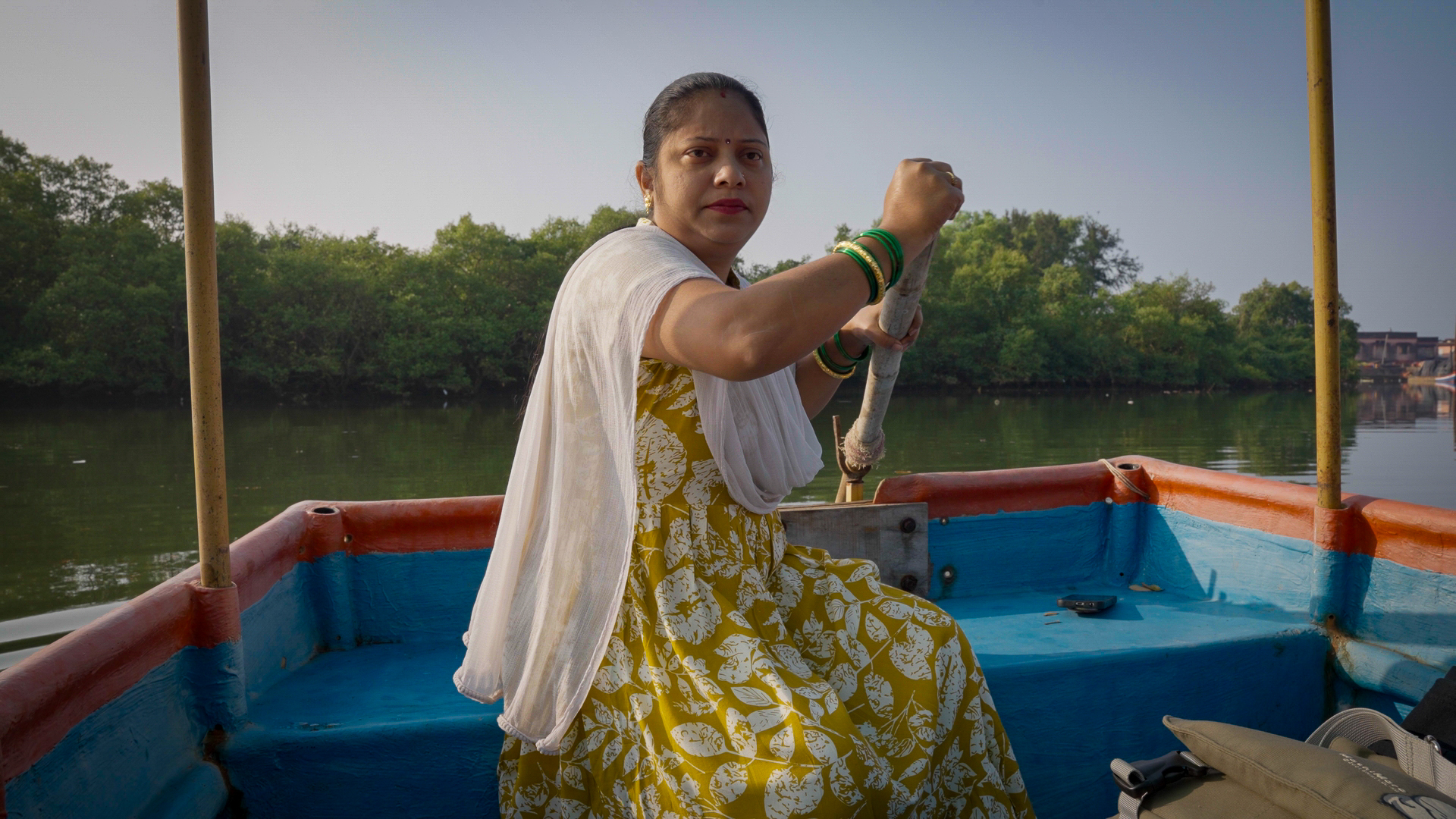
Traditional fishing boats use horsepower engines. Swamini decided to row hodhis (smaller, hand-rowed boats)along the length of the creek so as to not disturb the mangrove’s biodiversity. “Macchimaar mahilaanche sharir ghatta astaat. Pan hodhi valvaaycha kahich anubhav navhta [Fisherwomen’s bodies are sturdy. But we had no experience taking on the waters on our own],” Shweta says.
Traditional fishing boats use horsepower engines. Swamini decided to row hodhis (smaller, hand-rowed boats)along the length of the creek so as to not disturb the mangrove’s biodiversity.
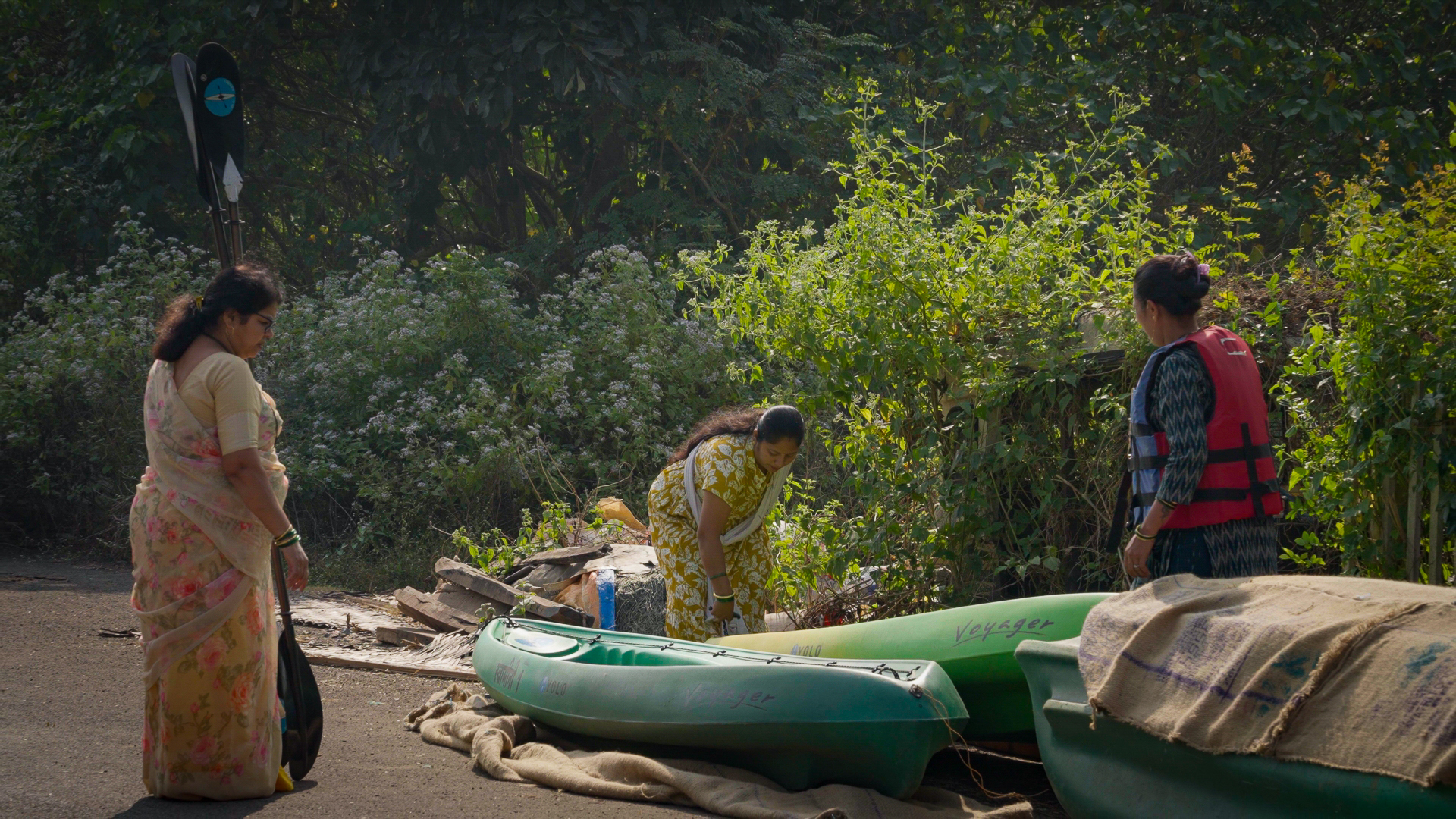
Her husband, Satish Hule, who owned a former fishing business in Vengurla was pivotal in supporting the SHG. “We trained for eight days under Satish dada’s guidance. At first, our boats spun in all directions and we glided straight into the mangroves, getting tangled in the branches,” chuckles Sai. Rowing took a toll on their bodies; but they grew more sure-footed once they began to apply technique and not just stamina. “Many villagers mocked us, saying we would give up in a few days,” says 39-year-old Ayesha Hule. “It feels good to prove them wrong.”
Swamini's women manually row hodhis and kayaks to leave the creek's biodiversity undisturbed (Photo Credit: Aditya Manoharan).
For the Mangrove Cell, Swamini’s mangrove safari was an exemplar of low-impact, non-invasive tourism. “The key players in conservation are local communities who are rooted in the ecosystem. Our objective behind promoting alternative livelihoods, including ecotourism, was to offer both an ecological and economic incentive to conserve mangroves,” Vasudevan says. “We receive hundreds of proposals and have noticed that enthusiasm peters out after a point, which is why we have a rigorous screening process. But Swamini had that rare determination powering them through all obstacles,” he adds.
Charting the depths
Conservation spoken of in the abstract rarely stays with people. But when someone is taken to the trees—invited to touch the bark, trace the roots, notice the flowers, and understand how each part plays a role—the experience becomes tactile and sensory. These encounters made conservation feel personal, to both the members of Swamini and the tourists they would meet.
“We receive hundreds of proposals and have noticed that enthusiasm peters out after a point, which is why we have a rigorous screening process. But Swamini had that rare determination powering them through all obstacles.”
I step into the boat on the morning of the safari that lasts for approximately an hour. Each boat holds up to ten people. We push off from the docks, and the oars cut silently through the water. The mangroves rise like tall gods on either side of us. I can see beneath the surface; the bed of the creek and the rocks encrusted with oysters.
The women identify each tree with ease and talk about its physical and medicinal properties. Sonneratia alba bursts into white bloom every June and July, whose fruit is pickled when raw. Avicennia marina and Avicennia officinalis belong to the same species group, but can be distinguished by their leaf shapes—one triangular and the other rounded—and by their shared yellow flowers and heart-shaped fruit. Rhizophora mucronata is a visually striking mangrove tree with dense clusters of aerial roots, whose bark is traditionally crushed into a powder as a remedy for diabetes.
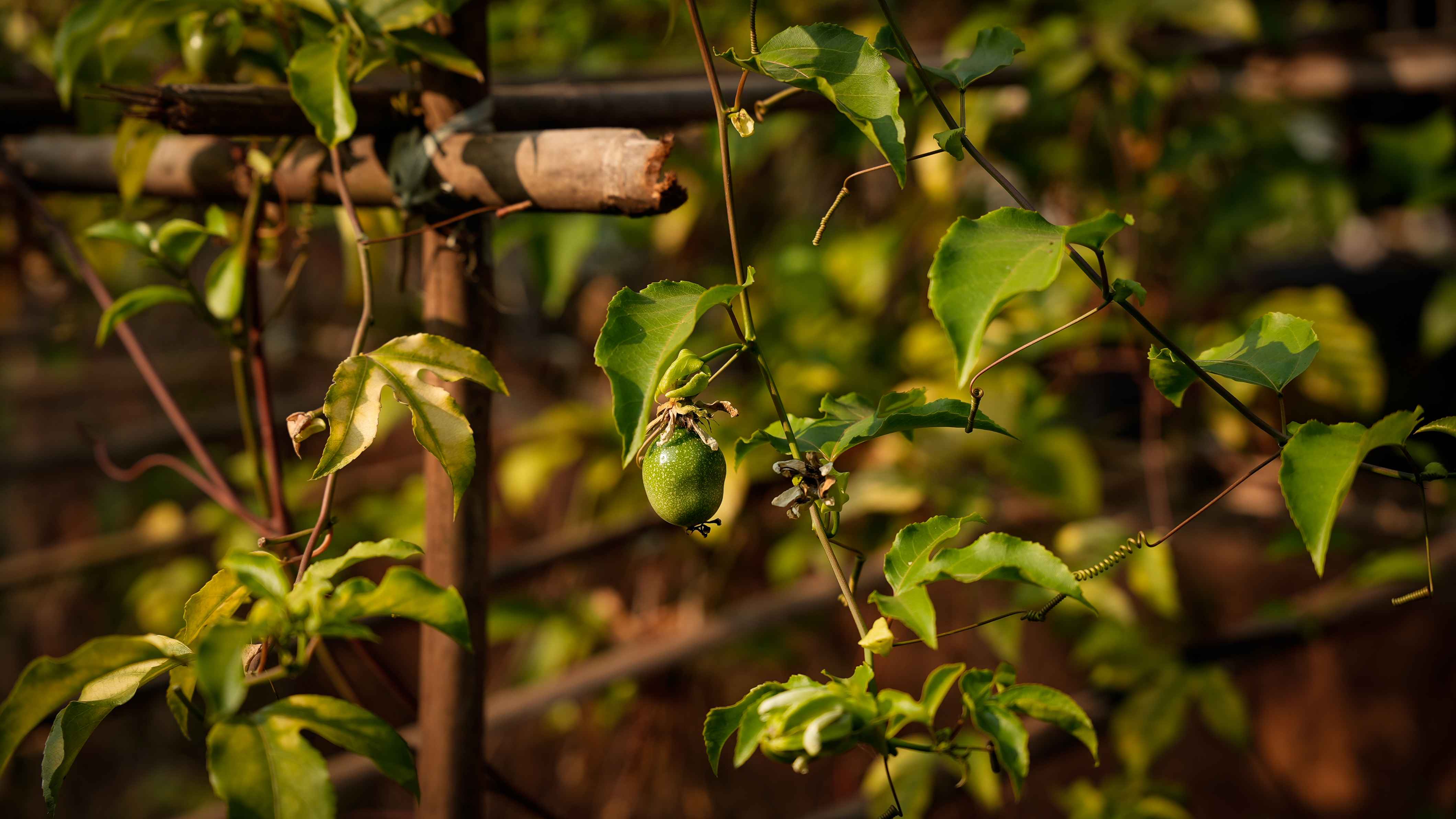
Each mangrove species bursts into bloom with distinct flowers and fruits (Photo Credit: Aditya Manoharan).
“We used to refer to these birds as bagle [egrets]. We later learned the names of the many distinct birds such as the Grey Heron, the Great Egret, the Malabar Hornbill, and the Indian Cormorant,” Sai says. “Our conversations with wildlife enthusiasts open new doors for us. For instance, a bird-watcher identified 52 bird species a few months ago in a single day!”
{{marquee}}
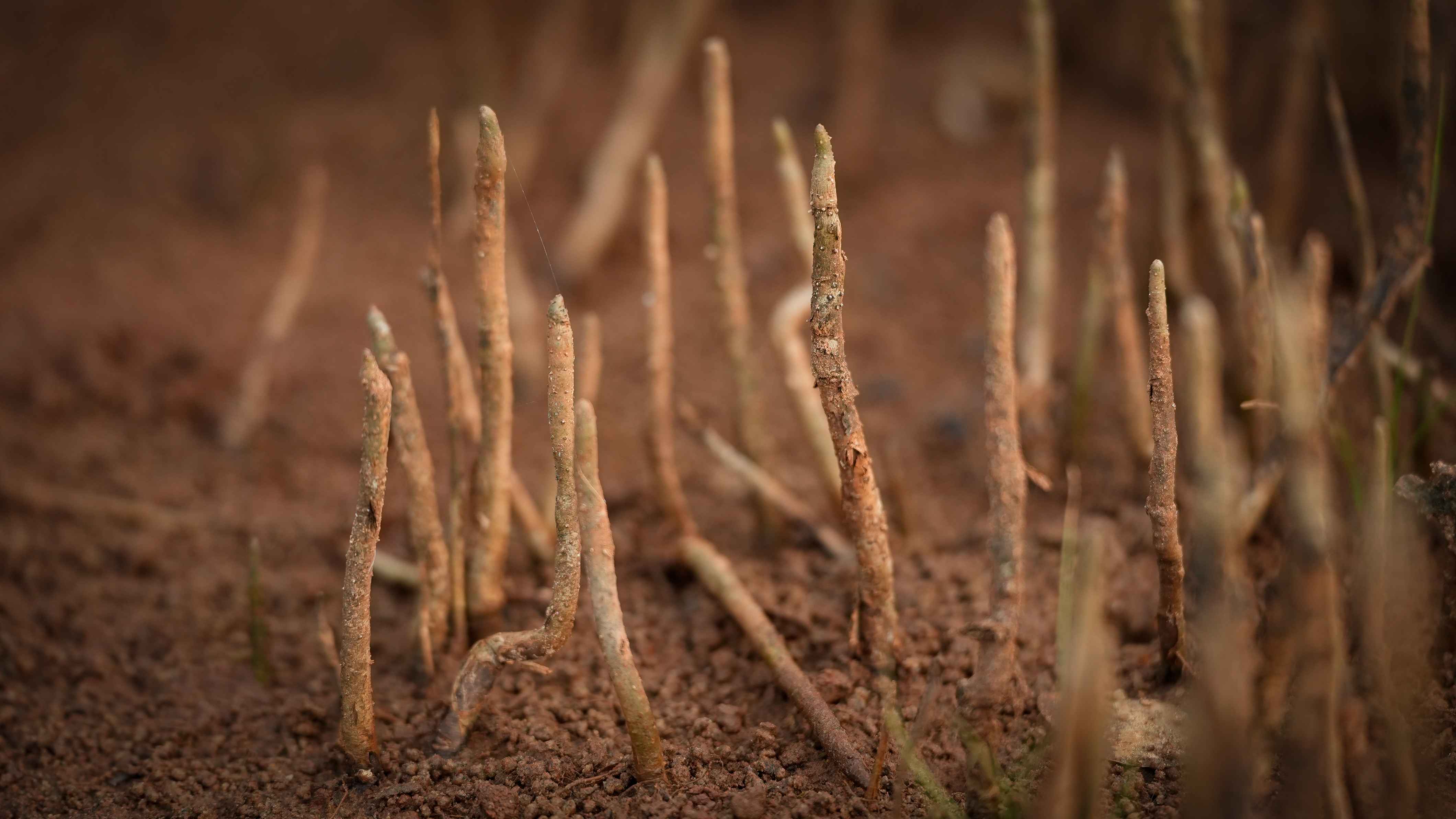
The salty soils of the intertidal pose an inhospitable barrier for most woody plants, but the mangrove is uniquely adapted for these conditions. The roots of different trees have varying shapes and forms, and are typically spread in a 5 m radius from the main trunk. They are either thin as a pencil, rising like a cone out of the sludge, or bent like a knee. “Most plants can access oxygen from gases trapped in the soil, but mangrove roots are also submerged underwater twice a day during high tide,” Ayesha says. These special breathing roots called pneumatophores grow upwards from the soil and have lenticels—pores that cover their surface and repel water during oxygen exchange. The roots of the mangroves spread out into the water and shelter juvenile fish and hatchlings in their tangles. “During the shifting tides, fish like sea bass, red snapper and tiger prawns lay their eggs here, safe from predators.” Sai says.
The lenticels on the roots of mangroves allow them to breathe even when submerged in brackish water (Photo Credit: Aditya Manoharan).
The mangroves have a self-sustaining logic. Fully ripened fruits fall from the trees during low tide and take root as saplings, eliminating the need for sowing. What the earthworm does for a field, the scorpion mud lobster does for mudflats—turning the soil endlessly to raise volcano-like mounds that crumble during high tide, only to be rebuilt. With every burrow, the lobsters aerate the mud, recycle nutrients, and renew the ground on which the mangroves grow. Together, the trees that seed themselves and the creatures that work the earth form an ecosystem where regeneration occurs on its own.
The women, too, have an unspoken understanding amongst themselves. When one feels the toll of the oars, another silently takes over. “We have now safely rowed tourists out of sticky situations, such as when one of our paddles floated away. This is only because of the many experiences we have accumulated on the creek,” says Radhika Lone, another member of the group.
Troubled waters
In 2020, Swamini attempted to go beyond ecotourism, experimenting with regenerating mangroves through a plantation drive. But their nursery lacked the ability to provide a consistent supply of saline water twice a day. “The land where we planted nearly 2,000 saplings was elevated, so tidal water couldn’t reach it,” says Shweta. “About 60-70 of these trees have survived but their growth is much slower than the ones that have naturally reproduced and been nourished by seawater,” adds Sai.
Mangrove ecosystems need to be nourished by both freshwater and seawater to thrive (Photo Credit: Aditya Manoharan).
Their work in revitalising Vengurla’s mangroves continues in other ways; any harm to the wooded shrubs is like a stab to their own hearts—like they’d feel about their own children being hurt. “When we first started the safari, we waded into the creek to clear out all the garbage that people dumped. This included plastic that clogged the breathing roots’ pores and thread from nirmaalya [devotional offerings] that could get entangled around them or choke the tiny fish who called this landscape home,” says Ayesha.
Their work in revitalising Vengurla’s mangroves continues in other ways; any harm to the wooded shrubs is like a stab to their own hearts—like they’d feel about their own children being hurt.
The disappointing outcome of the plantation initiative does not cut as deep as the threat of local politics stemming from both gender and caste-based discrimination. Tensions ran high, especially in the infancy of the project, in response to the group presenting a new model of leadership. “We faced the ridicule and wrath of fellow villagers. They cut the ropes that anchored our boats in the dead of night, so that they would drift out to sea. They would slash our paddles or mislead tourists who wanted to book a safari with us,” says Shweta. “But we had a stubbornness that kept us afloat, we were determined to not give up, no matter what came our way,” Ayesha adds.
Swamini think of themselves as environmental guardians. They routinely partner with NGOs and encourage Vengurla’s students to assist them in cleanup drives. School children from surrounding regions and even metropolitan cities such as Mumbai and Pune visit the village and are taught about the importance of sheltering mangroves and keeping the environment clean. Under their vigilance, nearly 200-300 new trees have flourished along the banks of the Mandavi, says the UNDP’s Durga Thigale.
Shweta Hule still wakes up in the wee hours of the morning to sell the first catch in Vengurla’s main bazaar. Like her, all the other women of Swamini have other livelihoods. The group was born not out of economic necessity but from a deep, self-driven passion to protect an ecosystem. “Initially, it was difficult to juggle Swamini with our other chores,” say Ayesha and Radhika. “Tourists flock to Vengurla during the summers, and the season plateaus during the rest of the year. We were satisfied with our pre-existing businesses, income generation was never our goal.” The initiative averages at 12-15 rides every month. Participants are charged about Rs. 300 per person for the boat ride, enabling each woman to earn about Rs. 25,000 every year. “These earnings help us tide over difficult times in our homes and in our independent businesses,” adds Radhika.
All the women primarily belong to fishing families in Vengurla. The mangrove safaris are rooted in a desire to introduce visitors to their native landscape, and thereby conserve it (Photo Credit: Aditya Manoharan).
Like the mangrove which grows slowly and is self-sufficient, the project has lent all the women associated with the SHG a distinct identity. “‘Aatmanirbharta’ —this emotion has driven our work. Women are always identified in relation to their male relatives. The feeling of doing work that is ‘mine,’ that I am recognised by, is unparalleled,” says Ayesha. “Being a guide has also instilled a lot of confidence in me. We are now invited to train women starting similar initiatives in nearby towns,” adds Radhika.
Like the mangrove which grows slowly and is self-sufficient, the project has lent all the women associated with the SHG a distinct identity. “
There is an easy camaraderie between the women, who gather in the kitchen of a homestay owned by Shweta and her family before a safari— laughing, sipping on their tea, and heatedly discussing the panchayat elections. It doesn’t take a trained eye to notice that these women are both co-workers and companions. “We bicker too, but make up as quickly. We recognise that our shared vision and cause is far greater than any individual differences in opinion that we may have,” Ayesha says.
Edited by Shobana Radhakrishnan and Neerja Deodhar
Editor’s Note: To work in ecology science and biodiversity conservation in India is to undertake the work of a lifetime. For many, but especially women, this work is as much a career as it is a calling, with challenges that pertain to the job itself—such as reasoning with authorities—as well as their personal journeys and identities. In this series, the Good Food Movement highlights female scientists, activists and community builders whose visions and labour have ensured forests, wetlands, and species across flora and fauna live another day.
At one point during our hours-long conversation about saving the Kosi river and conserving forests in Uttarakhand, Basanti Devi pauses to reflect on her seven decade-long life. “What would I have done, if not for this? What purpose would my life have served, if not helping to solve some of these crises plaguing our society?” she asks, as a faint smile crosses her face. My response to her reflection doesn’t matter.
Devi is a petite woman. Age, it seems, has shrunk her further. But there’s a largeness to her warmth: The first time we spoke over the phone, in July 2025, she was worried about where I would sleep, if and when I visited her in Pithoragarh (where she lives now)—because she only has one room, “with a tiny bed.” A few weeks later, when we spoke again, her inimitable sing-song Kumaoni inflection reflected concern as she warned me about the incessant, untimely rains, the resultant landslides, and the traffic snarls that had brought the hills to a crawl. “Come after a few weeks, when it is better to travel,” she advised.
On the day we finally meet, the weather swings back and forth like a pendulum between sunshine, cloudiness and drizzles. It feels like a fitting backdrop to a meeting with a woman whose own life has been marked by periods of extreme darkness and light.
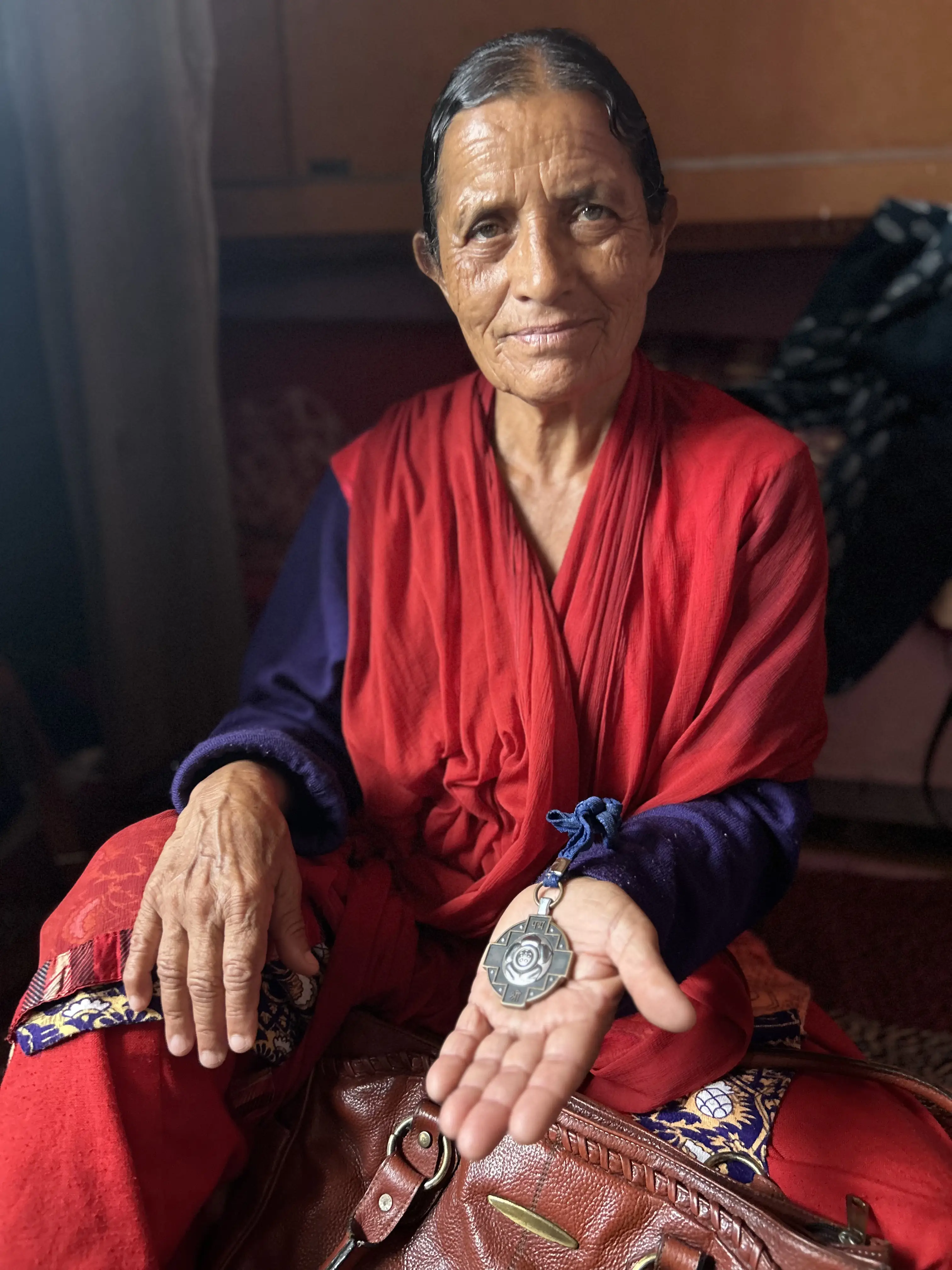
Devi, a widowed child bride who later became a Gandhian social worker, is the recipient of the Nari Shakti Puraskar (2016) and the Padma Shri (2022), honoured for her effort to empower women, educate children, and protect forests and water sources. The most significant of her life’s projects is the revival of the Kosi, an important tributary of the Ramganga in Uttarakhand’s Kumaon region.
Much of Devi’s work unfolded while she was affiliated with the Lakshmi Ashram in Kausani. Founded in 1946 by Sarla Behn (Catherine Heilemann), the ashram educates and organises women in the hills, encouraging self-reliance and care for water, forests and land. The awards were conferred upon her after she had already left the ashram where she had worked for most of her life. Even at that juncture, these national honours evoked pride at her, for this was recognition for decades of focused, dedicated work.
{{marquee}}
A difficult childhood
Devi was born to Kunwar Singh Samant and Tulsi Devi in Digra, a small village tucked in the hills of Pithoragarh, in 1958. At the time, life was simple but bound by custom: at age 12, when she could barely make sense of what the institution meant, she was married off. She had studied till Class 4 but dropped out, because continuing schooling would have meant walking several kilometres from the village she was married into. For girls in her generation in Pithoragarh, travelling such far distances to earn an education was out of the question.
Questions of grief aside, widowhood was cruel to Devi.
The boy she was married to was a Class 11 student. A little over two years later, he passed away; they’d never spent time together during this brief marriage. “For the first two years, he was away for his studies. In the third year, he was away for a teacher training programme in another village in the district. Then, news of his ill health arrived. He had a fever and died,” she says, describing the illness with no expression or emotion, as if the words had been uttered often.
Questions of grief aside, widowhood was cruel to Devi. Her mother-in-law accused her of being a witch; someone else called her a man-eater; and most others cursed her. She was blamed for her husband’s death and kept at a distance, often going days without food or fresh clothes. The world around her, already narrow, seemed to close in further. When life became unbearable, she decided to return to her parents’ home. “At least I’d be fed some food,” she recalls telling herself.
A few months later, “one Bubu (a grandfatherly figure) suggested I visit the ashram.” His physically disabled granddaughter lived there, and he thought it may help Devi, too. “He told me, ‘Do you want to live the rest of your life like this? Go there, study and learn.’” That’s exactly what she did, and never looked back.
At her home in Pithoragarh, Basanti Devi holds the Padma Shri awarded for her decades of work protecting forests and organising village women. Photo by Priyanka Bhadani.
Finding a home and hearth
Kasturba Mahila Utthan Mandal, or Lakshmi Ashram as it is better known, was founded in Kausani a year before India attained independence by Catherine Heilemann, better known as ‘Sarla Behn’. Sarla was a Gandhian dedicated to advancing the Mahatma’s constructive programme in the remote villages of Uttarakhand.
Described by historian Dr Shekhar Pathak as “a nursery for social activists” in the foreword to Sarla’s autobiography A Life in Two Worlds (translated from the Hindi by David Hopkins), the Ashram was the first basic education school in the Himalayas. When Devi arrived at its gates in the late 1970s with her father, she was immediately captivated by the atmosphere. At the time, around 40 girls lived there, and they were taught by 10 teachers. By then, Gandhian Radha Bhatt had taken over its leadership.
Once forced to drop out of school as a child bride, Devi had become a catalyst for change, helping educate and empower hundreds of women.
“Girls were studying, farming, working so hard,” Devi recalls, sitting in her small room and poring over old news clippings and photographs. Among them is a sheet of paper scribbled over with short sentences written by girls she once trained and educated: “Basanti didi bahadur hain, himmati hain.” (Basanti didi is brave and courageous.) “Didi karmath hain”. (Didi is relentless in her work.)
It was part of an exercise facilitated during her years at the Ashram, and she has preserved it carefully ever since. After she had settled into the institution, Radha Bhatt instructed her to take up kadhai-bunai (handicraft work including knitting, weaving and embroidery) and oversee other activities. Mentoring young girls was one of her responsibilities. “This sheet of paper is my life’s reward,” she says with pride.
Life at the ashram revolved around self-reliance: growing vegetables, keeping cows for milk, making woollen bedding and clothes, and taking turns to graze cattle, cut grass, and collect firewood from the forest. Grain was carried up from the market and ground at the watermill in the valley. As Sarla Behn wrote in her autobiography, the idea was to combine daily labour with learning so that girls grew in both skill and knowledge.
Devi became a pivotal force when Radha Behn put her in charge of addressing families in 200 villages, to convince them to send their girls to school. She went door to door to do just that, and later began opening Balwadis (children’s centres) across villages. Once forced to drop out of school as a child bride, Devi had become a catalyst for change, helping educate and empower hundreds of women. These women later became homemakers, teachers, joined the police force, and took up other public roles. “Some of them still call regularly to check up on me,” she says with a smile.
In his seminal book, The Chipko Movement, Dr Pathak traces the first environmental people’s movement of India, highlighting the smaller organising efforts that shaped—and continue to influence—bigger, influential ones. Among these is the tale of Khirakot, a small village in the Kosi catchment just before Kausani, where Devi felt the first stirrings of activism that would define the rest of her life.
In the early 1980s, Khirakot was being eaten away from within. A talc mine run by a contractor named Rampal Singh Katiyar had begun spilling waste into the villagers’ fields. The dust and debris smothered crops, and the sturdy banj trees (Quercus leucotrichophora)—the oaks that held the soil and water together for centuries—began to wither. Even the village road caved in, claiming the lives of animals, and disturbing the flow of the river Kosi.
The Kosi winds through the districts of Almora and Nainital in Uttarakhand before descending into the plains of Uttar Pradesh to meet the Ramganga. Its basin stretches from low valleys at around 330 metres to ridges rising above 2,700 metres. For generations, it has sustained life in the region, providing water to drink, fields to irrigate, fish to catch, and a place for final rites.
The Kosi near the Someshwar-Almora road. Photo by Priyanka Bhadani.
Amid this crisis, the men stayed silent but the women refused to look away. Malti Devi, who was leading Khirakot’s women, reached out to Lakshmi Ashram for help. Radha Bhatt had put Basanti Devi in charge. What followed were petitions, the confrontation of officials, and even taking down men in fake police uniforms. The mine was shut down. The banj forests slowly began to heal, at least at the time.
The Ashram continued its work, helping banj forests in the Kosi valley and strengthening women’s role in forest management.
Basanti Devi would later head to Danya, the Ashram’s field office about four hours away from Kausani, for almost two decades–to continue her work with local communities on education, eradication of alcoholism, and conservation of water, forests and farmland (jal, jungle, zameen).
A deep-rooted revolution
During the 20 years Devi spent in Danya, the Kosi kept thinning. Illegal mining was part of the problem, but there was more. Climate change, reckless construction, expanding farmland, tree felling and unplanned roads had slowly chipped away at its strength, leaving the river more fragile than ever before.
In the early 2000s, Radha Bhatt asked Devi to make a return. “Basanti,” she said, “you must return now. The forests need saving, the Kosi needs saving. Women must be organised again. Just as you mobilised people in Danya, you must do the same here. The Kosi is drying up.”
Around that time, Devi read a newspaper report about the depletion of water resources across the hills. She soon began to see the strain firsthand during her visits, one of which was to Layshal, a few kilometres from Kausani in the surrounding hills.
Devi’s effort faced strong resistance from conservative villagers who refused to allow women to participate in social or public work.
The forests closer to the villages had already been stripped, forcing women to walk deeper into the forested slopes each day in search of firewood. The same women who had once fought to save forests during the Chipko Movement were now, unknowingly, contributing to the depletion of forest resources. “They were cutting the banj trees for firewood,” Devi recalled, “without realising that banj is the lifeline of the forest.”
Ecologists note that the banj oak’s deep roots draw water from far below the surface, helping retain soil moisture and sustaining the springs that feed rivers like the Kosi. Across the western Himalayas, hydrologists have long warned that natural springs are drying up as groundwater recharge declines. In Kumaon, the rapid spread of chir pine at the cost of the water-retaining oak has further weakened the soil’s ability to hold water, leaving rivers like the Kosi more prone to danger.
Devi recounts a long wait of seven days to meet Layshal’s women; she would show up at the crack of dawn, only to find that they had already departed to cut wood. On the eighth morning, she embarked on the forest route herself, climbing through damp leaves and mist, when she finally crossed paths with them.
This encounter marked the beginning of a long debate with the women. In their exchanges, Devi spoke about her travels over two decades to countries like Bangladesh, Bhutan and Nepal. In parts of those countries, too, she told them, forests had been degraded, water sources had dried up, and greenery had disappeared. But once communities began protecting and regenerating forests, water returned to streams, rivers and springs, and the forests slowly turned green again.
She told the women that if they were willing, she would help them form a ‘Mahila Mangal Dal’ so they could protect the forest instead of wiping it out, using only dry wood for fuel instead. “Protecting the forest,” she told them, “could even bring water back to the Kosi, keep the forest healthy, and help feed animals.” The Mahila Mangal Dals went on to protect the interest of women in all spheres of their lives, including supporting the wife and children of a man charged with life imprisonment, whose crimes the villagers were hesitant to report—exhibiting how community ties could hold together a village in tough times.
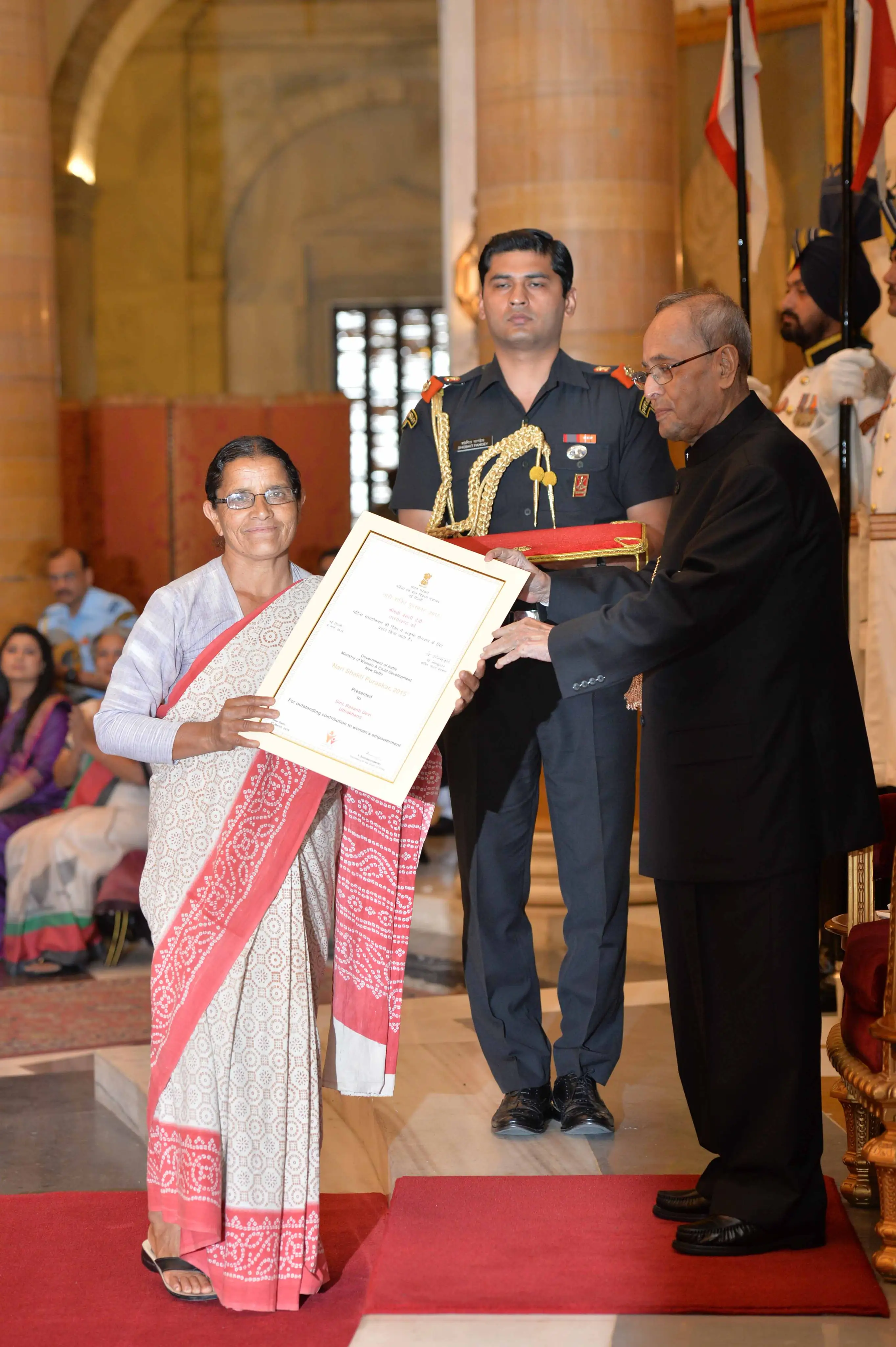
Basanti Devi receiving the Nari Shakti Puruskar from President Pranab Mukherjee in 2016. Image via X/President Mukherjee (@POI13)
Devi’s effort faced strong resistance from conservative villagers who refused to allow women to participate in social or public work. Many husbands and in-laws were irate. “Who is this woman?” they scoffed. “She has no home or family of her own and lives in an ashram, and now she’s turning our women against us.” The accusation followed Devi from village to village.
Building a movement against tree cutting was a slow process. Gradually, the women began to understand and joined Devi, persuading—and sometimes arguing with—their families to support the effort to protect their forests. Now in the winter of her life, Devi struggled to recall the finer details of the movement she had once helped shape. But with a little prompting, the memories returned.
Government officials, she says, would cut green trees from forests and sell the timber outside the village, even selling river water to large hotel establishments. “We stopped them—sometimes with force,” she says. “We imposed fines. If the forest wealth belonged to our region, its benefits should also remain here.” The women confiscated the timber, used it in the village, and the income generated was spent on welfare activities undertaken by the Mahila Mangal Dal.
For over a decade and a half, Devi helped organise large awareness marches that brought together women, men, elders and people from the ashram, drawing more villages into the effort to protect forests and water. Wherever they went, she urged people to hold soil from the Kosi forests in their palms and take a pledge: “Until now you protected us, but from today we will protect you.”
The oath included a promise not to cut young, living trees—“not baanj, not buransh (Rhododendron), not kharsu (Quercus semecarpifolia).” If wood was needed for a wedding or to build a house, she told them, they would go together to the Forest Department and seek permission to cut only cheed (pine), never green oak or buransh, because these held the soil and water together.
“If women like Sarla Didi, Radha Didi, and Basanti Didi hadn’t done what they did, walking from village to village, talking to people, mobilising women, we wouldn’t have a reason or even the confidence to keep doing this work today,”
The day the oath was taken, Layshal’s women returned home carrying their sickles and ropes, promising never again to cut live wood. In time, the movement spread to more than 200 villages across the region.
In 2010, the Friends of Lakshmi Ashram–a Denmark-based organisation that provides guidance and financial support to the ashram–sent out an update that affirmed Devi’s ability to understand and organise people as well as win them over. Lone Poulsen, who took over the administration of the organisation in 1991, wrote that over six years, “Basanti Behn had been working tirelessly across the Kosi valley, from its source to Someshwar”.
At Lakshmi Ashram, 48-year-old Shobha Bisht, one of the women now carrying forward the legacy of the institution, reflects on the scale of what came before her. “If women like Sarla Didi, Radha Didi, and Basanti Didi hadn’t done what they did, walking from village to village, talking to people, mobilising women, we wouldn’t have a reason or even the confidence to keep doing this work today,” she says over the phone from Kausani.
For Bisht and other Ashram residents and leaders, these women are both mentors to look up to, as well as a North star to lead them in the right direction as they keep up the fight for forests and water, and women’s self-reliance. “Everything that we do today is defined by the work that has been done before. We persist because they did; we follow in their footsteps,” Bisht adds.
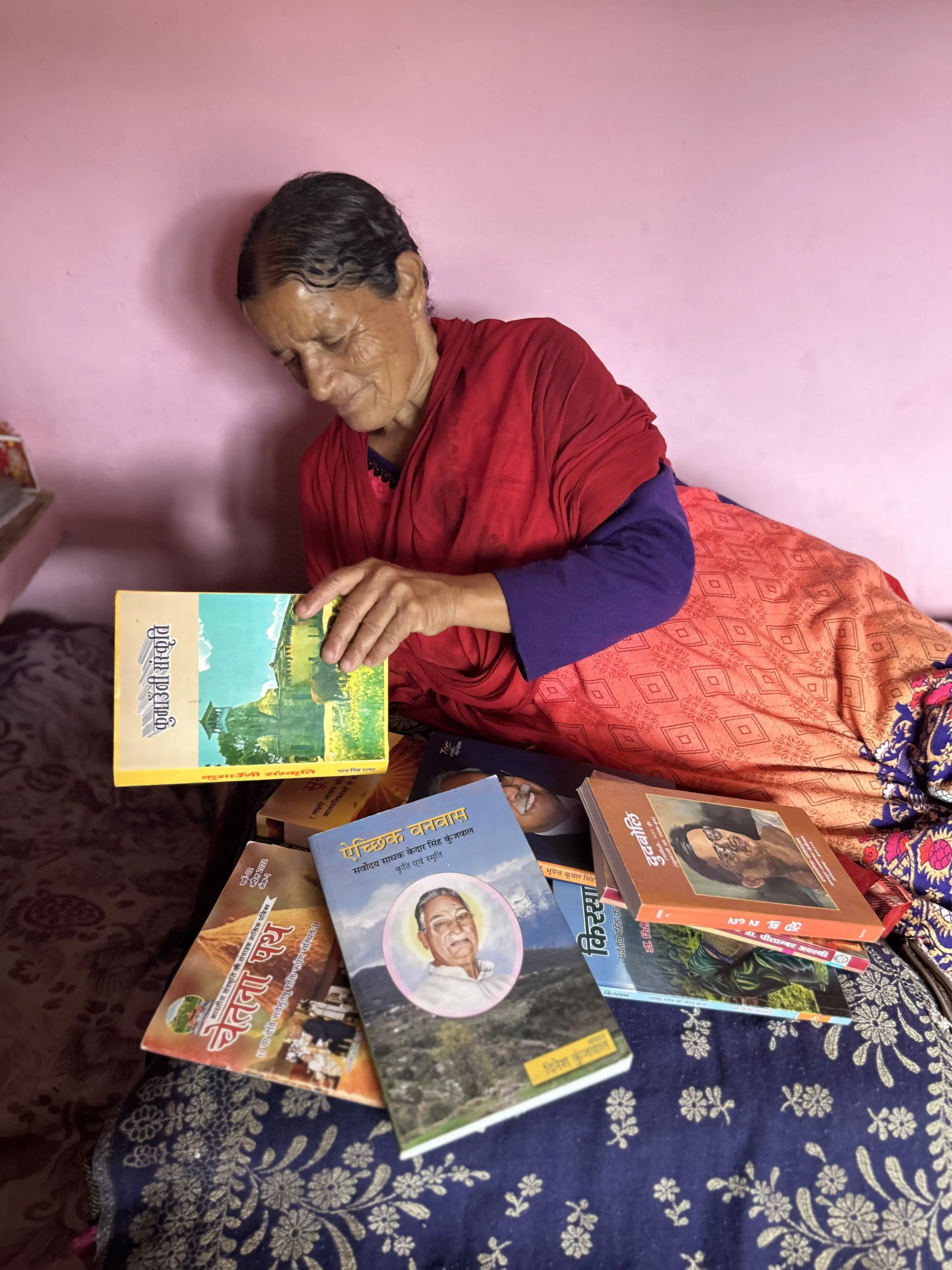
In the winter of her life, books remain a steady companion for Devi. Photo by Priyanka Bhadani.
After six decades in activism, Devi returned to her home in Pithoragarh’s Aincholi in 2015 to care for her ailing mother. And though she would continue to go back to the Ashram occasionally, this marked the end of her active service. She takes out pictures from photo album sleeves with utmost care, going down memory lane and speaking of some of the people from the photographs with childlike excitement. “Maybe this is what I was meant to do. That’s why my life turned out the way it did,” she reflects.
Entirely self-aware of her advancing age, Devi laughs easily at her own fading memory. “I forget things these days,” she says, waving a hand as if to brush the thought away. But what she has built over the decades casts a long shadow and won’t be forgotten. Her organising effort, spread across hundreds of villages, rivers and forests, runs deep in the hills of Kumaon.
Editor’s Note: To work in ecology science and biodiversity conservation in India is to undertake the work of a lifetime. For many, but especially women, this work is as much a career as it is a calling, with challenges that pertain to the job itself—such as reasoning with authorities—as well as their personal journeys and identities. In this series, the Good Food Movement highlights female scientists, activists and community builders whose visions and labour have ensured forests, wetlands, and species across flora and fauna live another day.
Decades before she won the Ramsar Award for Wise Use of Wetlands, long before she cofounded the conservation group Care Earth Trust, and years before she even moved to Chennai, Jayshree Vencatesan, now 65, loved to sit along the banks of the Godavari river and peer into the water.
Vencatesan grew up in Rajahmundry, a small town in Andhra Pradesh, and the river was just a short walk from home. She would stare at its ripples and eddies with a notebook and a pencil, watching the Godavari’s colour moult like the skin of a living creature, from cerulean to muddy green to the deep purple of a bruise. Vencatesan loved to draw what she described as the river’s “moods”, and it was in the water’s changing colours that she began to understand them. For example, when the Godavari turned brown with muck, she knew it would flood.
Long before Jayshree Vencatesan became invested in reviving wetlands, she loved to look out at the Godavari's ripples and draw the river's many 'moods.'
Vencatesan once told her mother to expect the river to rise the following day, and her mom—weary of a child who learned far more outside the confines of a classroom than inside of one—told her to “go do something useful.” “My mother keeps saying, ‘she was a vagabond, and she made a career of being a vagabond,’” Vencatesan says with a chuckle.
Still, Vencatesan was a bit of a paradox—a vagabond with roots. As she grew older and began a career in conservation science, there were plenty of opportunities for her to leave India and never think much about returning, but her father had always implored her to “do the best for your country first.”
Wetland conservation, as Vencatesan notes, is not the most glamorous of endeavours, even if India has lost between one third and one half of these ecosystems since the 1940s, and continues to lose them at a rate of about two-three percent per year.
So, instead of moving abroad, she moved to Chennai, where in 2000 she cofounded Care Earth Trust with ecologist R.J. Ranjit Daniels. The two of them were already well known in their fields; Vencatesan had earned a PhD researching the links between gender and biodiversity in the Kolli Hills, where she met and decided to work with Daniels while he was studying birds and other creatures in the area. But the organisation’s focus on reviving wetlands didn’t inspire anyone to help get the group off the ground. Wetland conservation, as Vencatesan notes, is not the most glamorous of endeavours, even if India has lost between one third and one half of these ecosystems since the 1940s, and continues to lose them at a rate of about two-three percent per year.
“We were broke,” Vencatesan says. “It was miserable, let me tell you that.”
Vencatesan and Daniels had one desk and one chair between the two of them. He sat at the desk because she said she didn’t mind the floor.
The pair went on like this, more or less, for a decade. They had no problem securing one meeting after another with government officials to talk about marshes and the work that Care Earth Trust could do to rejuvenate them. Still, it wasn’t the government that Vencatesan and Daniels had to convince.
More and more people were moving into Chennai, and apartment complexes—along with the roads and all the accompanying infrastructure—were rising almost anywhere land was available, and often even where there wasn’t. Real estate companies and government workers were happy to dump mud and rocks into wetlands until the soft, watery mud was firm enough to build on.
“Every road, every infrastructure project that has come up in Chennai has been at the expense of wetlands,” says Vencatesan. “It was the stupidest thing the government could do, to put it mildly.”
“Every road, every infrastructure project that has come up in Chennai has been at the expense of wetlands,” says Vencatesan. “It was the stupidest thing the government could do, to put it mildly.”
As the new century wore on, more people in Vencatesan’s adopted city began to see her point. Drought became a constant worry in Chennai, in part because the city’s ravenous 21st century expansion eradicated many of its water bodies and that meant less and less water found its way underground, where it could be pulled up to irrigate crops or to drink from in areas of the city that aren’t connected to the piped supply. The Care Earth Trust began to receive some work, and then came the 2015 floods that ravaged the city.
Wetlands prevent flooding in the same way they prevent drought: by providing water with a place to go. Vencatesan was one of the first scientists to write about how the fragmentation of Chennai’s 50 sq km Pallikaranai Marsh forced excess rainwater into the streets, and by 2015, so many of Chennai’s waterbodies had been paved with asphalt and concrete that the torrent of rain from that season’s seemingly never-ending monsoon had no choice but to swamp the city’s homes. Vencatesan says she had long thought that Chennai wouldn’t wake up to the ecological damage it had done to itself until a flood swallowed the affluent neighbourhoods, and that year proved her to be correct. International agencies began pouring money into recovery efforts, including wetland rehabilitation. Suddenly, Care Earth Trust was busy.
{{marquee}}
(A look into the avian biodiversity of the Pallikaranai Marsh. Credit: Wikimedia Commons/Shanmugam Saravanan, Amara Bharathy, Sudharsun Jayaraj, Timothy A. Gonsalves)
Vencatesan often finds herself giving lectures to institutes in and around Chennai, and she’s always looking for women interested in ecology who strike her as willing to challenge authority.
Ten years on, the group is still coaxing city marshes back to life, often with the help of communities who come looking for guidance in rehabilitating their own local wetlands. Each of these projects is a drawn-out process. At first, only a few community members care. Then their families start to show an interest. Then some friends. Over four or five years, Vencatesan says, birds start to reappear. Spotted deer show up. Finally, the marsh is back. These sorts of successes steadily built up the reputation of Care Earth Trust and Vencatesan, and in March 2025, she became the first Indian to receive a Ramsar Convention grant when the group honoured her with its ‘Wise Use of Wetlands’ award.
Ten years on, Care Earth Trust is coaxing Chennai's marshes back to life with the help of communities who want to rehabilitate their local wetlands.
Care Earth Trust remains grounded in the work that Vencatesan and Daniels initiated at the turn of the millennium, and the group now pays and trains young women to safeguard Chennai’s ecological balance well into the future, allowing them to grow into scientific careers away from the prejudices of men. Vencatesan often finds herself giving lectures to institutes in and around Chennai, and she’s always looking for women interested in ecology who strike her as willing to challenge authority.
“Women should be given the strength, the capability, the power, and the backup to function to their full potential,” she said.
Care Earth Trust has also recently begun to publish classroom material centred on wetland conservation, including a book released late last year called Be My Happy Place, which helps students explore their own urban ecologies.
Marshes, lakes, and rivers have always been a happy place for Vencatesan, and she hopes that kids will find themselves there just as she did.


.png)
.jpg)