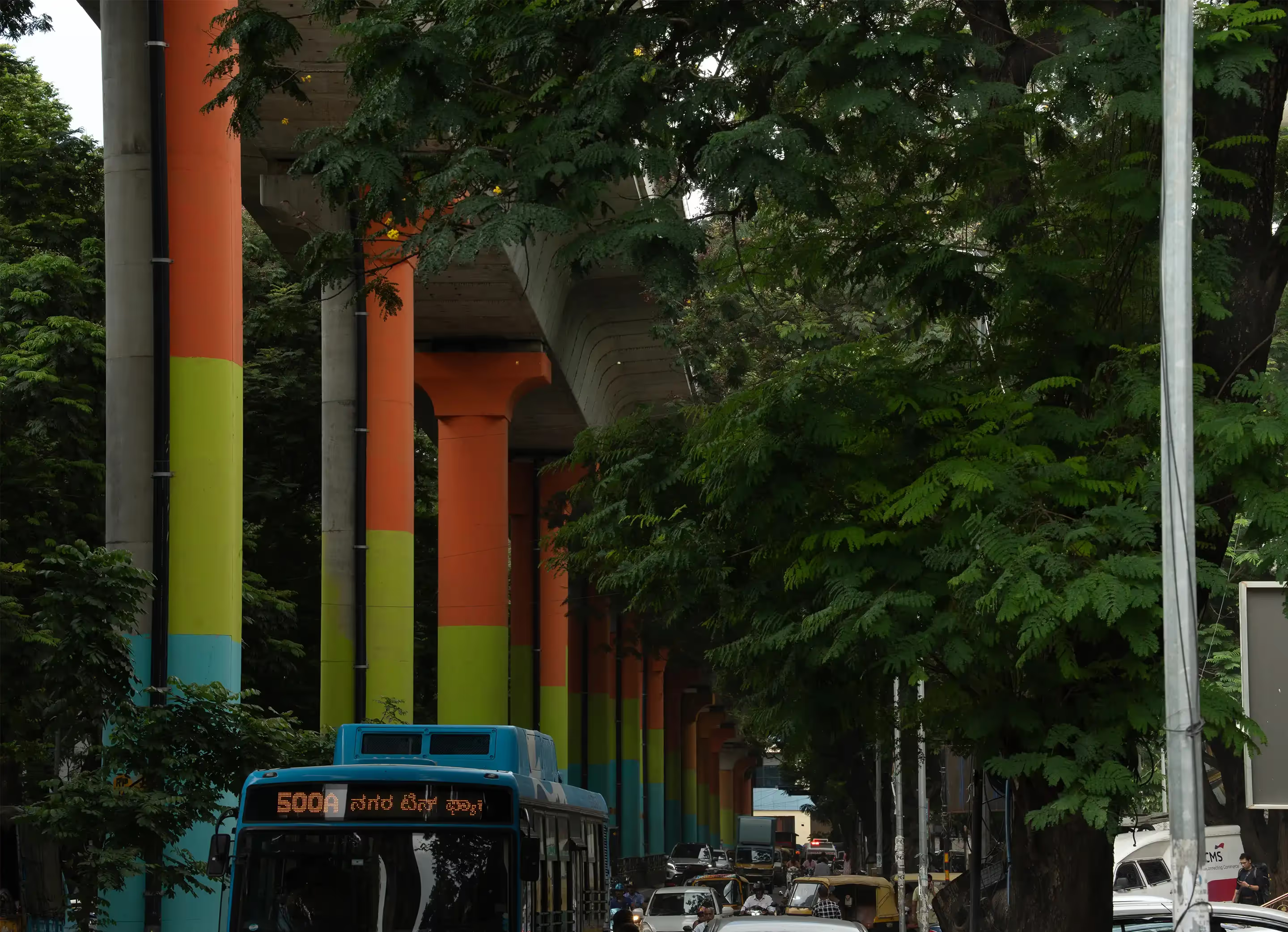
Trees of Bengaluru
Bengaluru—once the Garden City, now a metropolis racing against time and temperature. While traffic clogs our roads and high-rises dominate the skyline, we often forget that a rich, living world still thrives above and around us—our trees. Every February, social media explodes with images of “cherry blossom season” in Bengaluru. But the vibrant pink blooms we admire aren’t cherry trees at all; they’re Tabebuia rosea, a Central American species introduced decades ago. Elsewhere, trees like Muntingia calabura—known locally as Khas-Khas or Jamaican cherry—drop sweet, edible fruits all over the pavement. But how many of us pause to notice, let alone taste them? This series by the Good Food Movement is a small attempt to help Bengaluru rediscover its trees. We’ll identify the familiar strangers that surround us, explore their origins, uses, and ecological value, and most importantly, build curiosity and respect for the green life that supports this city. Because in a time of rising pollution, noise, and soaring urban temperatures, trees are no longer ornamental—they are essential. Cooling our air, calming our minds, and stitching the fabric of a liveable city back together.

The loving, painstaking work of archiving | posted on <span class="time-wrap"> October 16, 2025</span>
I have a distant, hazy memory of learning about leaf venation in school. Like with trigonometry, only traces of that knowledge remain in my head. So, when I came across the term ‘bipinnate leaves’ while reading about the rain tree, I had two options: be stumped, or go down an internet rabbit hole.
And, like the best rabbit holes do, it led me to a meticulously maintained Wikipedia page—perhaps my favourite Wikipedia pages in recent times: A Glossary of Leaf Morphology. It is a careful documentation of leaf structure, shape, and arrangement in plants. I keep returning to this page, out of both necessity and affection. In my trials as an amateur botanist, you might even catch me holding up a leaf against my laptop to use the glossary to classify it. Every time I do so, I marvel at how leaf shapes have been dissected and studied so deeply, and that someone has compiled this knowledge so lovingly.
– by Durga, Reporter & Sub-editor
Amateur Botanist | posted on <span class="time-wrap"> October 2, 2025</span>
Over the past few months, I’ve spent many hours under Bengaluru’s tree canopies, painstakingly identifying each tree’s leaves, trunks, seeds, fruits, and flowers. As an urbanite who has not studied botany since school, this has meant moments of hesitation and self-doubt coupled with excitement and wonder.
Thus began the journey of an amateur botanist. First, I learnt to watch—to observe how, even in a city, I was surrounded by stubborn, glorious plants. Aided by either a simple Google Lens or dedicated citizen-science apps like PlantNet and Seek, I began picking up on some names. The learning curve is steep, and demands leaning into both science and instinct. The barrier to entry, however, is very low. You don’t need to sign up for an elaborate plan; even an evening stroll in your neighbourhood can turn into a tree walk. With luck, you’ll soon be pointing at trees on the street and saying, “I think that’s a Hippo fig!”
– by Durga, Reporter & Sub-editor