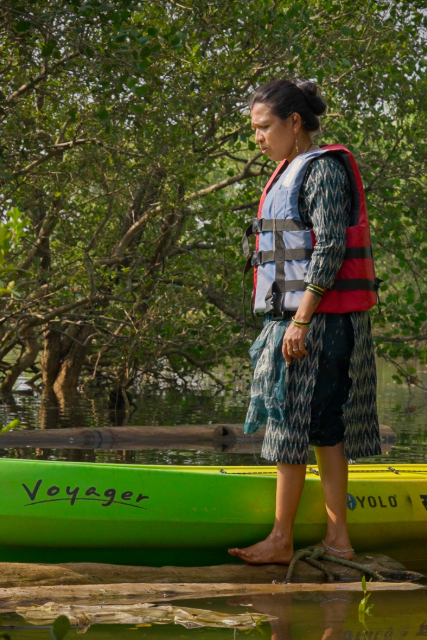
In this Konkan coast town, women rock the boat with their mangrove safaris
The Swamini self-help group, run by fisherwomen, act as the guardians of Vengurla’s mangroves, sensitising people to the fragile ecosystem


Editor's Note: To work in ecology science and biodiversity conservation in India is to undertake the work of a lifetime. For many, but especially women, this work is as much a career as it is a calling, with challenges that pertain to the job itself—such as reasoning with authorities—as well as their personal journeys and identities. In this series, the Good Food Movement highlights female scientists, activists and community builders whose visions and labour have ensured forests, wetlands, and species across flora and fauna live another day.
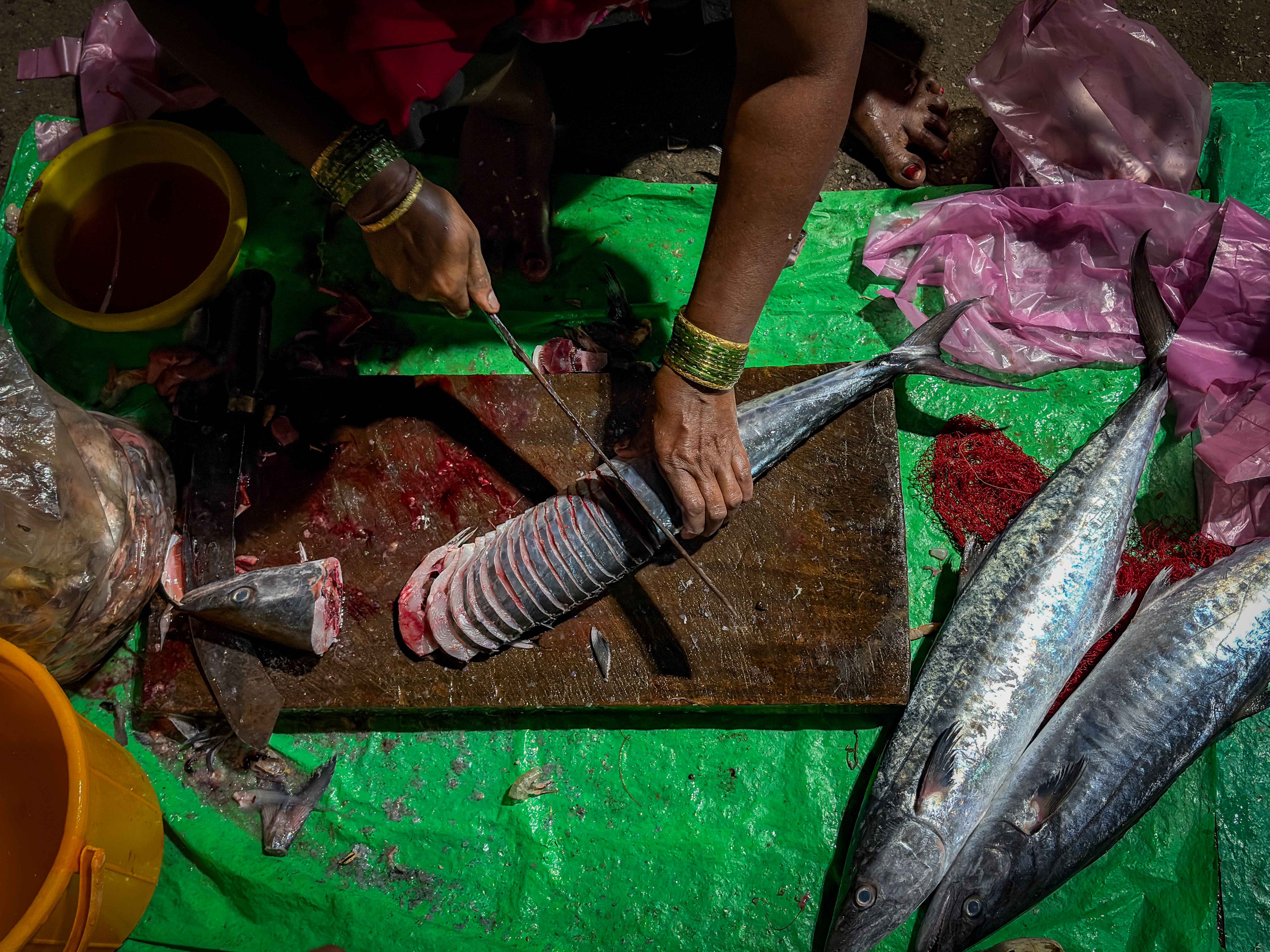
Until a decade ago, Shweta Hule’s mornings were defined by an unchanging routine: she would stand at the jetty in Maharashtra’s Vengurla, waiting for her fisherman husband to arrive at the shore and hand over the day’s catch to her. It’s a familiar routine for those who belong to the local Gabit community, whose women engage in the more informal aspects of the fishing economy such as cleaning and selling, while the men set out to the sea.
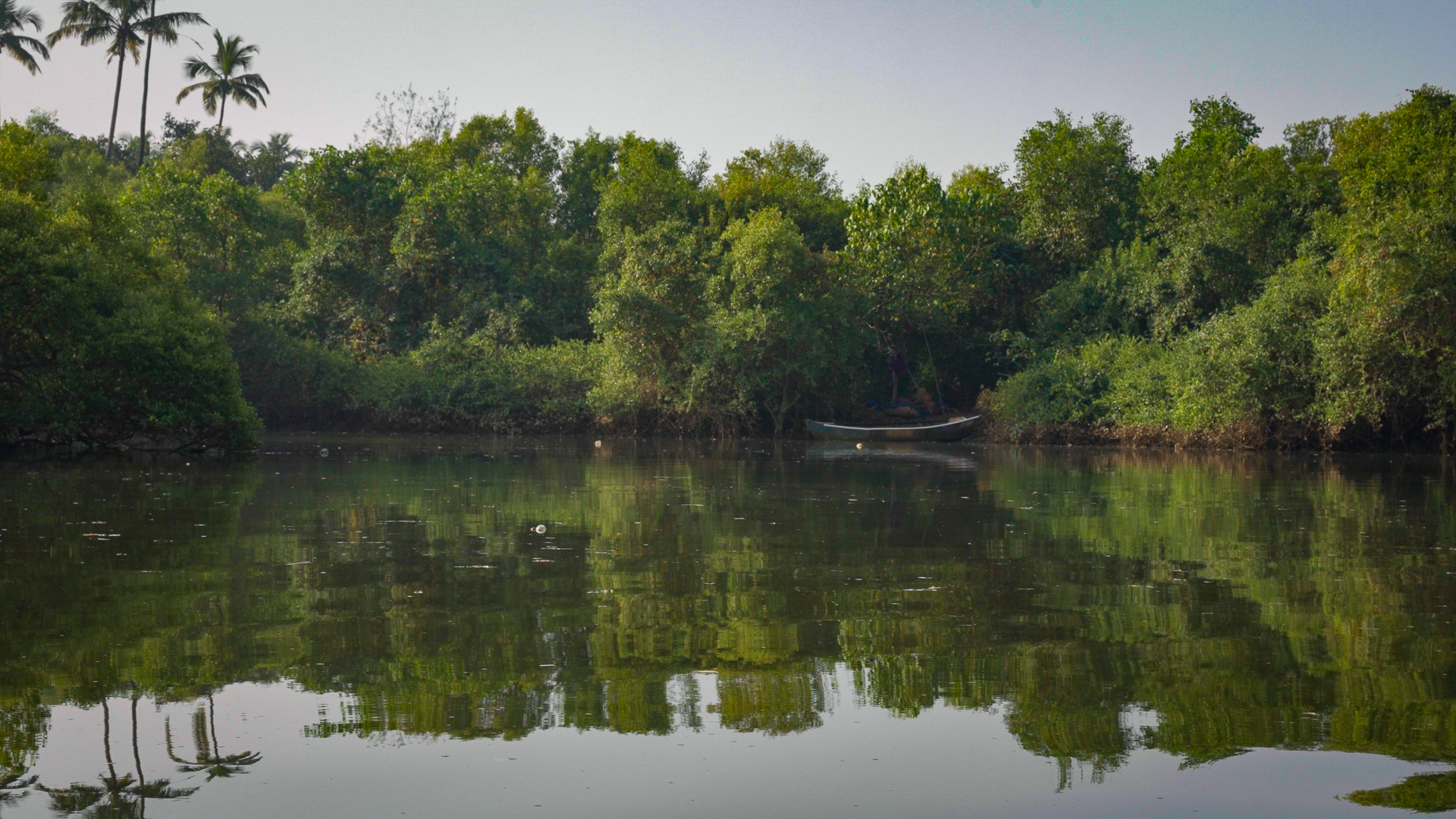
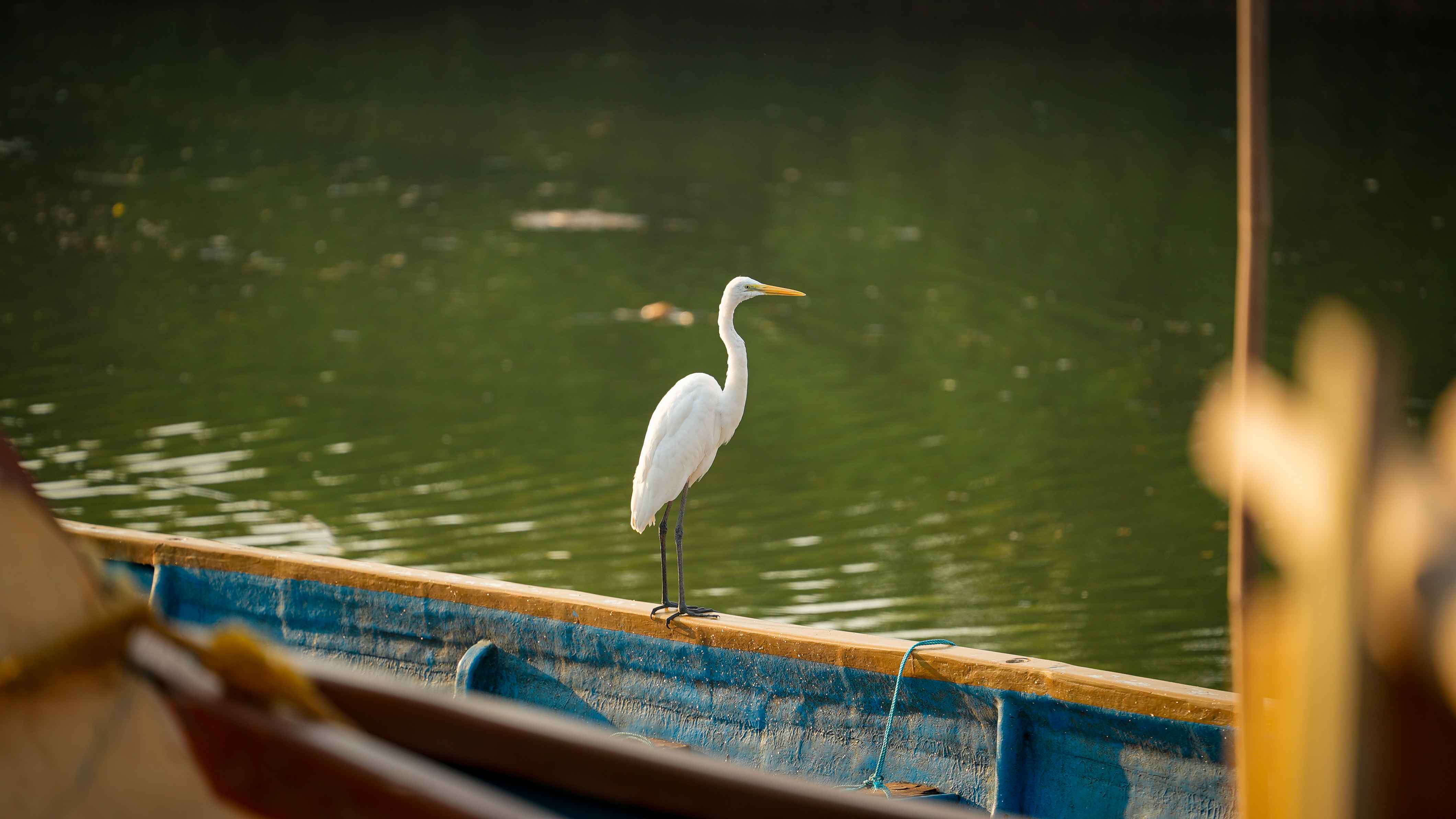
This stretch of the southern Konkan region is far lesser known than bustling Goa—only two hours away—though its landscape is equally lush: home to mangroves that glisten evergreen, taking root in the brackish water of the Mandavi Creek that eventually yields to the Arabian Sea. Married into Vengurla 34 years ago, Shweta took notice of the mangroves and the ecology surrounding them. One day a flying fish leaping out of the waters caught her attention; on another, she was mesmerised by egrets and herons. She recognised the mangroves only by their local name, ‘chippi’ or ‘hippali’.
It was after the 2004 Boxing Day tsunami that ravaged the western coast that the woody shrubs entered local consciousness. “At the time, news channels spoke about how regions where mangroves were present suffered lesser destruction,” she recalls. Armed with this awareness and moved to sustain the local ecosystem, Shweta wished for nothing more than to take Vengurla’s children through the mangroves on little boats and point out their uniqueness. It’s a dream that she made come true.
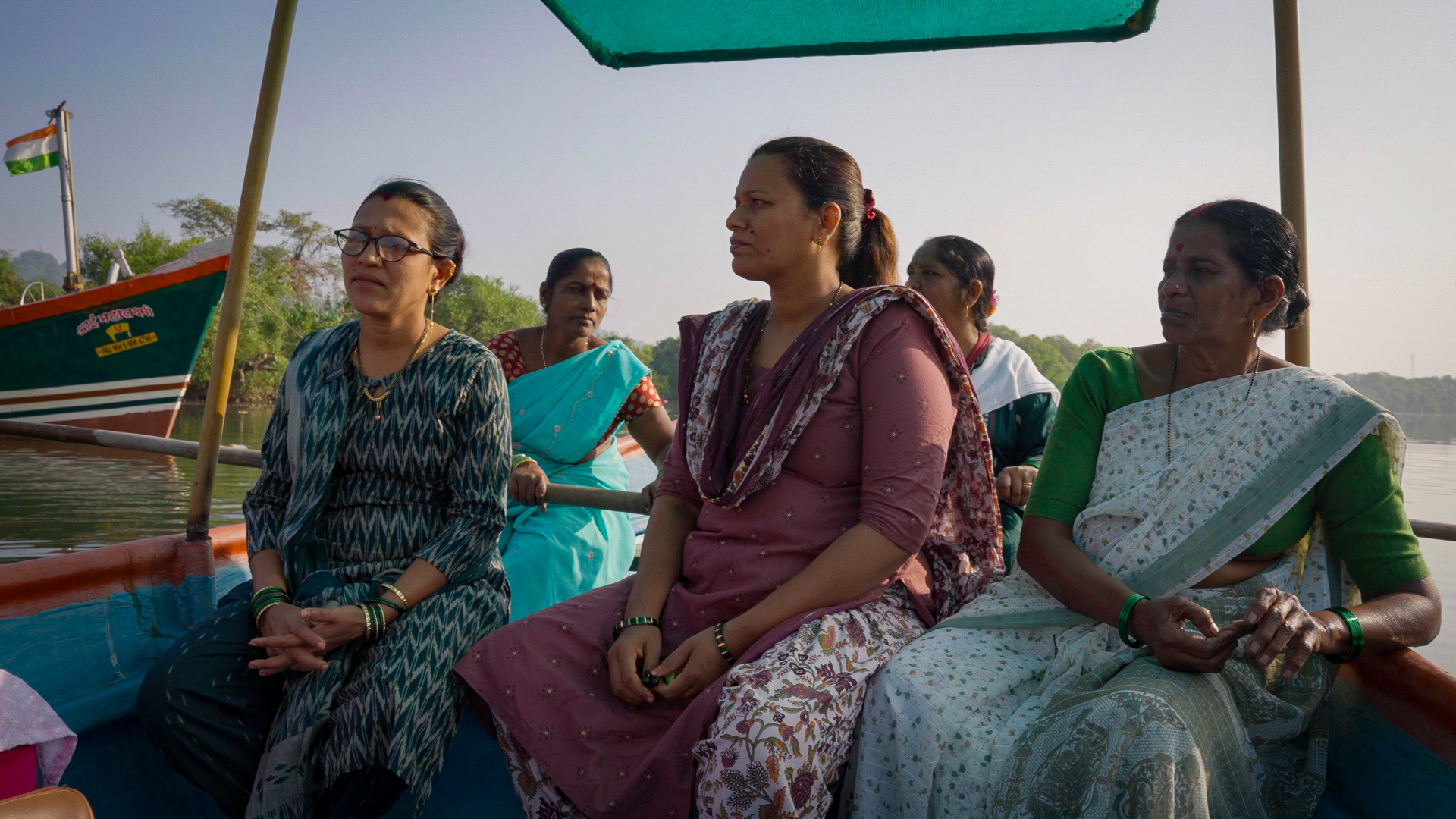
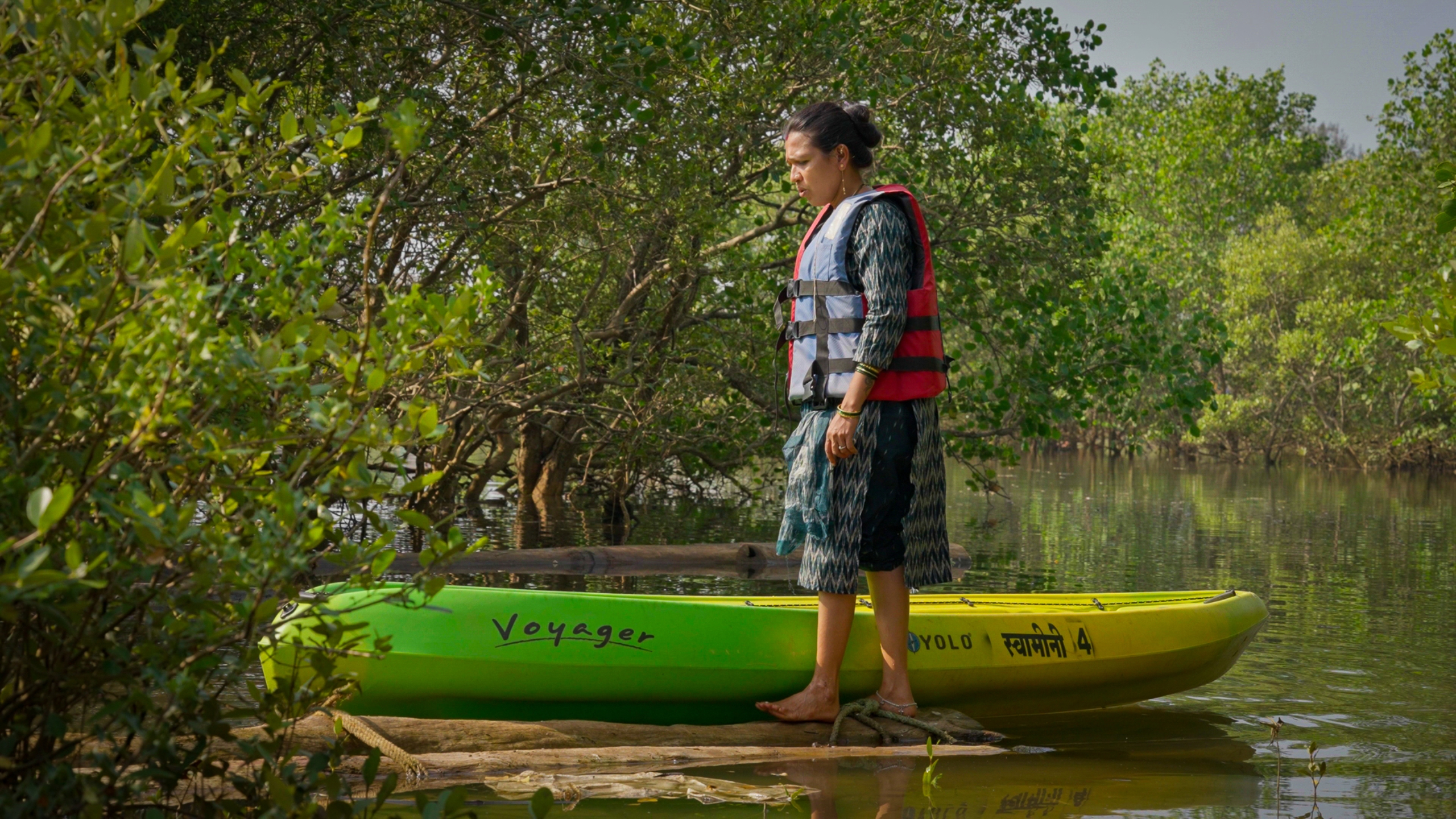
She now leads Swamini, a self-help group comprising eight women—most of whom are wives and daughters of fishermen—that has pioneered community-based ecotourism through mangrove safaris in Vengurla’s Mandavi creek since 2017. Conducted in small, manually rowed boats, these safaris take visitors deep into the estuary, through the dense mangroves, where the women introduce a landscape that they have come to know intimately. They point out different species, explain how different aquatic animals take shelter and breed in root systems, and engage tourists in identifying resident and migratory birds by sight and call.
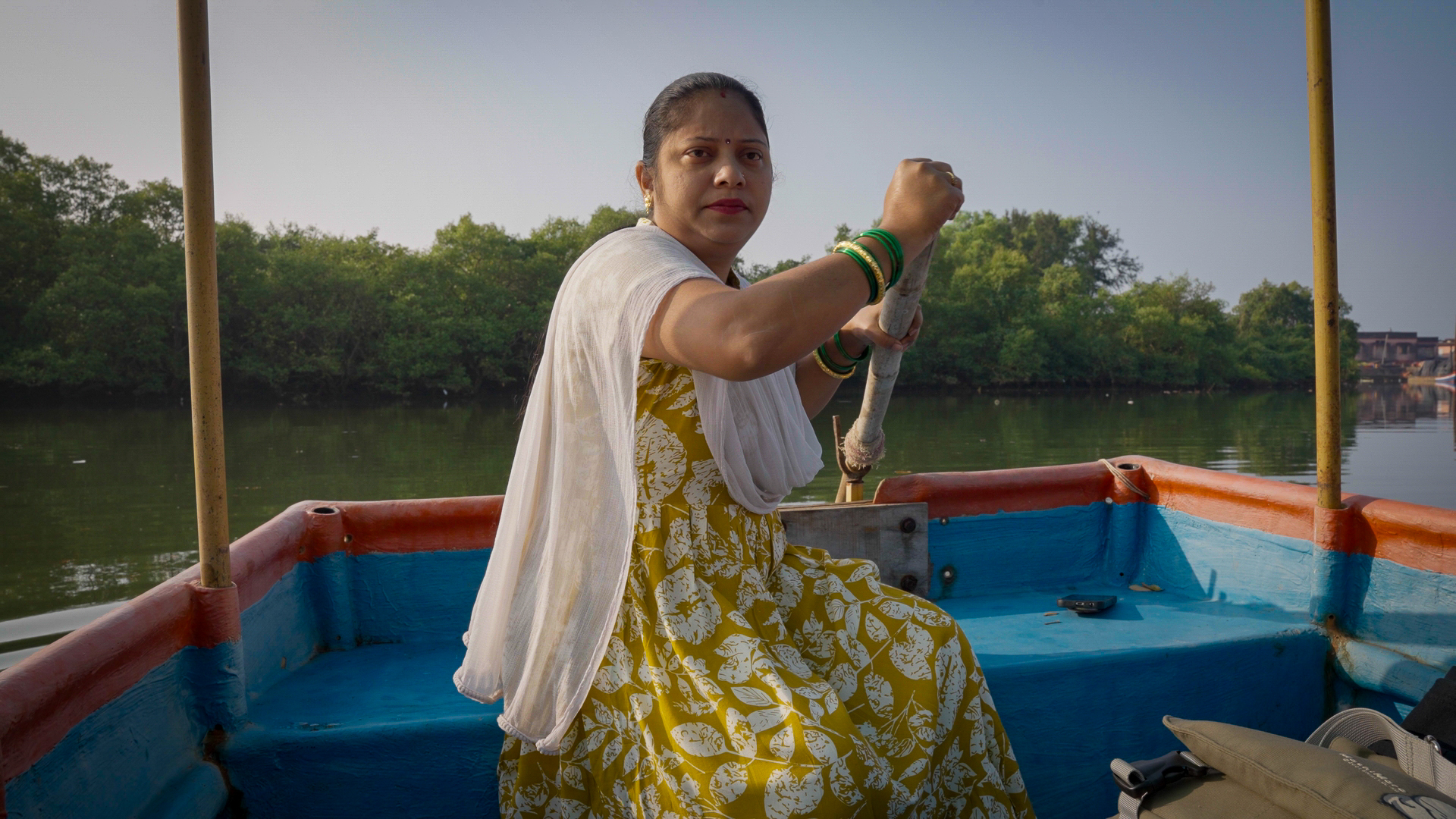
The group has hosted hundreds of visitors over the years—primarily nature enthusiasts, students, and researchers. Swamini’s work has drawn recognition and felicitation from state bodies like Maharashtra’s Mangrove Cell as well as other associations, such as the Mangrove Society of India and the Ministry of Environment, Forests and Climate Change as environmental changemakers.
Beyond its work in raising ecological awareness, Swamini is also rewriting gender roles in Vengurla’s society; once forbidden to climb onto fishing boats, their courage in starting an all-women mangrove safari was nothing short of revolutionary.
Taking root
Maharashtra has a 700 km-long coastline. As of 2021, over 30,000 hectares of mangroves belonging to 20 different species adorn the belt. Eight of these are found in the Sindhurdurg district, making it one of the most biodiverse regions along the state’s coast.
In the 2010s, Maharashtra’s Forest Department—and its Mangrove Cell in particular—partnered with the UNDP-Global Environment Facility (UNDP-GEF), spawning many alternative sources of income for people whose livelihoods depended on the sea, says N. Vasudevan, the then Principal Conservator of Forests in the Mangrove Cell, and also the Chief Nodal Officer for this project in Sindhudurg.
In 2013, while attending an annual fisherwomen’s meeting in Malvan, Shweta and other fisherwomen were given an opportunity to travel to Kerala for a workshop—a journey that proved to be a turning point. It was during training sessions in Kerala that she witnessed how mangroves sheltered soil and biodiversity. “Women here balanced their household chores and engaged in other small projects to revive the landscape,” she recounts.
Like her, many of the group’s women were curious about the mangroves but had never ventured into the thickets.
Back home, she wanted to undertake a project far different from the typical, smaller-scale ones encouraged by the UNDP (like crab and oyster farming): a mangrove safari. “Though I knew little of mangroves then, I knew this much—to save this beautiful coast, we had to teach people how these forests hold ecosystems together. The coastal regions of Maharashtra and Kerala were similar in terms of parisar [terroir] and weather conditions. If they could start an initiative there, why not us?”
Later that year, Shweta recruited a group of younger women from Vengurla under the banner of a self-help group she had established a few years ago. The endeavour required women who were hardy and passionate about nature—whom Shweta recognised and took on with her keen eye. Like her, many of the group’s women were curious about the mangroves but had never ventured into the thickets. “If we were to become guides for tourists, the first leg of awareness, knowledge and dedication would have to start with us!” she says. This was particularly crucial as most of the women had studied only up to Class 7 or 10 in Marathi medium schools. “We could barely pronounce the complicated Latin and Greek names of the plants around us, let alone spell them,” says 39-year-old Sai Satardekar.
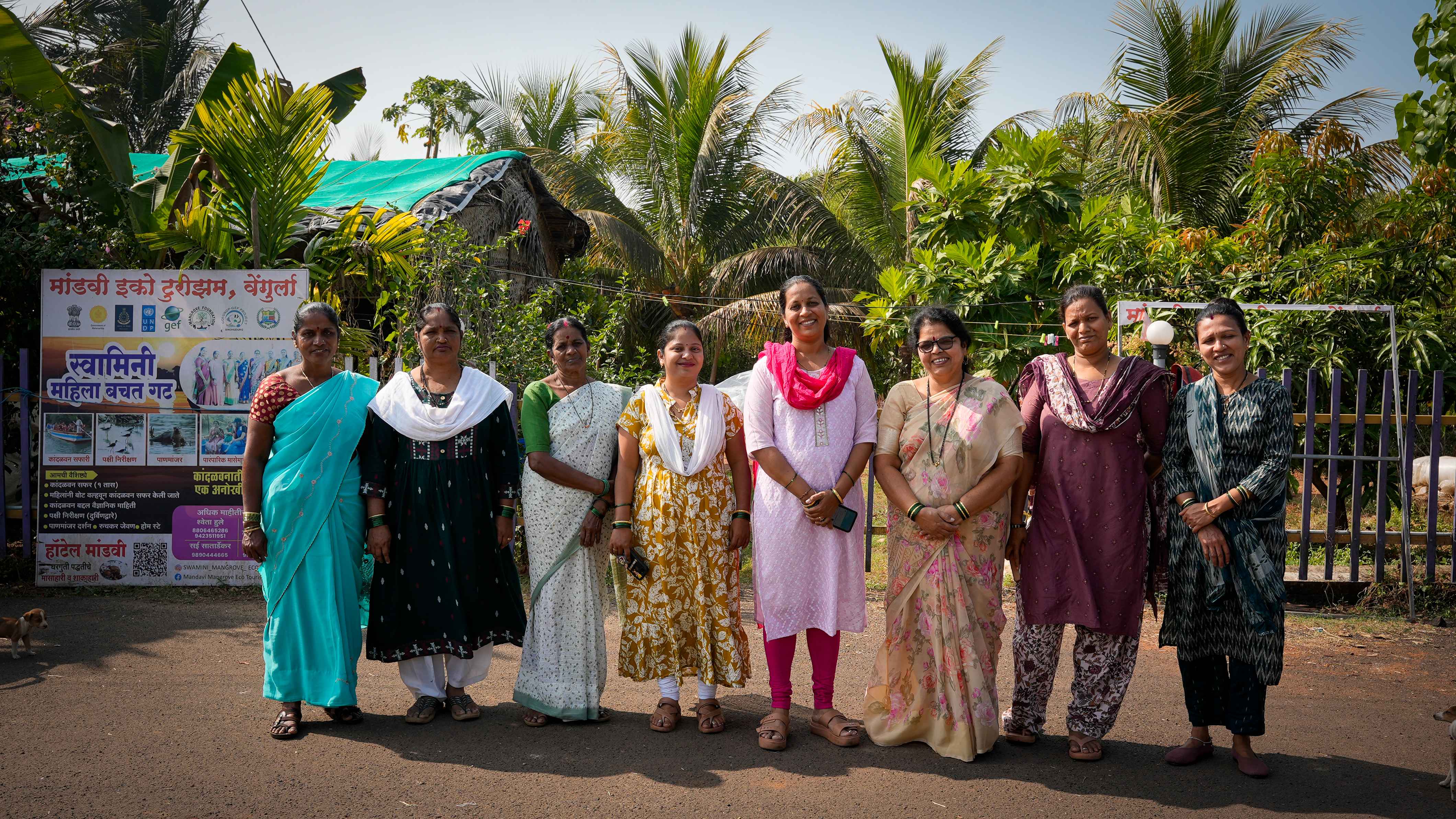
Brimming with enthusiasm, the eight women got in touch with the UNDP co-ordinator for Vengurla at the time, Durga Thigale. Durga and Dhanashree Patil, the Head of Botany at the nearby Balasaheb Khardekar College, became the group’s teachers, projecting images of flora and fauna onto screens and by turning the khadi (a delta region where water from the river and the sea mingles itself) into a diligent classroom. They studied in Shweta’s verandah and quizzed each other. Scientific names and characteristics became a verse they repeated as they went about their days, washing utensils and cleaning fish. Their young children, who accompanied them to workshops and training sessions, imbibed this knowledge and a natural curiosity about mangroves—pointing to trees and identifying them.
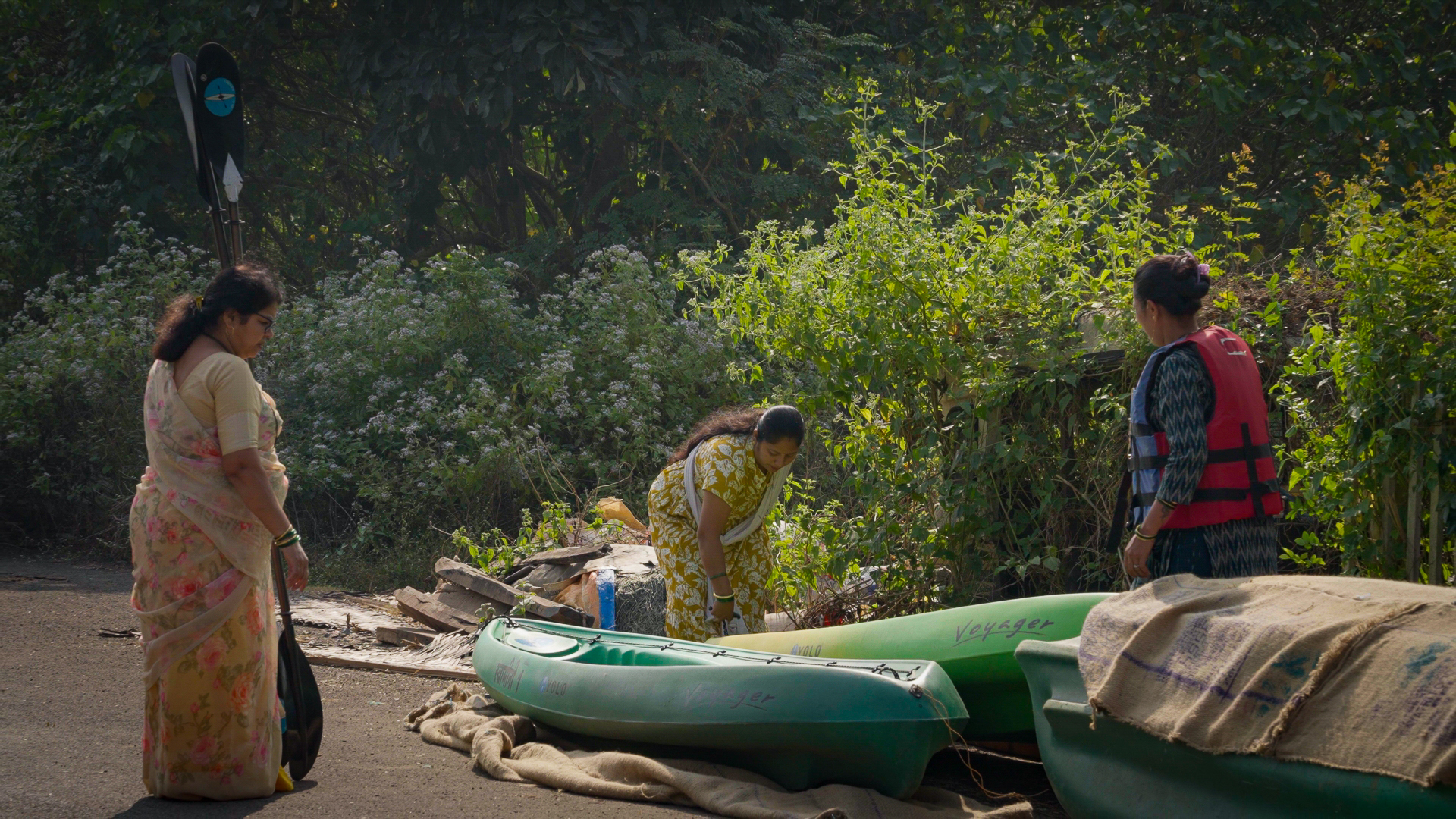
Such was their determination that they felt confident enough to officially launch their mangrove safaris in under two months. Durga helped prepare the project report for the UNDP, and aligned Swamini’s vision with funding frameworks. “Eventually, we received funding amounting to nearly Rs. 6 lakh under the UNDP-GEF project. We bought two boats, oars, and life jackets,” Shweta adds.
Also read: How Jayshree Vencatesan got Chennai to finally care for its wetlands
Learning in the mangrove’s shade
Traditional fishing boats use horsepower engines. Swamini decided to row hodhis (smaller, hand-rowed boats) along the length of the creek so as to not disturb the mangrove’s biodiversity. “Macchimaar mahilaanche sharir ghatta astaat. Pan hodhi valvaaycha kahich anubhav navhta [Fisherwomen’s bodies are sturdy. But we had no experience taking on the waters on our own],” Shweta says.
Traditional fishing boats use horsepower engines. Swamini decided to row hodhis (smaller, hand-rowed boats) along the length of the creek so as to not disturb the mangrove’s biodiversity.
Her husband, Satish Hule, who owned a former fishing business in Vengurla was pivotal in supporting the SHG. “We trained for eight days under Satish dada’s guidance. At first, our boats spun in all directions and we glided straight into the mangroves, getting tangled in the branches,” chuckles Sai. Rowing took a toll on their bodies; but they grew more sure-footed once they began to apply technique and not just stamina. “Many villagers mocked us, saying we would give up in a few days,” says 39-year-old Ayesha Hule. “It feels good to prove them wrong.”
For the Mangrove Cell, Swamini’s mangrove safari was an exemplar of low-impact, non-invasive tourism. “The key players in conservation are local communities who are rooted in the ecosystem. Our objective behind promoting alternative livelihoods, including ecotourism, was to offer both an ecological and economic incentive to conserve mangroves,” Vasudevan says. “We receive hundreds of proposals and have noticed that enthusiasm peters out after a point, which is why we have a rigorous screening process. But Swamini had that rare determination powering them through all obstacles,” he adds.
Charting the depths
Conservation spoken of in the abstract rarely stays with people. But when someone is taken to the trees—invited to touch the bark, trace the roots, notice the flowers, and understand how each part plays a role—the experience becomes tactile and sensory. These encounters made conservation feel personal, to both the members of Swamini and the tourists they would meet.
“We receive hundreds of proposals and have noticed that enthusiasm peters out after a point, which is why we have a rigorous screening process. But Swamini had that rare determination powering them through all obstacles.”
I step into the boat on the morning of the safari that lasts for approximately an hour. Each boat holds up to ten people. We push off from the docks, and the oars cut silently through the water. The mangroves rise like tall gods on either side of us. I can see beneath the surface; the bed of the creek and the rocks encrusted with oysters.
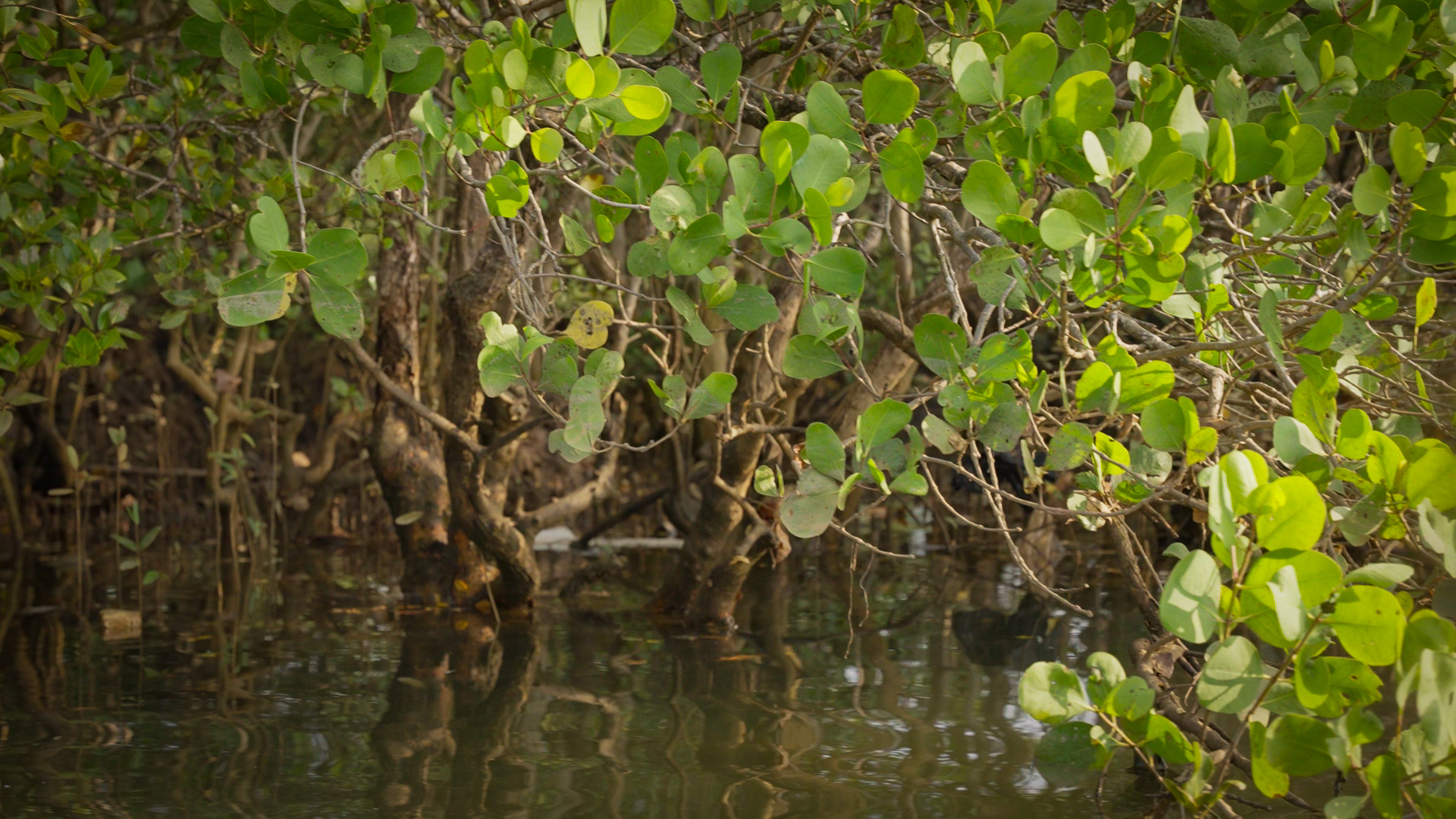
The women identify each tree with ease and talk about its physical and medicinal properties. Sonneratia alba bursts into white bloom every June and July, whose fruit is pickled when raw. Avicennia marina and Avicennia officinalis belong to the same species group, but can be distinguished by their leaf shapes—one triangular and the other rounded—and by their shared yellow flowers and heart-shaped fruit. Rhizophora mucronata is a visually striking mangrove tree with dense clusters of aerial roots, whose bark is traditionally crushed into a powder as a remedy for diabetes.
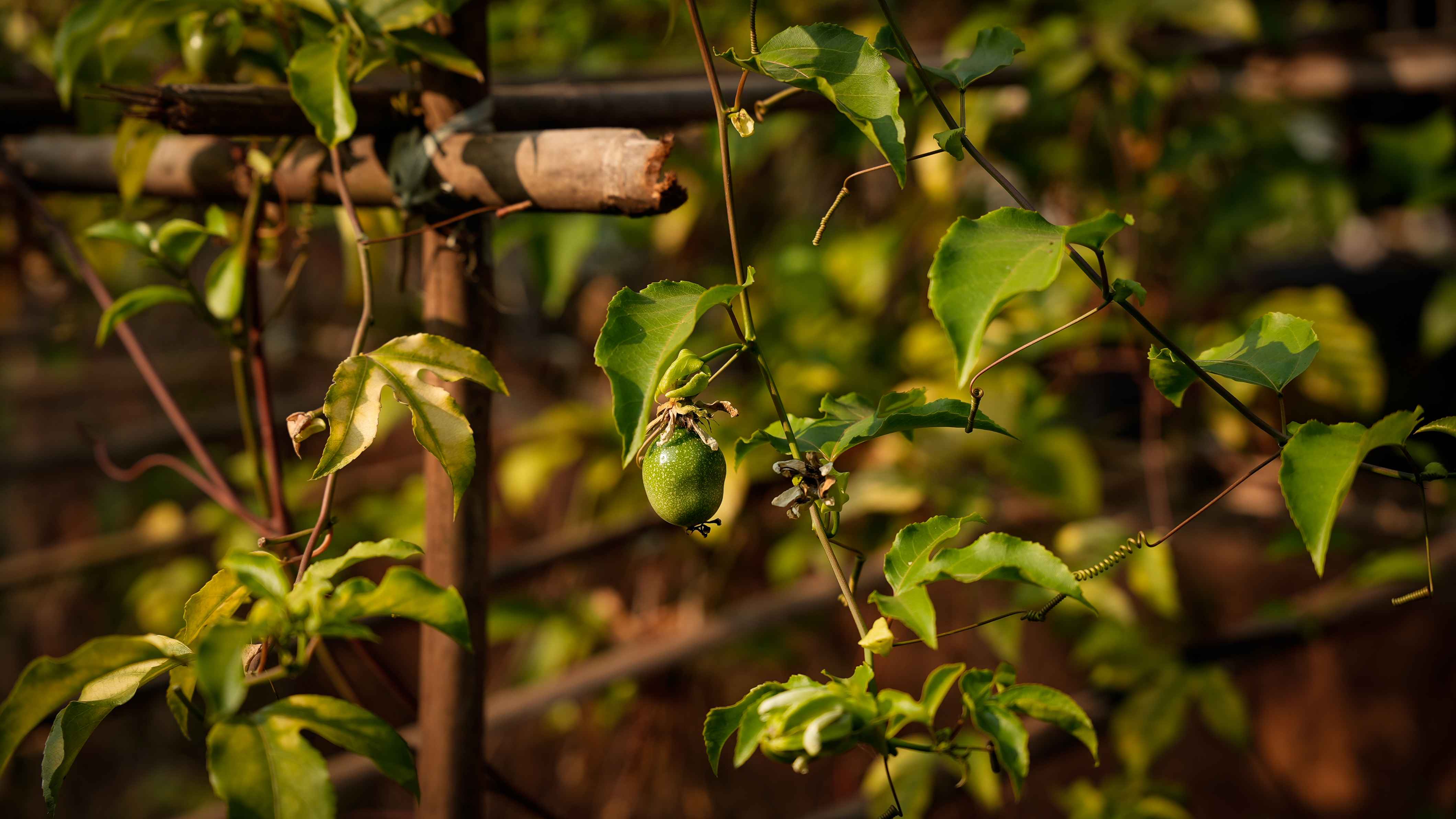
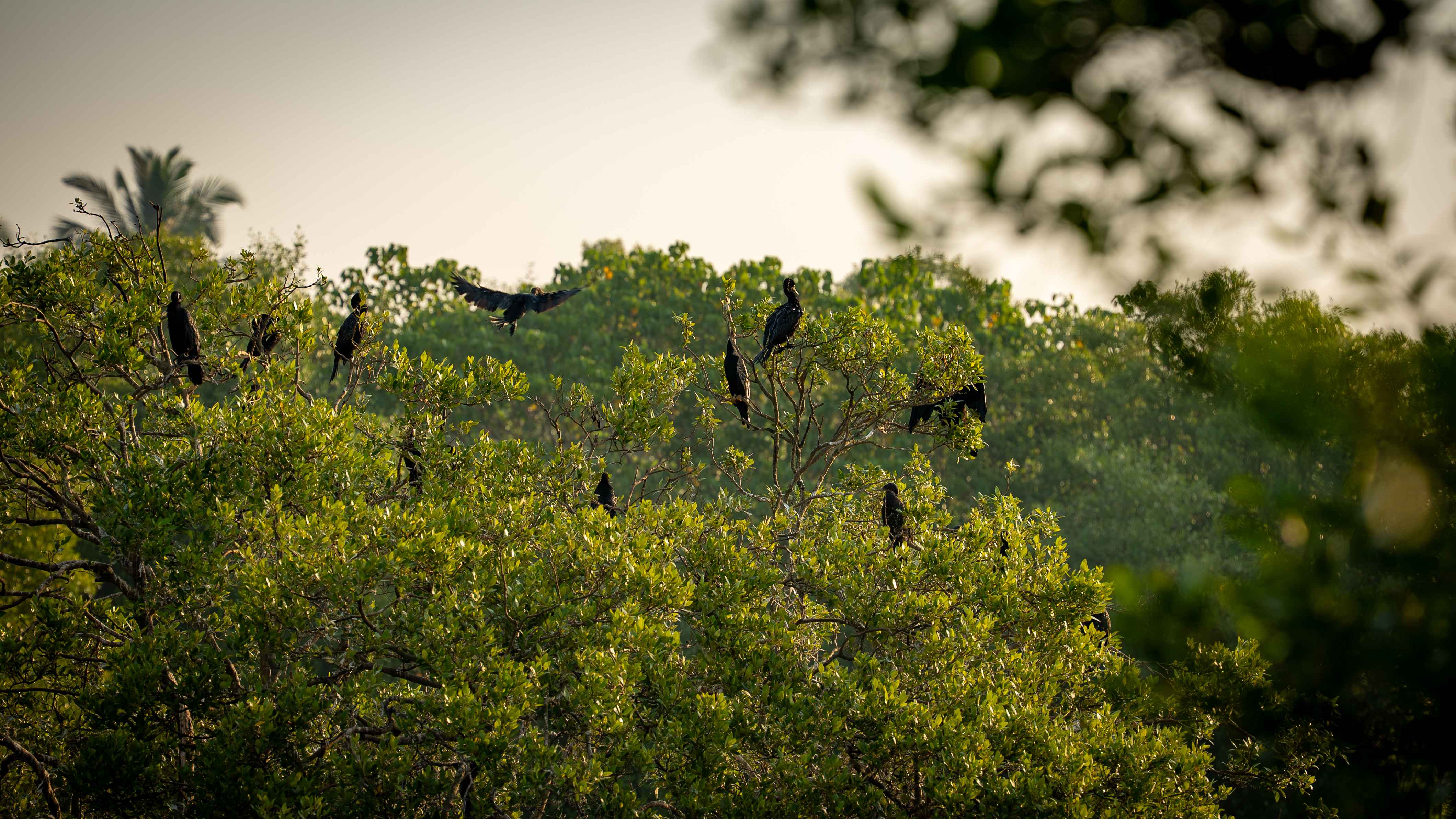
“We used to refer to these birds as bagle [egrets]. We later learned the names of the many distinct birds such as the Grey Heron, the Great Egret, the Malabar Hornbill, and the Indian Cormorant,” Sai says. “Our conversations with wildlife enthusiasts open new doors for us. For instance, a bird-watcher identified 52 bird species a few months ago in a single day!”
{{marquee}}
The salty soils of the intertidal pose an inhospitable barrier for most woody plants, but the mangrove is uniquely adapted for these conditions. The roots of different trees have varying shapes and forms, and are typically spread in a 5 m radius from the main trunk. They are either thin as a pencil, rising like a cone out of the sludge, or bent like a knee. “Most plants can access oxygen from gases trapped in the soil, but mangrove roots are also submerged underwater twice a day during high tide,” Ayesha says. These special breathing roots called pneumatophores grow upwards from the soil and have lenticels—pores that cover their surface and repel water during oxygen exchange. The roots of the mangroves spread out into the water and shelter juvenile fish and hatchlings in their tangles. “During the shifting tides, fish like sea bass, red snapper and tiger prawns lay their eggs here, safe from predators.” Sai says.
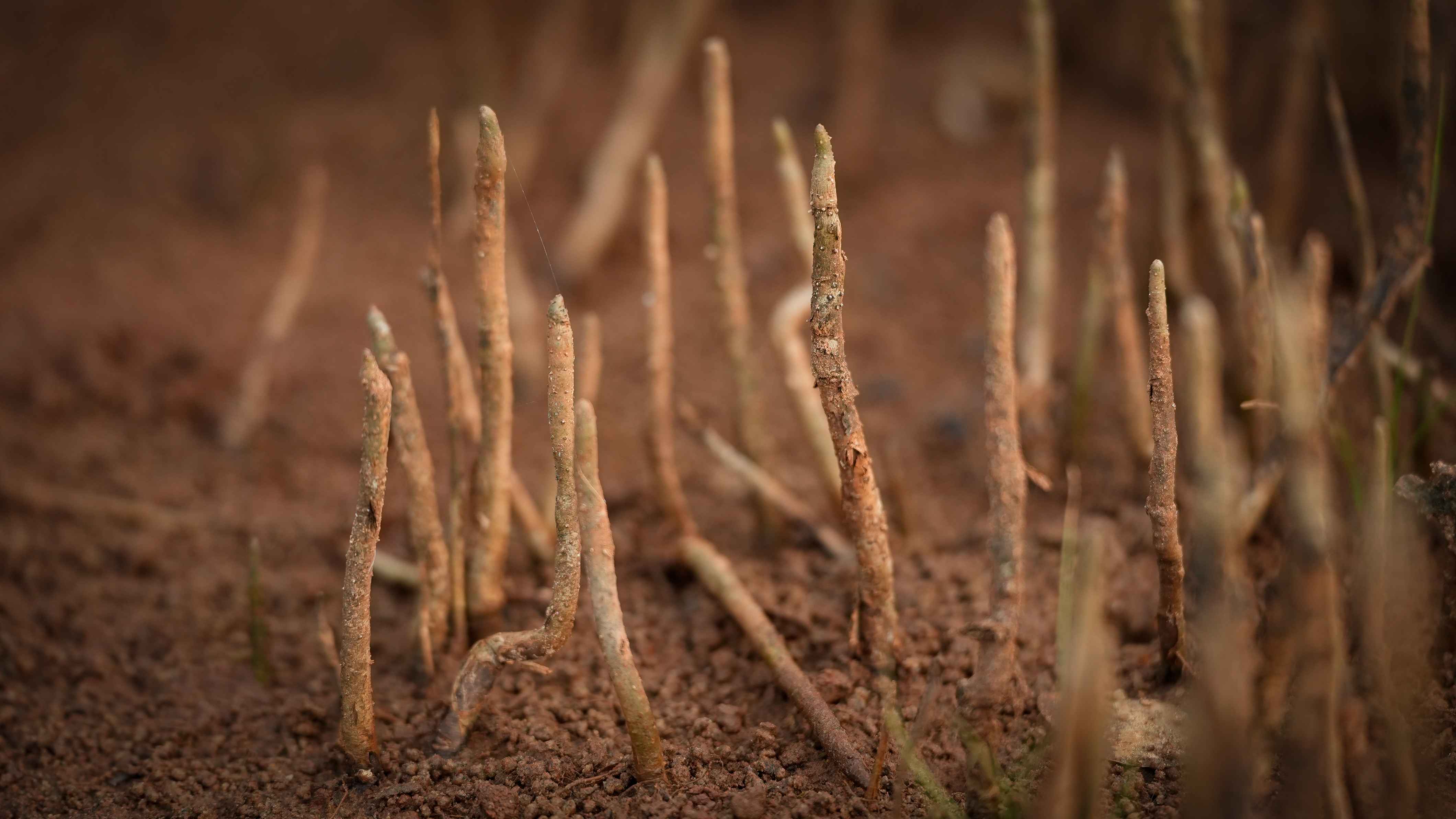
The mangroves have a self-sustaining logic. Fully ripened fruits fall from the trees during low tide and take root as saplings, eliminating the need for sowing. What the earthworm does for a field, the scorpion mud lobster does for mudflats—turning the soil endlessly to raise volcano-like mounds that crumble during high tide, only to be rebuilt. With every burrow, the lobsters aerate the mud, recycle nutrients, and renew the ground on which the mangroves grow. Together, the trees that seed themselves and the creatures that work the earth form an ecosystem where regeneration occurs on its own.
The women, too, have an unspoken understanding amongst themselves. When one feels the toll of the oars, another silently takes over. “We have now safely rowed tourists out of sticky situations, such as when one of our paddles floated away. This is only because of the many experiences we have accumulated on the creek,” says Radhika Lone, another member of the group.
Troubled waters
In 2020, Swamini attempted to go beyond ecotourism, experimenting with regenerating mangroves through a plantation drive. But their nursery lacked the ability to provide a consistent supply of saline water twice a day. “The land where we planted nearly 2,000 saplings was elevated, so tidal water couldn’t reach it,” says Shweta. “About 60-70 of these trees have survived but their growth is much slower than the ones that have naturally reproduced and been nourished by seawater,” adds Sai.

Their work in revitalising Vengurla’s mangroves continues in other ways; any harm to the wooded shrubs is like a stab to their own hearts—like they’d feel about their own children being hurt. “When we first started the safari, we waded into the creek to clear out all the garbage that people dumped. This included plastic that clogged the breathing roots’ pores and thread from nirmaalya [devotional offerings] that could get entangled around them or choke the tiny fish who called this landscape home,” says Ayesha.
Their work in revitalising Vengurla’s mangroves continues in other ways; any harm to the wooded shrubs is like a stab to their own hearts—like they’d feel about their own children being hurt.
The disappointing outcome of the plantation initiative does not cut as deep as the threat of local politics stemming from both gender and caste-based discrimination. Tensions ran high, especially in the infancy of the project, in response to the group presenting a new model of leadership. “We faced the ridicule and wrath of fellow villagers. They cut the ropes that anchored our boats in the dead of night, so that they would drift out to sea. They would slash our paddles or mislead tourists who wanted to book a safari with us,” says Shweta. “But we had a stubbornness that kept us afloat, we were determined to not give up, no matter what came our way,” Ayesha adds.
Swamini think of themselves as environmental guardians. They routinely partner with NGOs and encourage Vengurla’s students to assist them in cleanup drives. School children from surrounding regions and even metropolitan cities such as Mumbai and Pune visit the village and are taught about the importance of sheltering mangroves and keeping the environment clean. Under their vigilance, nearly 200-300 new trees have flourished along the banks of the Mandavi, says the UNDP’s Durga Thigale.
Also read: Basanti Devi’s boots are made for walking
Swamini continues to sail
Shweta Hule still wakes up in the wee hours of the morning to sell the first catch in Vengurla’s main bazaar. Like her, all the other women of Swamini have other livelihoods. The group was born not out of economic necessity but from a deep, self-driven passion to protect an ecosystem. “Initially, it was difficult to juggle Swamini with our other chores,” say Ayesha and Radhika. “Tourists flock to Vengurla during the summers, and the season plateaus during the rest of the year. We were satisfied with our pre-existing businesses, income generation was never our goal.” The initiative averages at 12-15 rides every month. Participants are charged about Rs. 300 per person for the boat ride, enabling each woman to earn about Rs. 25,000 every year. “These earnings help us tide over difficult times in our homes and in our independent businesses,” adds Radhika.
Like the mangrove which grows slowly and is self-sufficient, the project has lent all the women associated with the SHG a distinct identity. “‘Aatmanirbharta’ —this emotion has driven our work. Women are always identified in relation to their male relatives. The feeling of doing work that is ‘mine,’ that I am recognised by, is unparalleled,” says Ayesha. “Being a guide has also instilled a lot of confidence in me. We are now invited to train women starting similar initiatives in nearby towns,” adds Radhika.
Like the mangrove which grows slowly and is self-sufficient, the project has lent all the women associated with the SHG a distinct identity. “
There is an easy camaraderie between the women, who gather in the kitchen of a homestay owned by Shweta and her family before a safari— laughing, sipping on their tea, and heatedly discussing the panchayat elections. It doesn’t take a trained eye to notice that these women are both co-workers and companions. “We bicker too, but make up as quickly. We recognise that our shared vision and cause is far greater than any individual differences in opinion that we may have,” Ayesha says.
Edited by Shobana Radhakrishnan and Neerja Deodhar
All images by Aditya Manoharan
{{quiz}}

Explore other topics
References

How many mangrove species can be found in Maharashtra's Sindhudurg district?