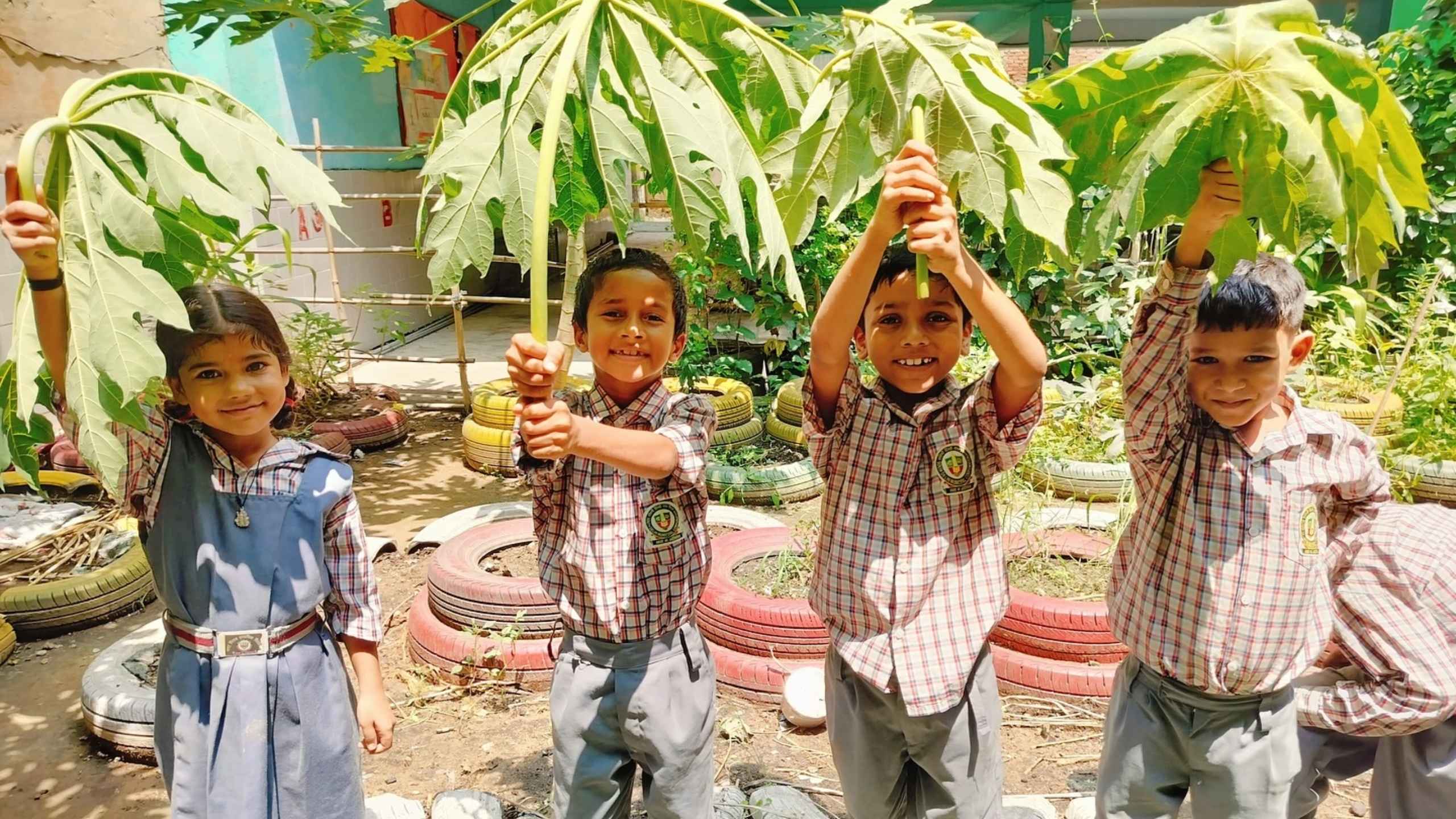
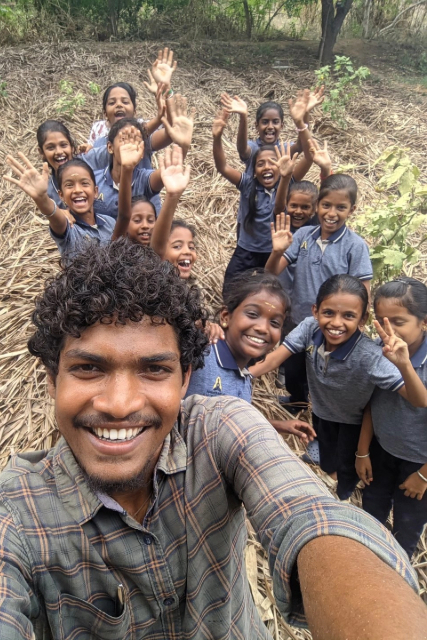
Making room for agriculture in the urban classroom
Schools in Indian cities are introducing farming into their curricula. Making this inclusion meaningful requires a rethink of what constitutes knowledge itself


Is it time to harvest the peas and carrots we sowed a few months ago?
Do the beds need to be prepared for the turmeric?
Does the cow dung need to be spread across the fields?
I didn’t know that cow dung can also be used as fuel!
These are some of the questions on the minds of children learning to farm at Vrindavan Farms in Palghar, on the outskirts of Mumbai. Every month, a group of fifteen children aged 7 to 13 from the alternative school Comini Learning make the 3-hour bus journey to the farm, to check on the land they have tended to all year, and participate in other activities, such as chasing crabs in fields of indigenous rice varieties, visiting a biogas slurry plant, feeding cows, and transplanting seedlings.
These curiosities don’t often find the space to be expressed or explored in a conventional classroom. In many schools today, children learn about plants, soil and ecosystems as scientific concepts, but seldom encounter the processes through which food is grown, the people who grow it, or the ecological relationships that make cultivation possible. This disconnect is particularly pronounced in urban India, where concrete landscapes, shrinking open spaces and increasingly distant food supply chains leave children with little direct experience of growing food. Vegetables and fruit arrive in sabji mandis, supermarket shelves, and on doorsteps via quick-commerce apps. Meals may be served in school canteens, with the labour, land, water and processes behind them largely invisible.
Some educational institutions—private, government-run, and municipal—offer an opportunity to bridge this gap by encouraging children to engage with the everyday realities of food production. The experience of Comini’s students, for example, raises a larger question: what might change if growing food were not an occasional excursion, but an integral part of how children learn?
The great outdoors is a great classroom
For Delhi-based Pragati Chaswal, a busy marketing professional, cooking and feeding tasty, nutritious food to her young son was a puzzle. “One day, my frustration led to me procuring soil and seeds. I wanted to demonstrate to my son that the fries and pizza sauce he relished came from the same potatoes and tomatoes he otherwise disliked,” she says. What started as an activity born out of a personal dilemma soon blossomed into SowGood—India’s only homegrown initiative that introduces students to farming and hands-on sustainability education. Started in 2017, SowGood has worked with nearly 80,000 children in both public and private schools across Delhi-NCR, Gujarat, Punjab and Haryana, integrating agriculture and waste management into curricula over a period of three school years.
“It’s easy to rattle off what tubers are during a viva quiz, or write down the five do’s and don’t of composting during an examination, recalled from what has been hurriedly memorised the night before. But how many children have even looked at a compost pit?” asks Chaswal.
We structure time on the farm according to what the students are studying in their regular classes.
With this in mind, the three-year programme at SowGood begins with creating a small farm, compost pit and waste segregation unit inside the campus. The programme’s core audience is Grades 3 through 5, but the whole school is incorporated into the fold. After this, the farm becomes an organic gateway to learning different subjects.
“We structure time on the farm according to what the students are studying in their regular classes. If they are learning about the life cycle of a plant, or types of soil, our facilitators bring special attention to germination and the ripening of whatever they’ve planted that season. If they are studying a chapter on solid waste management in cities, we schedule a trip to the recycling plant,” Chaswal says.
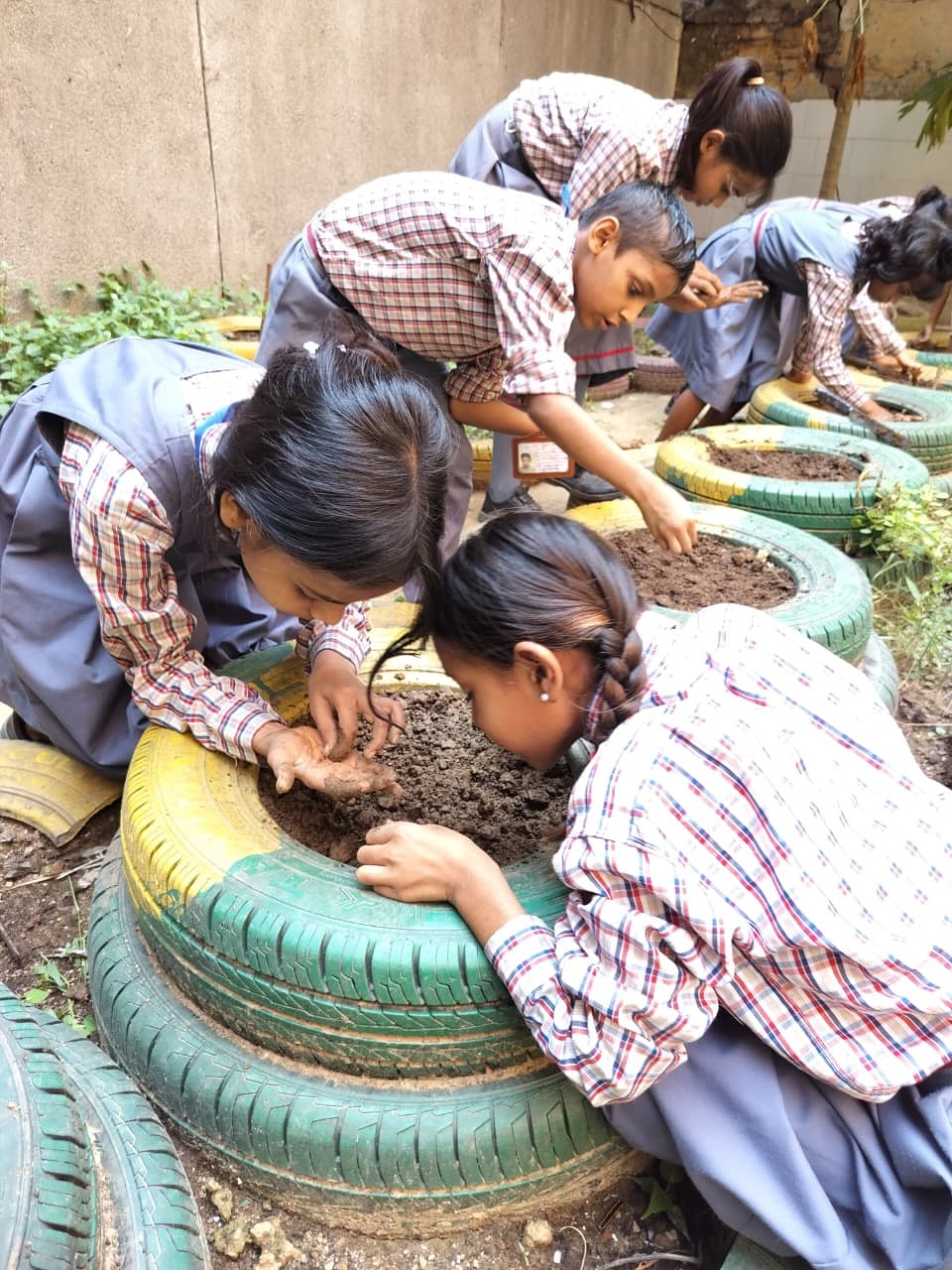
Priyanka Rai, co-founder of Comini Learning, says, “Kids thrive in open, natural environments. Rather than rote-memorising what ‘xylem’ and ‘phloem’ are, kids seeing how plants actually receive water and nutrients on the field has been very special! Once they find something meaningful, they become interested in learning how to do it better,” Rai says. “And children, of course, find meaning in very different things,” she chuckles.
Students across SowGood’s schools measure plots, plant crops in meticulously portioned rows, track crop growth and calculate yields and harvests. They may also watch bees build a hive and termites raise a mound, and witness how a plethora of living creatures like earthworms, ants, bees and birds come together and play a part in what grows.
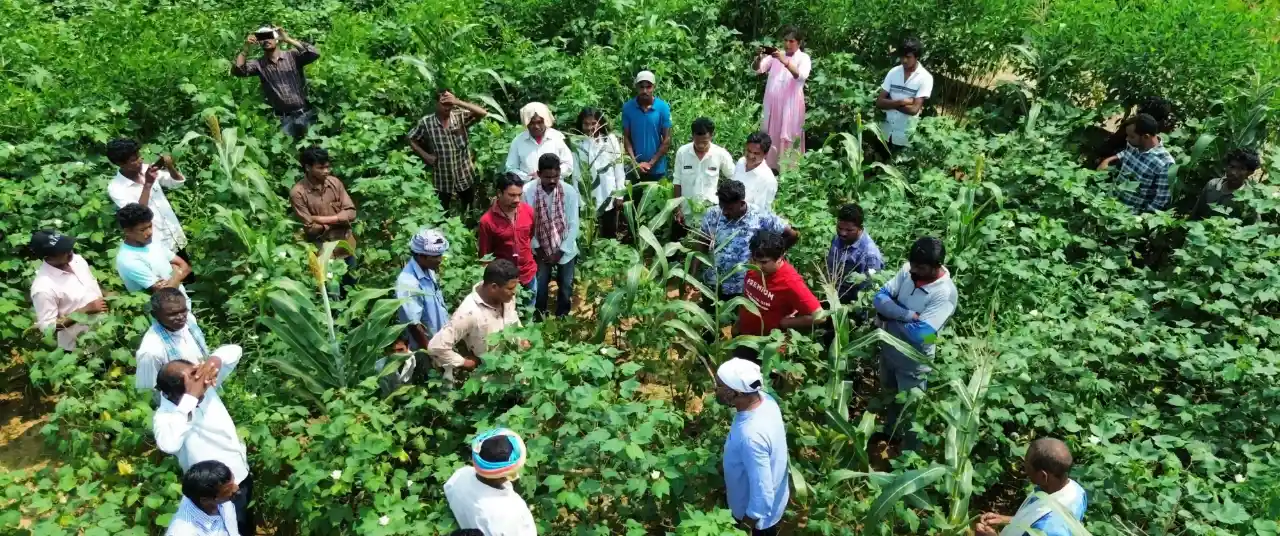
Farmer and educator Muthukumaran, who taught Grades 3 through 8 at Agastya Academy, a private school in Erode, Tamil Nadu, attests to this. “We undertook more complex assignments based on permaculture principles, like what should be integrated on a low-lying farm next to a river with loamy soil? But we also opened our minds to nature’s simple revelations—we often took birdwatching trips where I showed children how the spotted owlet, for instance, keeps rodents and rats in check, while bees flit from flower to flower while pollinating,” he says.
Also read: Carbon credits in agriculture: A half-baked promise?
Getting your hands dirty
Comini serendipitously partnered with Vrindavan Farms in 2022 when a parent introduced Rai to the farm’s produce. “Cities are generally so hostile,” Rai says, “There are not many routes through which children or adults can meaningfully interact with nature. Kids usually believe that their milk magically emerges from a packet and groceries overflow from the Instamart delivery person’s bag,” she adds. Farmschool, the brainchild of Vrindavan Farms’ owner Gaytri Bhatia, is designed to help children experience the toil behind every morsel. From being antsy about the hot weather and squirming in the smells of a farm at the start, their perspective evolves as they till the land in the burning heat and transport straw to the cowshed with little complaint. “I want them to know that nothing grows overnight, and we are often at the mercy of nature!” Rai adds.
India’s National Education Policy (NEP) 2020 has underscored that agriculture and gardening be integrated into schools as vocational education. While the policy does not make farming a compulsory subject, its approach encourages learning about food and the livelihoods engaged in it. Other research across the world shows how gardening and farming in schools are promising interventions. This 2022 study, which looked at children from over 12 countries, found that their knowledge about nutrition and the plant world improved, as did their attitude towards eating a diversity of vegetables. Other studies found participants describing gardens as spaces for cooperation, shared responsibility and social connection.
In Mumbai, the Brihanmumbai Municipal Corporation (BMC) began taking this approach into its civic schools in 2023, in collaboration with the NGO Project Mumbai and urban farming organisation Living Greens. The programme was also in line with the state education department’s mandate to include agriculture in the curriculum for students between Class 6 to 8 from the same academic year, intended to introduce children to organic farming and urban food production. At Dadar’s Woollen Mills Municipal School, Living Greens installed six terrace vegetable beds with drip irrigation—but that was the extent of their involvement, says Poonam Bhaskar, a science teacher at the school. The responsibility of keeping the terrace garden alive has largely fallen upon the school since then. But that hasn’t seemed to deter students or teachers.
“We harvested bitter gourd, chillies and cotton just this past week,” says Bhaskar. Teachers have devised innovative ways to make cross-disciplinary connections and fundraise. “Children love harvesting—they get to see the fruits of their labour in real time. The concepts of their textbooks are also translated into something tangible: simple and compound leaves, parallel and reticulate venation and so on. We also have many fruit trees in the garden, and I ask children to bring fruits and flowers to individually dissect,” she adds.
Students from Grades 6 through 8 are most actively involved in the activities. They sell the produce to parents, teachers and staff, and their earnings fund soil, manure and other fertiliser. Being intricately involved in each part of the life cycle of what they grow—from sowing, nurturing, harvesting, packaging and selling—has helped students understand why something is priced higher when it’s not mass-manufactured.
Children love harvesting—they get to see the fruits of their labour in real time.
Agriculture becoming part of schooling has also allowed children to reconsider their relationship with what they eat. Are the ingredients they usually consume seasonal and native to where they live? Comini’s students were introduced to indigenous varieties of paddy like Ajara Ghansal, which resiliently grow through heavy monsoons, and Mahadi, which learned to survive drought.
“It’s important to design the course keeping in mind what children find interesting at different ages. Younger children aren’t afraid of hard work and love harvesting! All our produce is sent to the school kitchen, and the children love eating what they’ve grown themselves. Gardening is a great way to encourage better eating habits,” Muthukumaran says.
Meanwhile, SowGood’s students across regions are custodians of a joint seed bank. “We encourage them to bring back seeds from their villages and hometowns. When there is a harvest of beans or native gourds or tubers, they save some for the next season and also send them out to other schools. They may not know each other—but are growing what a peer has perhaps nourished!” Chaswal says. It is essential that kids know seeds should ideally be exchanged and not bought, she adds. In the context of agrochemical giants monopolising seeds, and homogenising what we eat, this is all the more important.
Unlike conventional subjects, farming is typically not graded or marked.
Unlike conventional subjects, farming is typically not graded or marked. Instead, it offers a way to bring the existing syllabus to life, allowing children to understand concepts through practical experience. Similar initiatives have emerged in other parts of the country. Tamil Nadu's Green Schools programme, launched in 2023, selected 297 government schools to develop vegetable and medicinal gardens alongside composting, rainwater harvesting and other climate-resilient infrastructure. In Meghalaya, a School Nutrition Garden campaign launched in April 2024 aimed to establish kitchen gardens in all schools serving meals under PM POSHAN, with horticulture departments and Krishi Vigyan Kendras providing seeds and saplings. Even small schools like the Government Senior Secondary School in Nagaland’s Salomi village have found simple ways to integrate organic farming into education, while the Akshar Foundation in Assam’s Pamohi village accepts fees in the form of students depositing plastic waste.
Regardless of the value it brings to learning, there is a contradiction at the heart of many urban school gardening initiatives. Children in affluent schools may have access to dedicated growing spaces, specialist educators, and field visits, while municipal schools contend with limited space, limited funding sources, and teachers’ time being taken up. The BMC’s original initiative intended to install gardens in 250 schools across Mumbai, but there has been a gap between policy and implementation. At Woollen Mills, Bhaskar says, “The garden was launched with a lot of fanfare by the then-education minister, but no one has checked in since then. We can’t be too picky about asking children to source organic seeds and soil, otherwise we may unintentionally become a barrier to their enthusiasm and capacity.” More funding, she adds, would help the school organise farm visits and sustain its garden.
Also read: Food miles: The cost of ingredients from a land far away
A radical cure for anxious times
The constraints that schools face are not merely financial. They point to the kind of knowledge the Indian educational system inherently values. Even schools that have incorporated agriculture into their education see participation peter out in older grades, as the pressure to complete the syllabus and prepare for crucial examinations leaves little room for additional activities. “We only assign one farming-related project to these students, who are already stressed because of upcoming board exams,” Bhaskar says.
However, repeatedly, children have demonstrated that the more they spend time with the natural world, the more they find joy and a growing affinity with it. Students at MCD Primary School, Ghitorni describe their plot as a ‘utopia’ and have aptly named it ‘Jagmag Garden’—a place of endless magic and fascination. “One student transfer at Agastya had trouble mingling with the other kids. He often used to wordlessly come and help out at the farm, which was perhaps a source of solace. By the end of the year, I could see his spark returning,” Muthukumaran says fondly.
Returning to the same piece of land over seasons also helps children learn patience, says Rai. Many ‘tree-planting’ or afforestation drives are a one-time activity which might not foster ownership or an understanding of what didn’t work. “Botched attempts and figuring out how to nurture something over time is also part of the learning process,” she says. By giving children the opportunity to sometimes fail without punishing repercussions, school gardens help them experience both nature’s plenty and teeth.
Gardening in urban schools will always have to contend with space constraints. The key is to innovate and involve kids in the process!
Not every school needs a dedicated garden to begin. “Gardening in urban schools will always have to contend with space constraints. The key is to innovate and involve kids in the process! Low-maintenance crops like microgreens, beans and spinach, which give children more immediate, visible results, are a great way to begin,” Chaswal says. However, all these require continuity and support, so as to not become another responsibility for already-stretched teachers.
This shift in schooling gives children a way to be participants in the world rather than merely consumers. “We talk about kids wanting to care about the environment and learn sustainability. But advocacy can only follow once you’re deeply connected to something, deep enough to try to save it,” says Rai. That is what makes school farming potentially radical. It offers an alternative to an education in which nature is something to study and environmental problems are something to feel anxious about from a distance. “Children have a lot of hope, which can counter the cynicism that climate doom can foster. Our job is to keep their hope alive,” Rai adds.
Also read: Tomato Truths: To know your farmer is to know your food
Edited by Anushka Mukherjee and Neerja Deodhar
Opening images courtesy of SowGood and Muthukumaran


Explore other topics
References