Food miles: The cost of ingredients from a land far away
In a globalised food market with long supply chains, food miles nudge us to think of the environmental footprints of imported ingredients


When we pick up an avocado at a supermarket or a local bazaar, to examine it for quality and ripeness, the distance it travels may be the last thought to occur to us; if anything, its origin in a faraway place only adds to its appeal and reinforces its authenticity.
Having to pay a high price for this well-travelled ingredient is no longer a deterrent, nor does it give pause to many urban consumers; in 2024 alone, India imported nearly 11,828.47 metric tonnes of avocados. Many of these avocados arrive at our neighbourhoods from farms in Tanzania and Australia by cargo ships or planes—a journey made possible thanks to cold storage technology.
The term gained popularity because it enabled consumers to translate an abstract environmental problem into tangible data.
This “invisible”, intercontinental distance has a name: food miles. In simple terms, food miles refers to the distance an item travels from where it was produced to where it is consumed, and the resulting impact. Its coinage was intended to raise awareness among consumers about the environmental costs of transportation over long distances; the more your food travels, the more fossil fuels are burned, increasing greenhouse gas emissions. The term was coined in 1992 by Prof. Tim Lang, who was part of the Sustainable Agriculture, Food and Environment (SAFE) alliance. It first appeared in a print report compiled by Angela Paxton, a researcher with the UK-based alliance.
The term gained popularity because it enabled consumers to translate an abstract environmental problem into tangible data. Measured in tonne-kilometres, food miles are calculated by multiplying the weight of the food item by the distance travelled. By being conscious of the final figure, in the context of ingredients like avocado, consumers can take the first step in environmentally-conscious consumption.
The concealed costs of produce
The concept emerged at a time when food systems were undergoing a global transition. Previously, food was mostly sourced from nearby farms and markets. Diets were, to a great extent, shaped by geographical specificity and seasonal availability, which meant certain foods, such as varieties of mango, remained local delicacies rather than becoming widely available commodities. However, globalisation and advancements in storage and economical transportation technologies altered supply chains and their inherently short nature. Improvements in packaging extended the shelf lives of even perishable goods.
An increase in the consumer demand for foreign products resulted in higher food miles. The liberalisation of world trade and the reduction of trade tariffs have made it easier for countries to trade goods produced in surplus. India’s own agricultural exports rose from $3.35 billion in 1990-91, after the landmark economic reforms of that decade, to $52.55 billion in 2025-26. Producers found new markets beyond local territories, while consumers gained access to an unparalleled variety of food choices.
Longer supply chains mean more dependence on energy-intensive processing units and storage infrastructure.
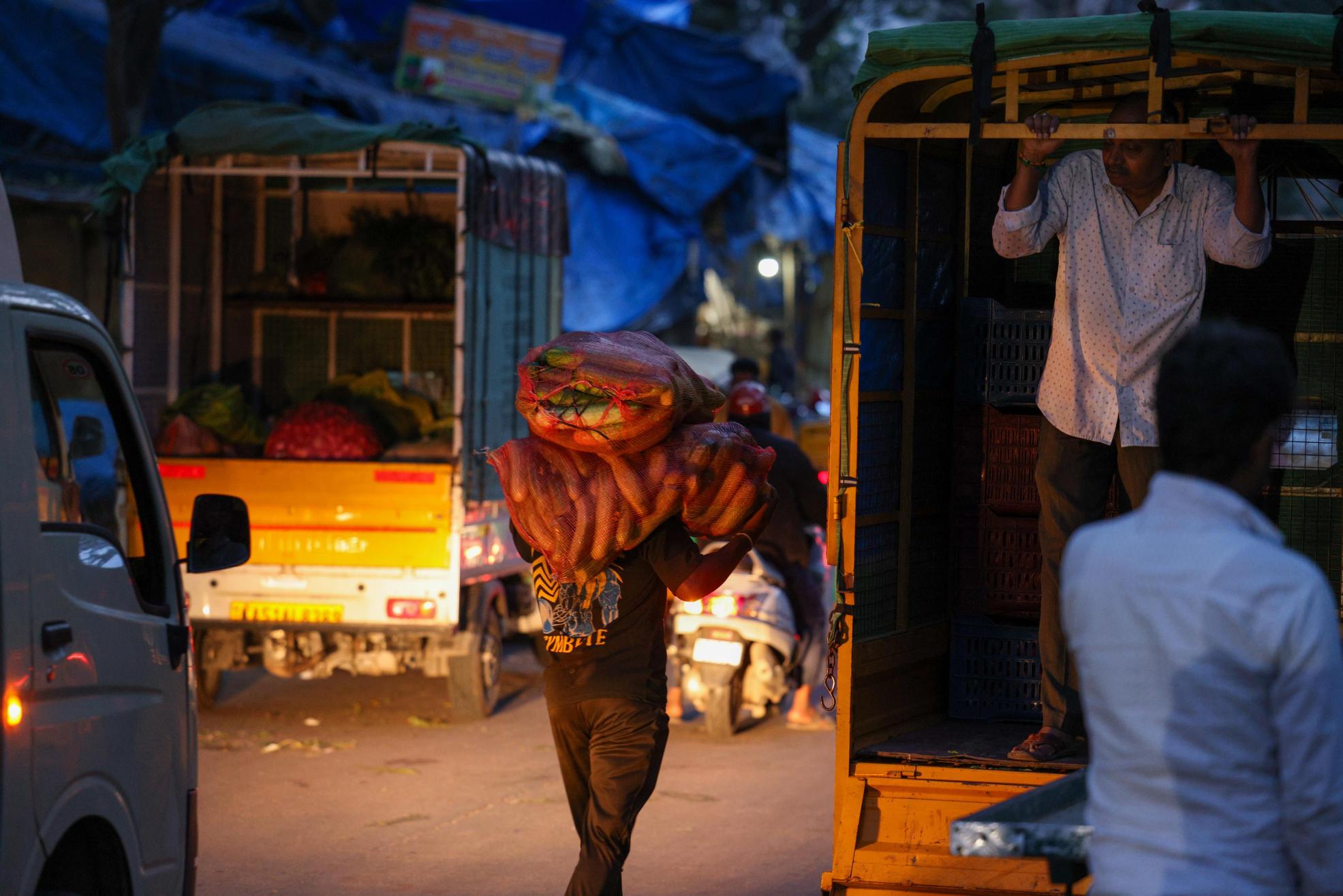
The rise of large retail chains strengthened the dependence on sophisticated distribution networks involving multiple warehouses and modes of transportation. For example, tomatoes from a local farm in Andhra Pradesh do not go straight to consumers; rather, they pass through several intermediaries and godowns across India. About 80% of the total tomatoes produced in the state are either exported to other states, or processed and sold as finished goods across the country.
In many ways, longer supply chains may have benefited producers by improving the availability of ready-to-eat foods and reducing seasonal shortages. But this comes at a price borne by the environment. “Longer supply chains mean more dependence on energy-intensive processing units and storage infrastructure. This also means extra stops between the producer and the consumer,” shares sustainability expert Dr. Indu K. Murthy, who works with the Center for Study of Science, Technology and Policy (CSTEP), a Bengaluru-based think-tank.
According to a study by the European Commission, food miles are responsible for nearly 20% of global food emissions. High-income countries have a stronger contribution to this, constituting only 12.5% of the world’s population, but accounting for nearly 46% of food miles globally. Nonetheless, India has a significant footprint when it comes to food miles emissions, owing to its large area and population. It ranks as the second-largest producer of domestic food miles (or the miles food travels to reach the domestic population) after China.
A country’s dependence on food imports, and by extension the food miles it generates, are also shaped by factors like climate shocks, conflicts and structural poverty. This is particularly true of low-income countries in the Middle East, North and Sub-Saharan Africa. These countries face challenges of food insecurity and extreme malnutrition while battling scarcely available natural resources. While high-income nations drive food miles through choice, low-income countries unconsciously contribute to food emissions in their attempt to prevent widespread hunger and famine.
Also read: Fish and seasonality: How year-round demand and extraction hurt our seas
Frequent flyer miles
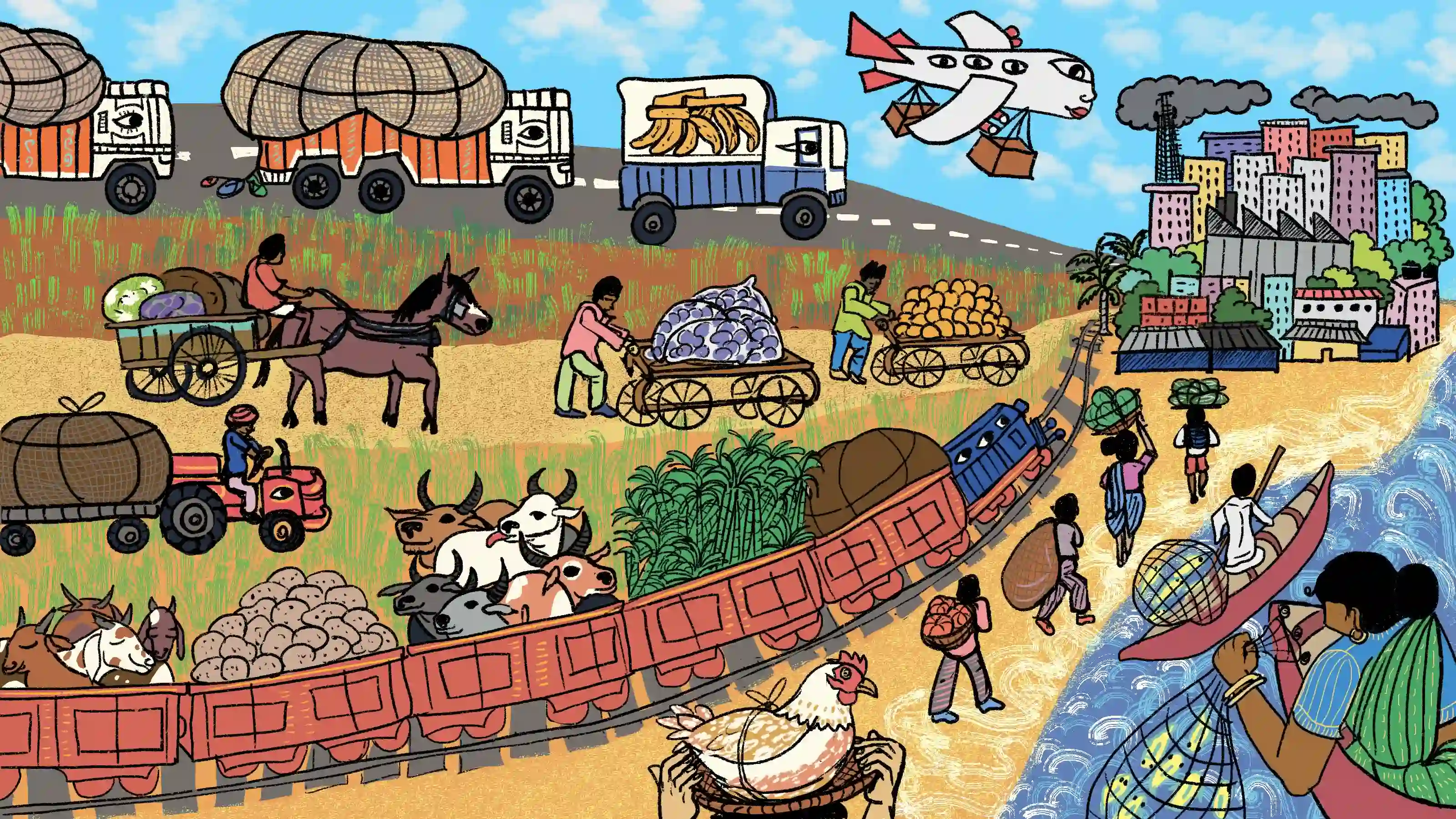
Each mode of transport contributes differently to food miles, both in scale and the emissions it contributes. For instance, food travels almost twice as much by sea than it does by road. But road transport releases far more carbon dioxide, producing 60% of the world's food transport carbon emissions. Air transport, though minimal in absolute food miles, accounts for 20%, and rail and sea transport contribute 10% each to global food transport emissions. Due to recent improvements in roadway infrastructure, heavy goods trucks have become the most favoured mode in India.
Road transport releases far more carbon dioxide, producing 60% of the world's food transport carbon emissions.
Transportation, however, plays only a minimal role in the mounting increase in greenhouse emissions. The environmental footprint of a tomato begins even before it is sown. It includes diesel guzzled by farming machinery, fertilisers and pesticides, and the emissions from refrigeration, packaging, cooking, and food waste. This makes food miles alone an incomplete measure.
Also read: What it takes to feed India’s growing cities
Limitations
Agricultural and climate scientists have debated the efficacy of food miles as a sustainability indicator. The term’s simplicity is one of its greatest weaknesses, as it fails to consider other externalities associated with food systems aside from transportation. Food miles exclude questions of how something is grown, stored, or prepared. Consider meats—particularly processed meat and cold cuts which eat up a lot of resources—where food miles contribute to a smaller proportion of their overall emissions.
A shorter journey does not automatically mean a lower emission rate. For urban Indians, driving outside city limits every weekend to source local, organic produce in a private vehicle can reverse the effects of shorter food miles. Similarly, food that has travelled farther does not necessarily have a large environmental impact. Importing produce that is naturally rain-fed can be less carbon-intensive than growing the same crop locally under resource-heavy conditions. For instance, apple production methods in New Zealand are more energy-efficient owing to the favourable climate, efficient farming techniques and fewer artificial inputs. This makes importing apples from New Zealand to the UK a more sustainable option, despite the distance, than growing them in resource-intensive greenhouses in the UK.
Importing produce that is naturally rain-fed can be less carbon-intensive than growing the same crop locally under resource-heavy conditions.
Thus, food miles solve only one part of a larger puzzle. “By themselves, food miles may not be transparent enough to provide all the details about emissions that a consumer needs. There is a pressing need to increase transparency, at least by mentioning details about the produce and its place of origin on the label,” Dr. Murthy explains.
In some cases, how food is produced can matter more than how far it travels. Scientists now rely on a much more comprehensive and efficient tool called the Life Cycle Assessment (LCA), which is recommended by both the European Commission and the United Nations Environment Programme. LCA assesses the potential environmental impacts of a product throughout its life cycle, starting from the acquisition of natural resources, production, and waste management, including disposal and recycling. This keeps a check on not just the carbon emissions, but also other aspects concerning utilisation of resources during food production. By accounting for each unit of the supply chain, LCA provides a much more accurate picture of food carbon emissions. However, calculating LCA involves specialised software and complex technical procedures that are not consumer-friendly, making it inaccessible.
Also read: Traceability in Indian food supply chains: Complicated by costs, lack of incentive
Should consumers measure miles?
One means to reduce the consumption of items with high food miles is opting for seasonal produce grown locally and in natural climates, without the need for additional support via greenhouses, artificial lighting or intensive preservation and storage methods. According to Dr. Madhura Rao, who teaches food systems governance at Maastricht University in the Netherlands, “Local food has the strongest sustainability case when it is grown in season and suited to the local agroclimate, requires fewer inputs like fertilisers and pesticides, is produced without damaging forests, wetlands or scarce water resources, is associated with low food waste and loss, and uses limited non-biodegradable packaging.”
Reviving native crops can help reduce the dependence on resource-intensive cash crops, which require more chemical inputs. The midday meal scheme and the public procurement policies in India can play a significant role in making this possible by sourcing ingredients directly from local small-scale farmers.
Since cities are not built for food production, reducing their reliance on long-distance food supply chains is not feasible
Since cities are not built for food production, reducing their reliance on long-distance food supply chains is not feasible, observes Dr. Rao. “Competition for land is intense in these areas, and farming is generally not prioritised in urban and peri-urban development. Regardless, urban and peri-urban farming projects are worthwhile pursuits because they help strengthen food security and keep urban residents connected with the origins of their food to some extent.”
Although food miles, as a sustainability index, do not capture the complexities of food carbon emissions, they do prompt consumers to consider that the food they eat could leave an invisible carbon footprint. They serve as a reminder that every item on the plate has undergone a journey. A label on the produce might not tell you whether the avocado you are eating has depleted groundwater levels or if tomatoes in your salad were grown in a greenhouse. However, choosing organic counterparts and investigating the place of origin could help. Sustainability does not depend on isolated, individual choices. It requires an understanding of the broader context in which these choices are made.
Edited by Aathira Konikkara and Neerja Deodhar
Artwork by Alia Sinha
{{quiz}}


Explore other topics
References