Carbon credits in agriculture: A half-baked promise?
Farmers bear the biggest risk in carbon credit projects, with little to no assurance of compensation


Industrial pollution is destroying the Earth. But we aren't quite ready to ask brands, companies and conglomerates to quit. How else will we get our phones, clothes, and cars?
Alongside policies—half-hearted or genuine—to adopt eco-friendly alternatives in manufacturing and production, and worldwide appeals to simply consume less, there has been an attempt to negotiate between the demands of a modern life and the need for a clean environment. The deal that the world managed to strike, through the 1997 Kyoto Protocol, is one that we know as carbon credits.
Think of carbon credits as coupons. To earn these coupons, companies have to keep their emissions below the benchmark prescribed by their country’s government. They can then sell these coupons to companies that were not able to meet the benchmark. Thus, the premise of the carbon credit system is that high-polluting companies buy the permits for their excesses from their less polluting counterparts. In countries like the US and Brazil, this target sets a total emission limit for the industry as a whole. Countries like India, Indonesia, and China instead choose an efficiency-focused benchmark, where companies have to reduce the quantity of greenhouse gases they are emitting per unit of production.
But this only applies to industries where the government makes it a compliance requirement, i.e. the compulsory carbon market. In India, work towards it has begun, but trading will only commence in October 2026. Before it emerged a voluntary carbon market wherein companies can “offset” their polluting activities. Their motivation? Being able to claim they are “net zero” or “carbon neutral”. Many multinational companies also make proactive commitments towards such goals, and voluntary carbon markets help them fulfil these.
These credits can serve as a way to support India's large farming populations to transition to sustainable farming while increasing carbon sequestration and reducing greenhouse gases.
India is one of the largest voluntary carbon credit markets. One sector stands out, both because it has already seen high activity (adding up to 24% of all current projects), and because it has high potential for removing carbon from the atmosphere: agriculture, with sustainable practices having the capacity to sequester 85.5 Mt CO2 annually while enhancing rural incomes and engaging a large section of the economy.
Agricultural carbon markets hold a lot of promise if the regulatory system is set up properly. With India having more than 50 agricultural carbon credit projects currently, targeting 16.5 million hectares, it is emerging as a leader in the space, and deserves careful attention. These credits can serve as a way to support India's large farming populations to transition to sustainable farming while increasing carbon sequestration and reducing greenhouse gases. They are linked to specific projects, like agroforestry ventures, or implementing water conservation techniques. But what do these projects look like in practice, and what kind of future can they hold for our farmers?
The mechanism
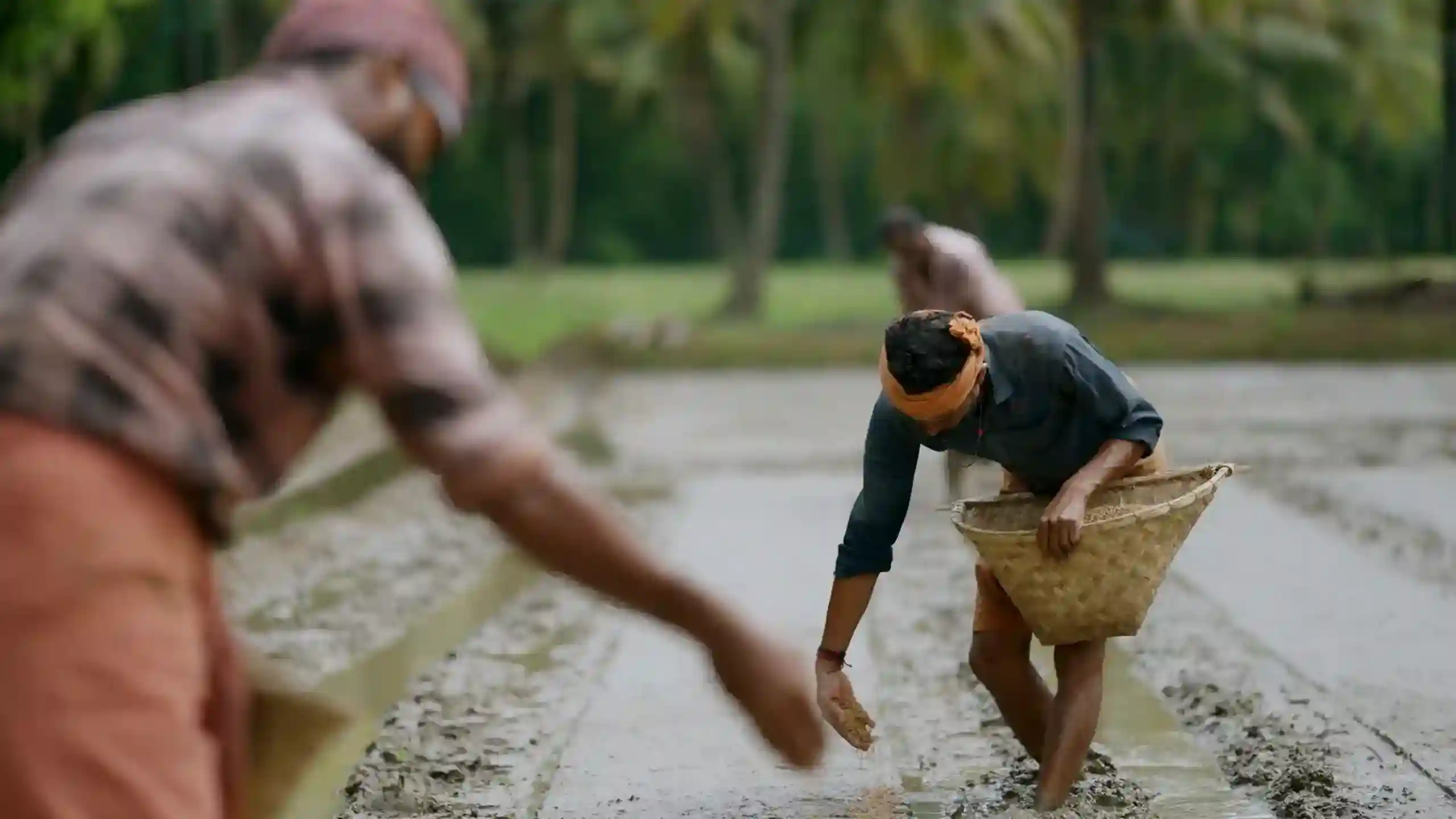
To understand how this works on-ground, let us follow a hypothetical project. A project developer (sometimes an NGO, usually a start-up) decides to help farmers in West Bengal shift to an alternative technique to cultivate paddy: the wetting and drying method. Long-term flooding of paddy fields releases large quantities of methane. The wetting and drying method ensures that the fields are flooded for lesser time, hence reducing greenhouse gas emissions. This combination of geography, goal, and behavioural shift becomes the basis for planning out the project.
Certain independent certification bodies (notably Verra), set standards and methodologies to ensure that carbon credits are being awarded fairly. They outline what parameters to use to measure changes, how frequently to measure these parameters, how to report them, and the eligibility criteria that qualify it for credits. Each sustainable practice comes under an outlined methodology. For example, alternate wetting and drying comes under the VM0051 titled 'Improved Water Management in Rice Production Systems'.
The NGO designs the details of the project to align with the methodologies outlined by international standards. This design has to be approved by a third-party auditor before the project is officially registered with the standard. It's only after this that the NGO reaches out to farmers or farmer groups. They explain the process to the farmers: how it can benefit them, and how long it might take for the project to bear fruit (in the form of meaningfully reduced emissions)—usually anywhere between 3 and 5 years for agricultural projects.
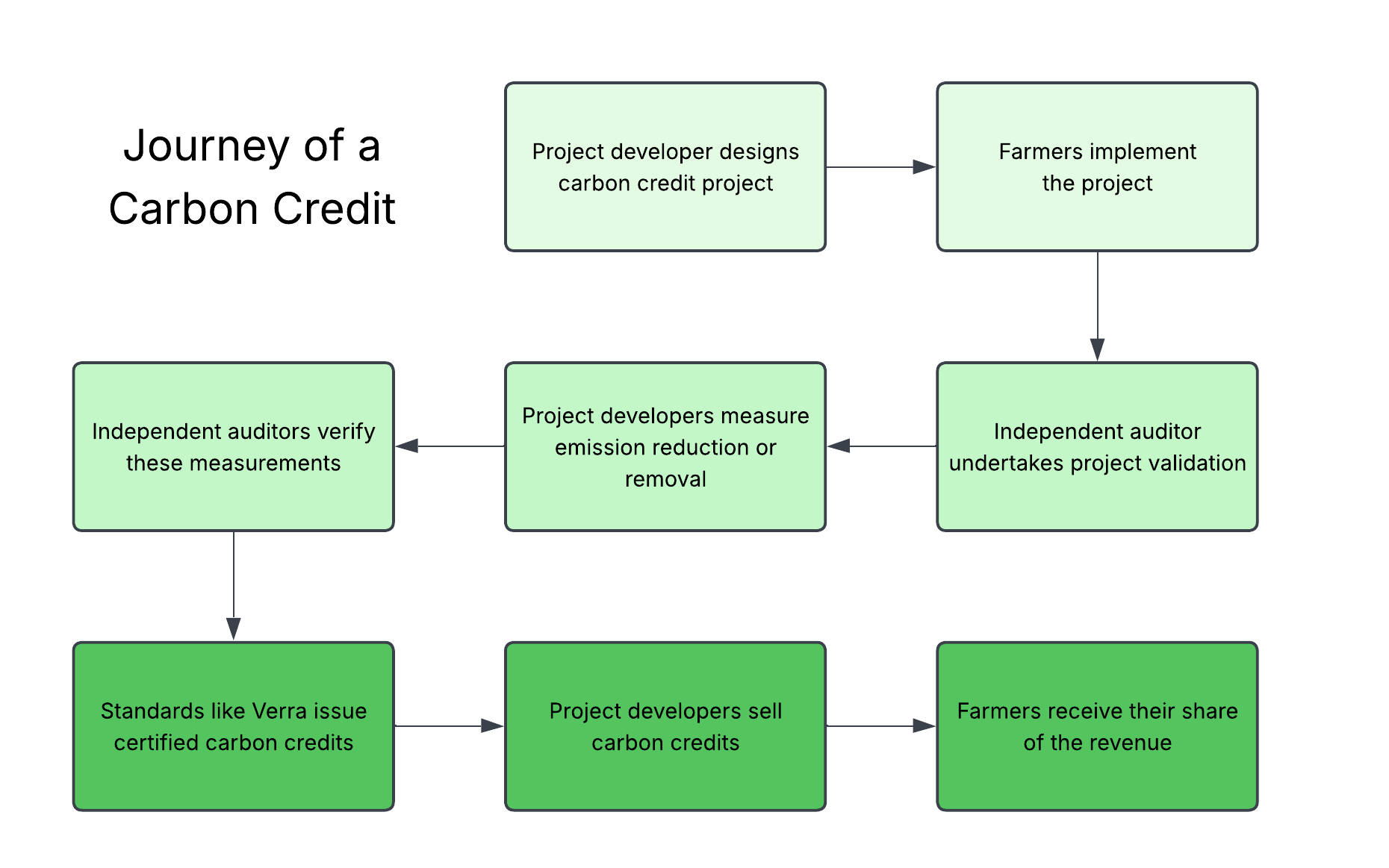
Throughout this period, the NGO continues to be in touch with the farmers, measuring the changes in soil and emissions. How they maintain the records of these projects is critical, since the final audit of their documents and calculations determines if (and how many) carbon credits get issued. Issuance of credits is the equivalent of a product finally entering supermarket shelves, and much like these everyday products, credits sit among a plethora of options, ready for polluting bodies to purchase. Credits can only be purchased after they are issued, with companies or governments being the usual buyers.
Issuance of credits is the equivalent of a product finally entering supermarket shelves, and much like these everyday products, credits sit among a plethora of options, ready for polluting bodies to purchase.
Environmental and resource economist Dr. A. G. Adeeth Cariappa shares that of the 120+ agricultural carbon credit projects listed in India, only 4-5 projects (~3%) are issuing credits—a recent development, since they were issued only last December. The money that comes in is divided between the project developer and farmers. "Project developers are reporting that they will provide probably 50% of the gross revenue, or 70% of the net revenue to the farmers," says Dr. Cariappa.
Also read: Green data centres: Sustainable alternative, or marketing myth?
The cracks in the system
The supermarket analogy highlights much that is imperfect with the current carbon market. Farmers and project developers stick their necks out to reduce emissions or sequester carbon into the soil, only to become one among many options that a company can pick from. There is no guarantee that the credit is bought, and since it is not a product that expires, there's no way to tell when and if it will be bought either.
Cariappa shares that as per the surveys he was part of in 2023 and 2025, though a handful of farmers had been given advances, most farmers had not received any money. But he remains hopeful. "At that time, audits hadn't been done and sales were not happening. But this time, there are issuances, there are sales, and probably by the end of the year, we will have a better picture of if farmers have received the money or not."
Naturally, the farmer is more vulnerable than any other stakeholder in this scenario: they are the ones bearing the most risk—of yield, weather, markets and prices—by changing their practices. These risks can take the form of failed rains, pest attacks, delayed sowing, skyrocketing input prices, or fluctuations in the price that the grain commands. The compensation promised, if it comes, arrives after the hardest years have passed. Farmers often back out of projects precisely because this sort of support is unavailable.
The blame for these gaps in remuneration is usually placed squarely on project developers, especially if they are well-funded. It is their responsibility to plan for these payments not only out of fairness, but to ensure that their project sustains and yields results. But Cariappa, who has criticised project developers in the past, concedes that this might be an unfair burden to place on them.
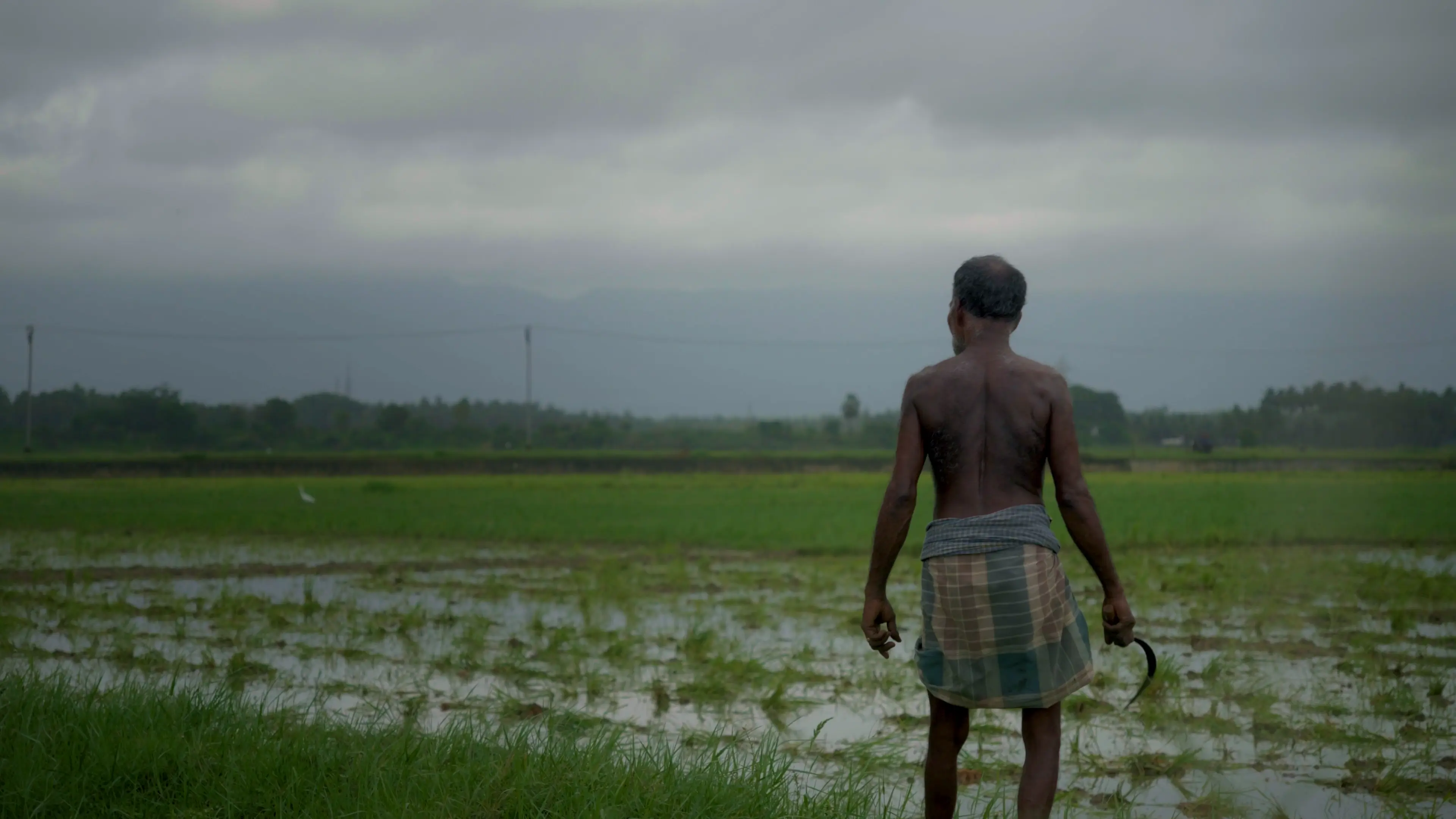
Project developers are often start-ups putting their own funds or that of an investor into the project and waiting 3-5 years without any revenue. As far as carbon credits are concerned, farmers and project developers exist in a symbiotic relationship. Without farmers adopting the practices, there are no carbon credits and consequently no reason for the project developer to exist. But without the project developer or carbon market, the farmer has no chance at that additional income. How, then, can these projects receive funds when they most need it?
Also read: Plastic is key to food packaging. Who should bear its responsibility?
Potential fixes
Cariappa outlines three possible routes that can be explored. First, securing investments from banks and non-banking financial companies (NBFCs). But he admits that the agricultural carbon markets are too nascent to draw in ready investors.
Naturally, the farmer is more vulnerable than any other stakeholder in this scenario: they are the ones bearing the most risk—of yield, weather, markets and prices—by changing their practices.
An emerging solution to this has been offtake agreements. Here, a company commits to purchasing credits at the outset of the project. The agreement becomes a guarantee against which funds can be raised. It also brings greater rigour into the implementation process, driven by the buyer's expectations.
Offtake agreements are the route with most activity in India right now, with the Varaha-Microsoft and the The Good Rice Alliance-Amazon agreements signed earlier this year; both being closely observed as emerging models in India's agricultural carbon markets.
Cariappa shares that buyers can also control other attributes of the project while entering the agreement, including how inclusive it is. This has the potential to balance out the current tendency of these projects to choose farmers from privileged castes and larger landholding.
In the meantime, governments can lend support by tapping into existing staff and extension systems, and providing the manpower needed by these projects. Companies can finance Krishi Vigyan Kendras (KVKs) and utilise their services to collect data, touch base with farmers at regular intervals etc.
Currently, the agricultural carbon markets are still finding their footing. Projects take significantly longer to get registered in India than in other parts of Asia. Even globally, it is a sector that sees the most number of projects being put on hold or rejected. Project financing is not yet streamlined, and offtake agreements, while promising, cannot be the sole financing mechanism companies rely on. "Until and unless there is some formal mechanism of co-financing outside the offtake agreements, it's difficult for the project developers to even sustain," Cariappa concludes.
Also read: Food miles: The cost of ingredients from a land far away
{{quiz}}
.avif)

.avif)
Explore other topics
References