As the saffron economy unravels, Kashmir’s women stand to lose
Climate change and a steep decline in production affects women who work in the fields, as well as those who play key roles in trade


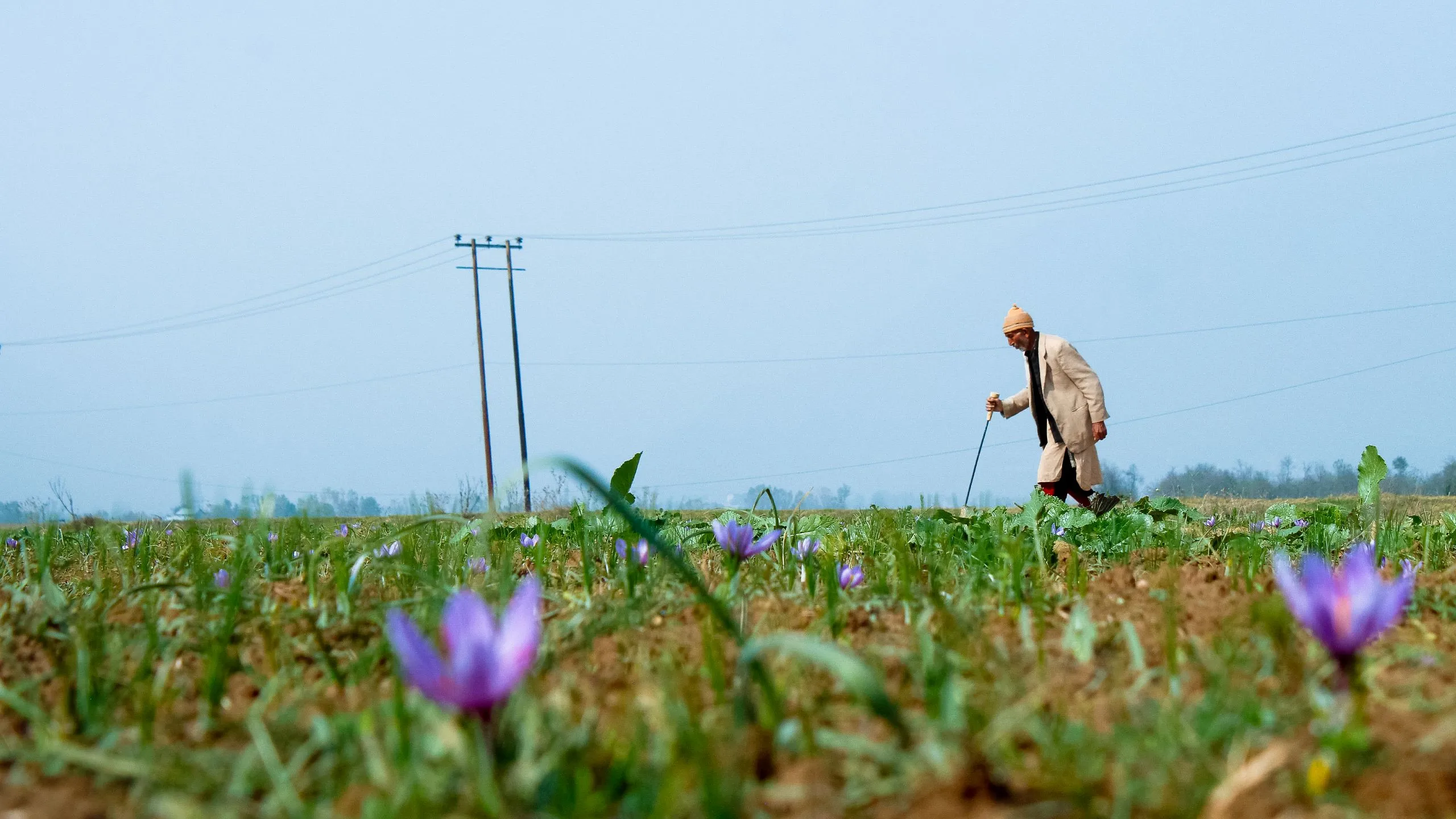
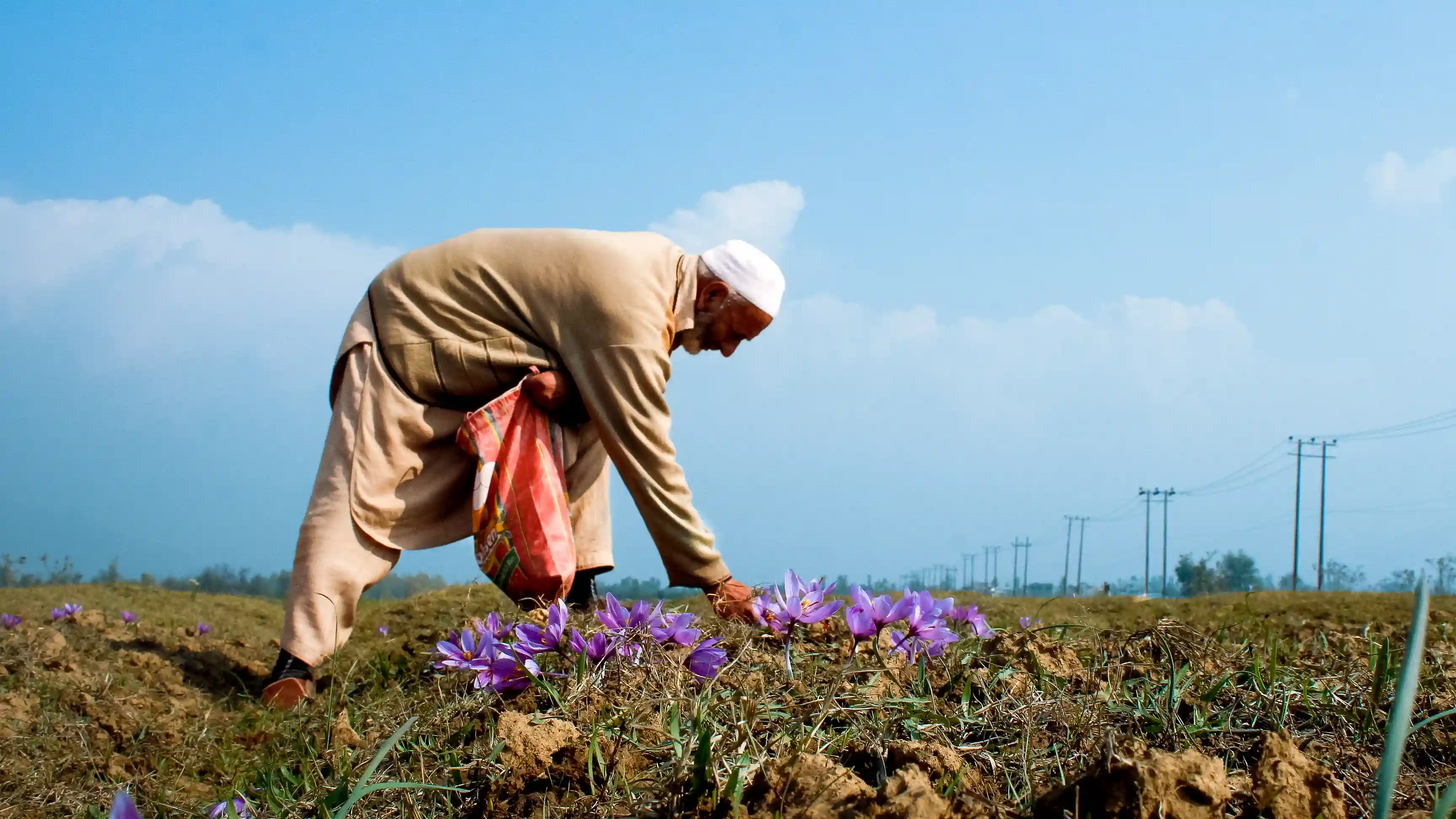
Every morning, Hajra Begum visits her saffron fields in Lethpora, in Jammu and Kashmir’s Pulwama district. The 56-year-old religiously plucks out the weeds from the earth that may threaten the growth of the precious spice. Lately, she has monitored another intruder in the fields: a porcupine.
Begum is one among many farmers worried about the fate of this age-old crop. Kashmir's saffron belt Pampore and nearby areas have seen a sharp increase in porcupine incursions. Experts claim that the destruction of the large rodent’s natural habitat by cement factories and mining sites has forced them to move towards the plains.
The land lost to porcupines eats further into the holdings of saffron cultivators.
These farmers have watched their fields rapidly shrink due to climate change. Prof. Mir Ghulam Hassan, Chief Scientist at the Saffron Research Centre (IIKSTC), Dussu, says, “We have been witnessing rain deficits and snowless winters that are affecting saffron production… This past winter, too, there was very little snowfall. There’s a high possibility of lower production again.” These weather events specifically damage saffron corms—round, onion-like bulbs that grow under the surface of the soil, and store the energy that the Crocus sativus plant needs.
According to the 2011 Census, nearly 16,000 families in the area depended on saffron cultivation for their livelihoods–a sector that employed over 11,000 women in Jammu and Kashmir.
Along with extreme weather events, it is fluctuations in climate, too, that have a bearing on the crop. “Abrupt, heavy rainfall is followed by a sharp increase in temperature in recent years. These weather variations create favourable conditions for the growth of fungi on saffron corms, and cause them to rot. Farmers often do not realise the damage until the harvest season, when the fungi have already destroyed the crop,” Prof. Hassan explains.
“In the past, we had more than two hectares of land under saffron cultivation. I used to earn over Rs 8–9 lakh annually. Now, only four kanals (0.20 hectares) of that land remain,” Begum rues. Until a few decades ago, saffron farming was the main source of income for Begum‘s family. In 2003, her husband was diagnosed with kidney failure, and the responsibility of supporting the family fell on Begum. “I was able to educate my four children and afford medical care for my husband because of my saffron fields. Now, breaking even on production costs is difficult,” she says.
According to the 2011 Census, nearly 16,000 families in the area depended on saffron cultivation for their livelihoods–a sector that employed over 11,000 women in Jammu and Kashmir. But cultivation has been in decline since the turn of the century, prompting farmers to shift to other profitable crops like apples. And though apples have provided a safety net, the women who were dependent on saffron have lost out on their individual incomes.
A crop that demands love and attention
Interestingly, the spice isn’t grown from a seed. This perennial crop slowly erupts from the corm, which the farmers dig up, divide, and replant directly into the soil. Before planting, the farmers plough their fields for a year or more, letting the soil loosen and absorb nutrients. The corms then go into the earth in July, until September–sometimes even the beginning of October–then lie dormant through the dry Kashmir summer.
As long as its lifespan is, so rare the revered spice born of it: each flower gives just three delicate crimson stigmas.
As the winds chill, in a small flowering window in October and November, the corms send up thin, purple flowers. Generally, the crop needs little irrigation, being sensitive to water; the rains from August to November are crucial to its growth. Manual irrigation is recommended post sprouting, right before flowering, and then right after.
A single saffron plant can keep producing for years: corms can be productive for up to 15 years. But as long as its lifespan is, so rare the revered spice born of it: each flower gives just three delicate crimson stigmas. These are then hand-plucked—making saffron one of the most laboriously harvested spices—and dried.

A backbreaking, unstable livelihood
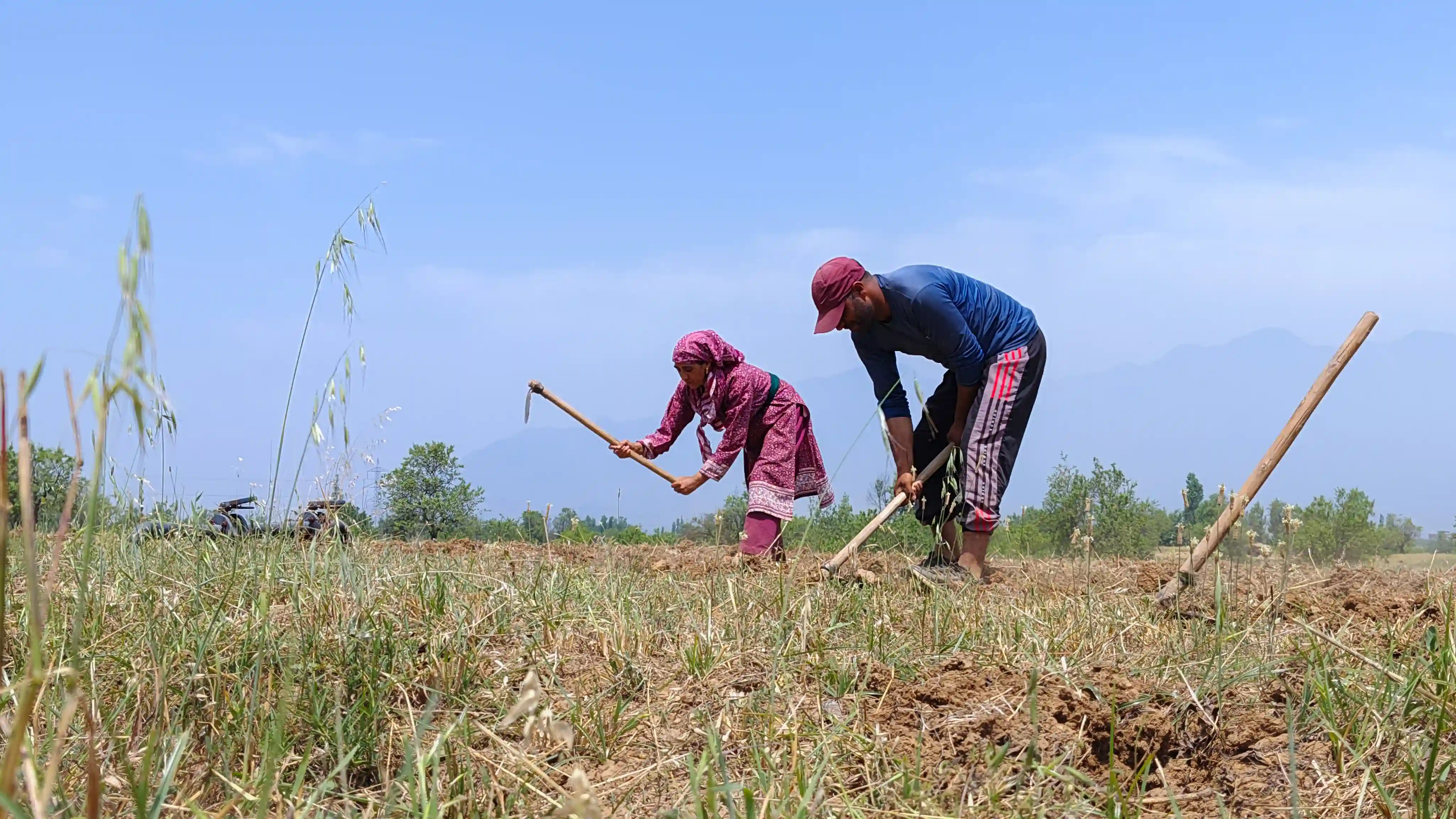
Traditionally, women have formed the backbone of Kashmir's saffron industry. A 2026 study by the Sher-e-Kashmir University of Agricultural Sciences and Technology, Kashmir (SKUAST-K) found that women account for 70% of labour–planting the corms–65% of weeding activities, 80% of harvesting, and 75% of post-harvest processing in saffron cultivation.
The first de-weeding, which involves digging the entire field, starts in the first week of June. The second begins between August and September, just a few months before the saffron starts flowering. The women in the household work shoulder to shoulder with men.
Once the crop blooms in October through November, farmers bring their entire families to the fields to pluck the purple flowers. Farooq Ahmad, a 48-year-old, fifth-generation saffron grower, says that the production used to be so high that they either sought help from neighbours and returned the favour when their neighbours undertook harvest in their fields, or they would employ women from landless households (The wages for these labourers range from Rs. 500 to Rs. 700 per day). The same women also participated in the next phase of the harvest: carefully, tenderly picking the stigmas from the flowers—the orange threads that impart both colour and flavour to food. Ahmad says, “If we happen to employ labourers in the fields, we pay them in cash. Traditionally, we used to pay local women with saffron for their work, but that is now unimaginable."
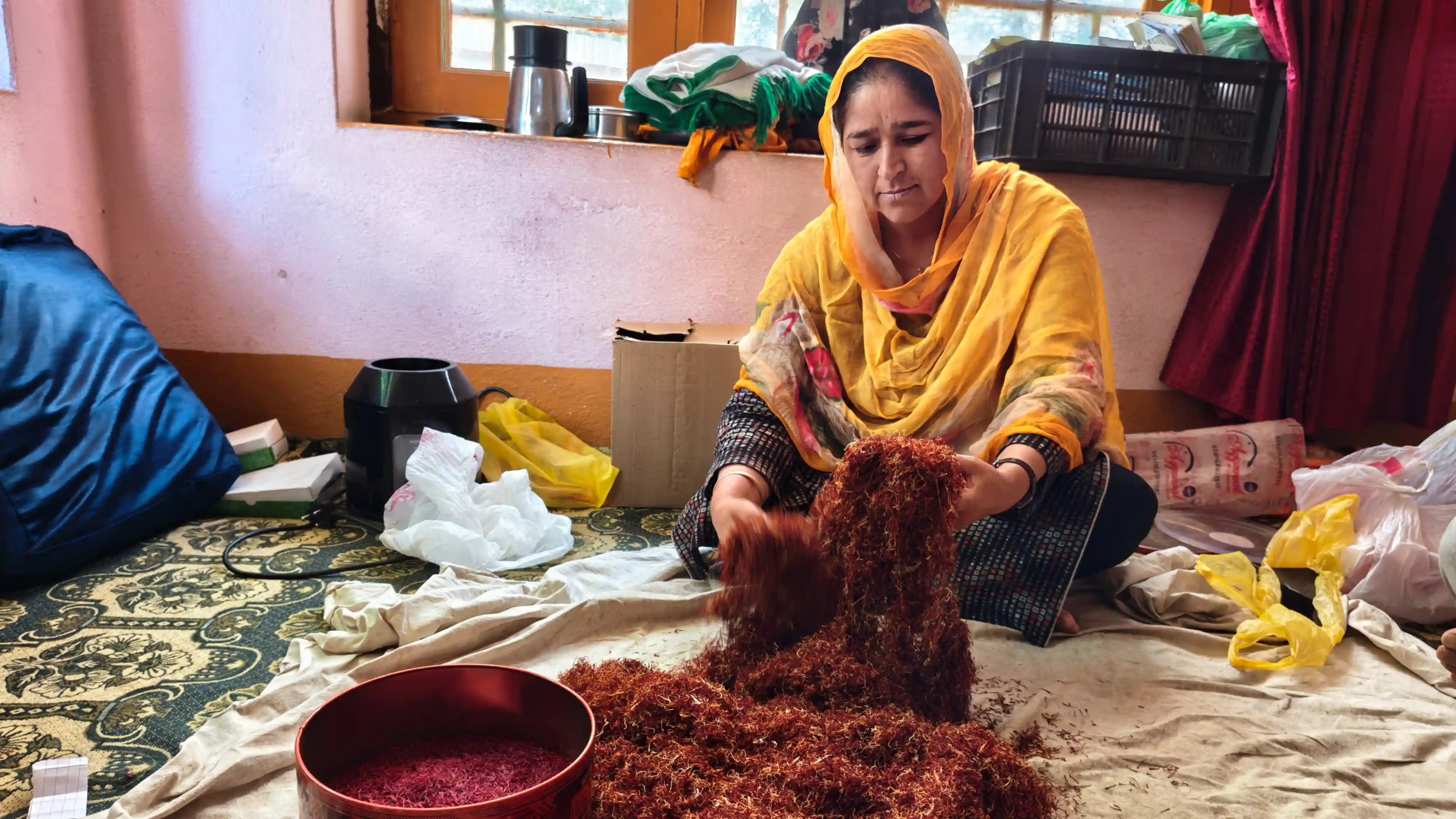
In the face of few employment opportunities, saffron farming was the only source of livelihood for Shaheena (name changed upon request), a 50-year-old resident of Meej, a village that borders the Pampore town. Working in the fields as well as helping the farmers with plucking and post-processing usually provided her with work for over three months. In the winter, Shaheena would engage in carefully extracting the saffron stamens from the petals, known locally as paet—the pollen-bearing, yellow male reproductive parts—which fetched women like her between Rs. 50 and Rs. 100 per 10 gm. The bright paet strands are used in Ayurvedic medicines, and even as natural yellow dyes. Shaheena recalls, “I used to earn Rs. 400–500 a day working in the fields.”
The work in the saffron fields enabled her to take care of her and her children’s expenses.
She owns a very small piece of farmland with her husband, who was a daily wage worker; here, they cultivate vegetables for their own sustenance. The work in the saffron fields enabled her to take care of her and her children’s expenses. “Now, there is no work left for me. The farmers mostly do it all by themselves, or they use motor tillers to save on labour costs,” she explains.
Now, Shaheena mostly stays at home. “I have two sons who work as masons; they take care of all my needs,” she says.
The unravelling of women’s work—and networks
Jammu and Kashmir is reported to have received only 49.8% of its normal precipitation between October 2024 and February 2025. During the corresponding period from October 2025 to February 2026, precipitation stood at just 45.6% of normal levels. “Thirty years ago, farmers used to give more huss posh—the share of saffron produce given to the women in the families after the peak bloom—than the total production many farmers can achieve today,” observes Ahmad, as he monitors labourers working in his field. Last year, his production—a total of only 30 gm—declined by 80%, in contrast to quantities of 300 to 400 gm in the past. “The crop failed due to drought-like conditions,” Ahmad explains, “There is no alternative irrigation facility available to farmers.”
The impact is also felt by local trade networks that women once occupied. Shakeela Banu, 45, a resident of Khrew near Pampore, has been running a saffron firm for the past two decades. She goes door to door, purchasing saffron directly from farming families. One of the few women in the spice’s trade business, Banu occupied a unique position, as a solid confidante for female farmers, and a source of hope in times of distress and need.
“I used to buy all the saffron from the women in one season,” Banu says, wryly. “Not a kg or two; I used to buy 20-25 kg from over 70 to 80 women,” she adds. In the golden days of her business, she recalls buying at least 2 kg every day and selling it in the market. “The business was lucrative. I was able to build a house and send my children to private schools.”
In present times, she can scarcely source 500 gm from farmers in an entire month. “None of the women I used to buy from have enough saffron to sell for in order to earn a disposable income,” Shakeela says. Tragically, villagers speaking to this reporter estimated that only four out of 500 families in Khrew continue to farm saffron.
Naseema, another resident of Khrew, remembers the time spent in her family’s saffron fields. “It used to take us days to collect the flowers. The process itself was a social activity that allowed me to meet friends whose fields bordered ours,” the 46-year-old says.
“None of the women I used to buy from have enough saffron to sell for in order to earn a disposable income”
All of their land is now barren. Her family followed new farming practices as reportedly advised by the Department of Agriculture under the National Saffron Mission; this included sowing seeds 6-8 inches deep into the soil, instead of the typical logic of burying them a few inches deeper. They observed the more intense impact of the heat wave on these shallowly sown seeds, in addition to crop failure owing to delayed rain. “During the first season, more flowers bloomed than normal, but in the second year, we found our land ruined… few saffron flowers here and there, and then nothing,” Naseema says.
When the yield was more generous, Naseema could expect to earn Rs 50,000 and Rs 70,000 for a little over a kilo of paet. The yellow-coloured stamen comprised a major chunk of income for women like her—an income that has entirely vanished. “Since the saffron production is very little, the farmers keep both the saffron strands as well as the paet for themselves,” Banu says.
Also read: Climate change in my cup: Why India’s cocoa and coffee production is at risk
Encouragement falls short
In 2010, the central government launched the National Saffron Mission to encourage growers to pursue standardised saffron farming, aimed at increasing yields. More than Rs. 400 crore was sanctioned under the scheme, including provisions for financial assistance and irrigation infrastructure.
In 2020, Kashmiri saffron was granted a Geographical Indication (GI) tag to strengthen its market identity. A spice park, India International Kashmir Saffron Trading Centre (IIKSTC), was constructed at Dussu to aid farmers with post-production. The facility is reportedly equipped to process, dry, grade, pack and e-auction the spice.
In 2020, Kashmiri saffron was granted a Geographical Indication (GI) tag to strengthen its market identity.
In 2022, the Department of Agriculture issued a notification banning the sale of saffron corms outside the union territory. Suhail Inamullah, Technical Officer at the Directorate of Agriculture, Jammu and Kashmir, explains that this ban was aimed at keeping the prices of seeds in check, ensuring that they remain available and accessible to farmers.
Amid disastrous climate events, the mass exit of farmers from saffron farming, and the lack of robust data, figures concerning land under cultivation and production remain disputed.
Also read: The fragile future of Guchi mushrooms
Corms leaving the Valley
“A 100 kg of saffron corms now cost between Rs. 1.5 lakh and Rs. 2 lakh. No farmer can afford seed at that price,” says Abdul Majeed Wani, President of the Jammu & Kashmir Saffron Growers Association. The rise in price is evidenced by the fact that farmers used to buy the same amount of corms for one-tenth the cost in the past; this steep rise is attributed to a decrease in availability of corms, as well as the increased demand from indoor units across India, which employ aeroponic or soilless systems agriculture techniques to grow the spice, typically outside the Valley where the weather conditions aren’t otherwise feasible.
Wani advocates for the development of corm nurseries by the government, so that farmers who want to revive cultivation can access planting material at affordable prices.
Despite restrictions, growers say corms continue to leave the Valley through road transport networks. “The responsibility also lies with farmers. It is difficult to stop illegal exports when growers can earn significant profits through illicit means,” the Directorate of Agriculture’s Suhail Inamullah says.
Amid uncertain climate conditions, rising production costs, and weak policy support, many women still hold on to the hope that Kashmir’s red gold, and their livelihoods, can survive.
Also read: The perilous future of Kashmir’s once-abundant trout
Edited by Anushka Mukherjee and Neerja Deodhar


Explore other topics
References