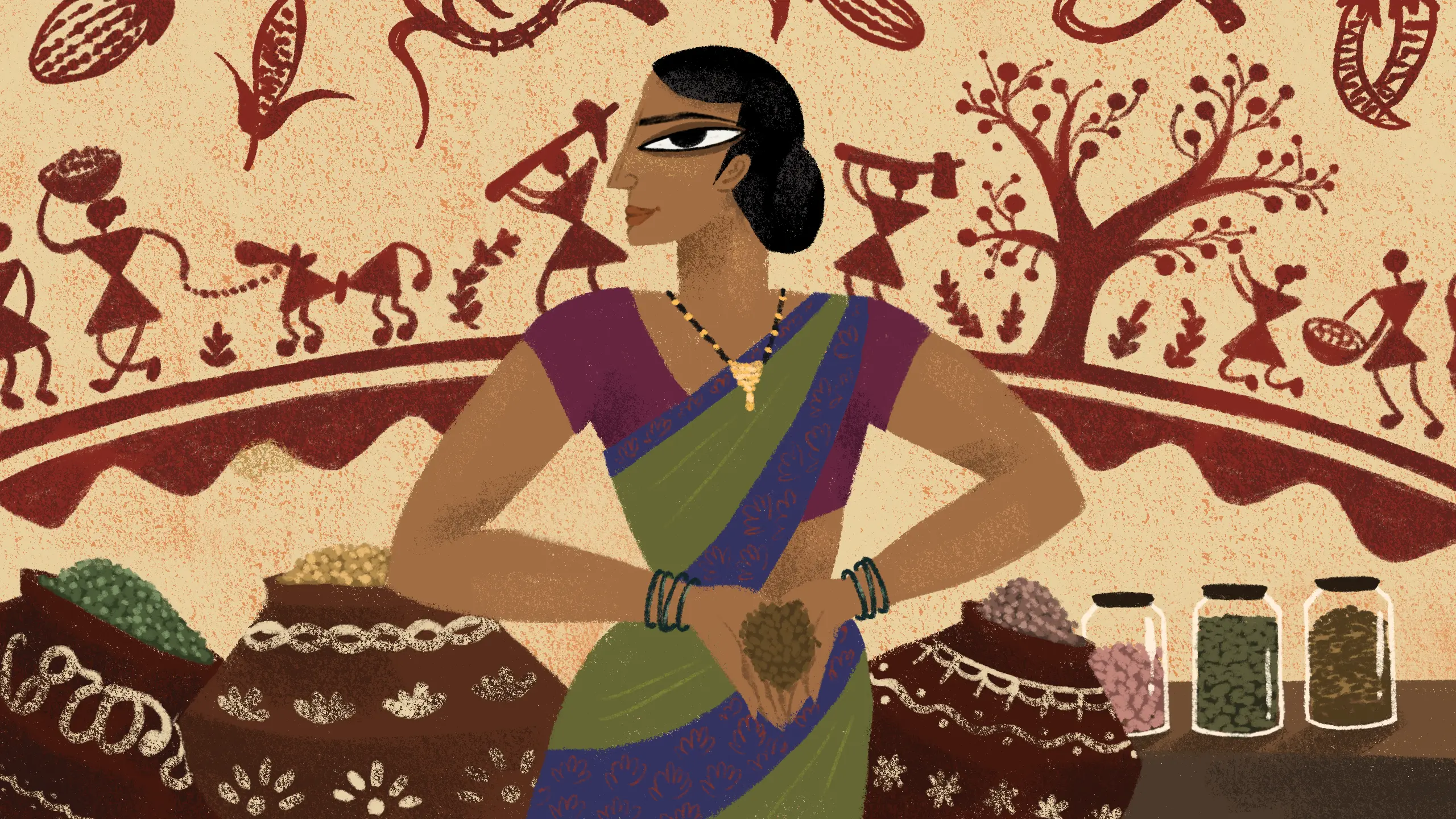
Bibijan Halemani dared to dream—of millets, and a better world for women
Halemani’s award-winning self-help group in Karnataka runs a seed bank and instills new confidence in millet cultivation


Editor's note: Every farmer who tills the land is an inextricable part of the Indian agriculture story. Some challenge convention, others uplift their less privileged peers, others still courageously pave the way for a more organic, sustainable future. All of them feed the country. In this series, the Good Food Movement highlights the lives and careers of pioneers in Indian agriculture—cultivators, seed preservers, collective organisers and entrepreneurs.
On a Sunday morning in September 2025, in Teertha—a small village about 30 km from Karnataka’s Hubli region—Bibijan Halemani makes her way home. A man sitting near a corner store asks her, “Will you buy mekke beeja (maize seeds) this time?”
Before she can respond, another man has a ready answer: “They have won a prize. She can.” Halemani smiles and continues walking.
“People are talking about the prize now, but until recently, they had little faith in our self-help group (SHG),” she says. The prize she speaks of is the Equator Initiative Award, won by the Bibi Fatima Self-Help Group for community-led biodiversity conservation, meaningful work in food security, and creating jobs for marginalised women.
“Recognitions like these make it difficult to dismiss our [women’s] work,” she says. However, it isn’t the first one. In the last seven years, the SHG has received several recognitions; of these, the one that first changed the way people looked at them was Deccan Herald’s Changemakers Award in 2023.
As the 40-year-old reaches the SHG’s community seed bank, started in 2018, which is next to her house, two sparrows are chirping around in the verandah. “You’ll always find sparrows here. They love seeds.” As she opens the door, the birds rush in, happily flying in circles near the roof.
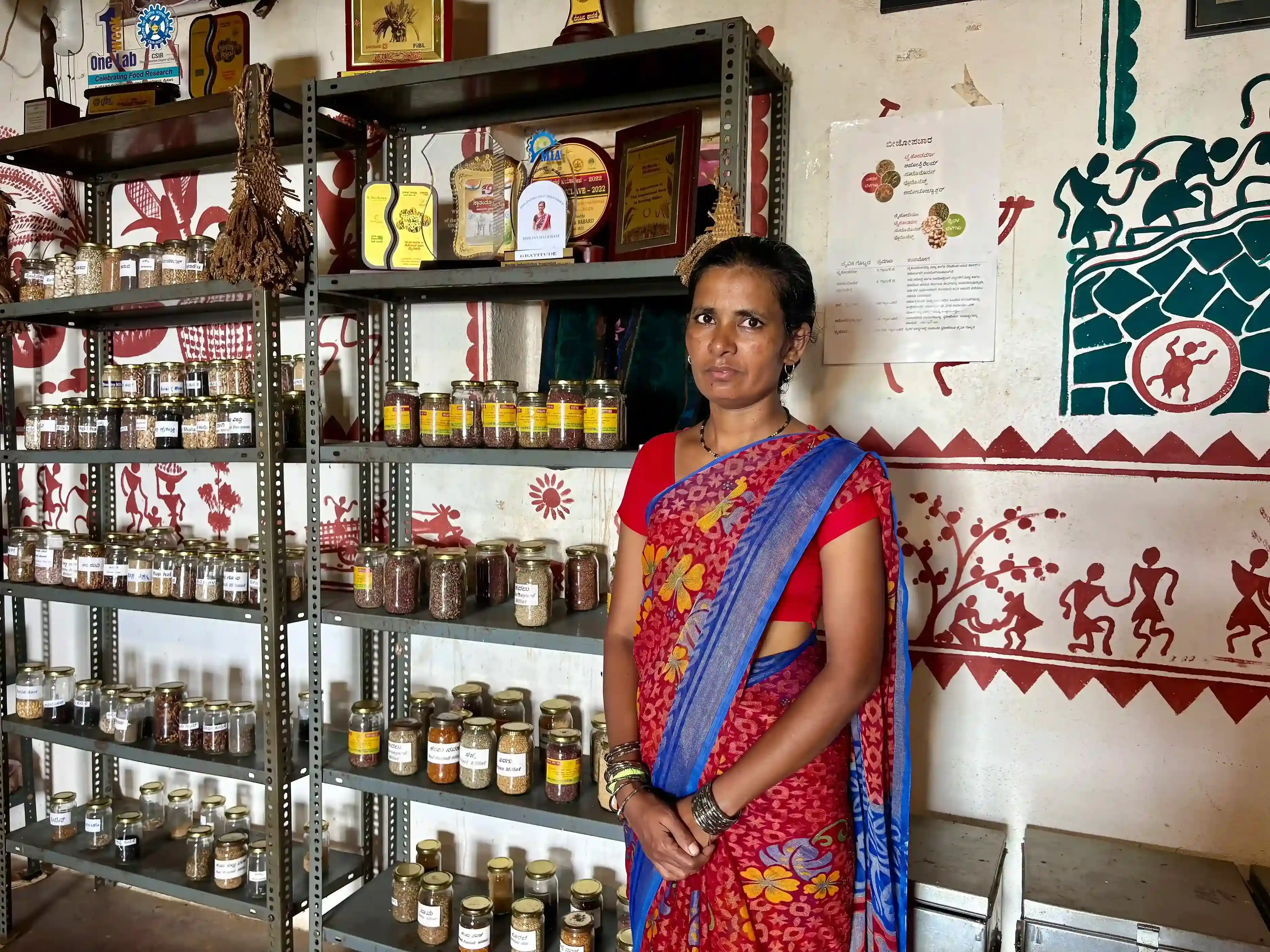
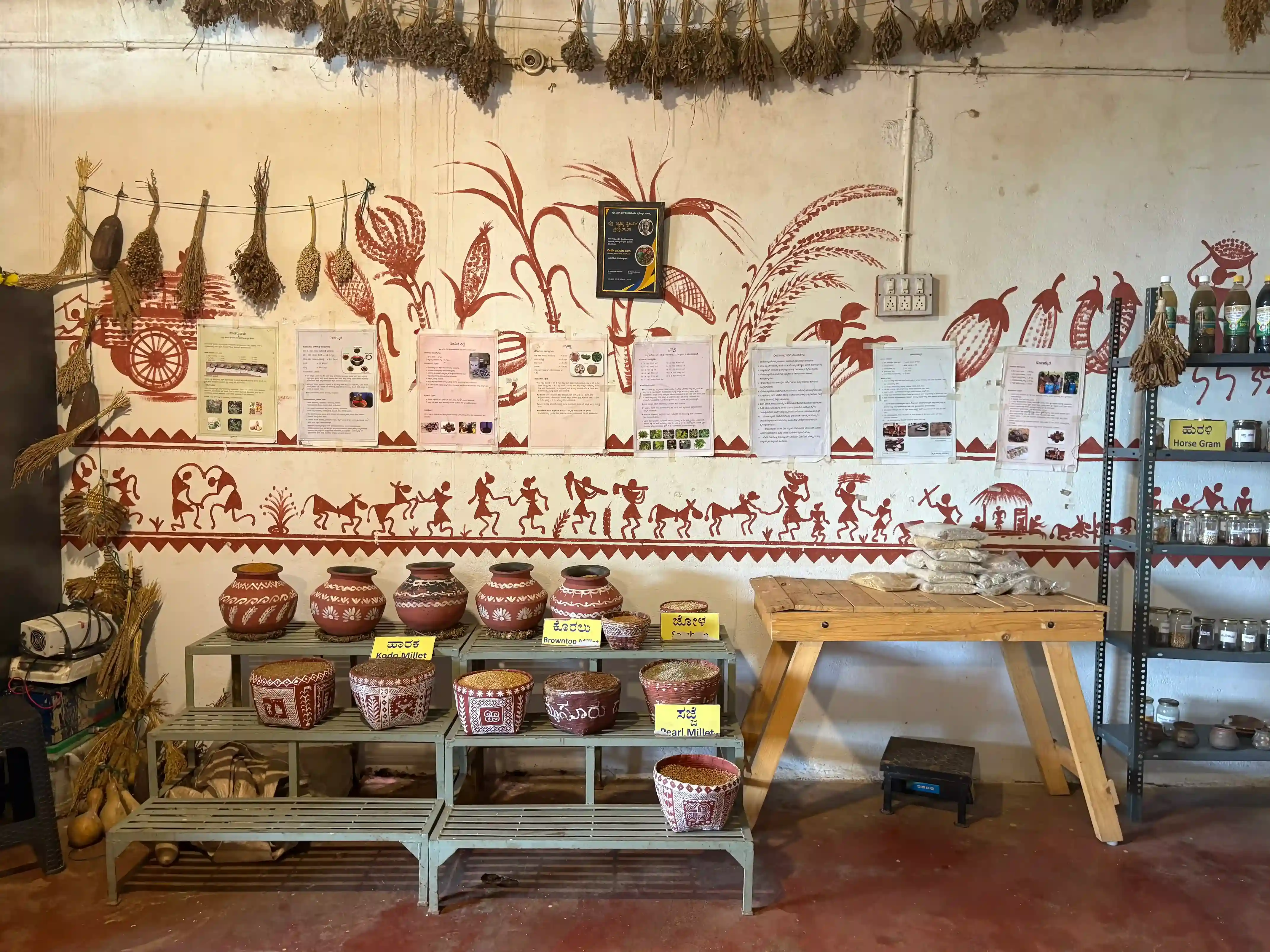
With earthy-red hand-paintings across the white walls and millet husks all around, the seed bank stands out from the line of houses surrounding it. Near the entrance, three rows of baskets full of millets—from the popular kodo and foxtail, to the lesser known browntop–greet us. Next to them, some millet foods such as sevai (vermicelli noodles) and beaten millet rice flakes are displayed on a wooden table where Halemani keeps tea and snacks for visitors. As we enter, the wall opposite the door is lined with various colourful seeds and millets in small glass bottles, along with the awards that the SHG has won.
Within ten minutes of meeting Halemani, three phone calls have already interrupted the conversation. Her busyness is also reflected in her way of talking: fast and to the point. But life wasn’t always like this for her, she recalls.
“About 20 years ago, if someone had told me this is what I will be doing, it would be a little surprising,” she says. For Halemani, ambition came with constant reminders of her gender identity. “The women in my family didn’t really have the option to study a great deal, or work—or even step out of our homes,” she says. Today, her work routinely takes her far away from Teertha, her hometown and address after marriage, to Delhi and Maharashtra.
The catalyst
A ghost ship, carrying dreams of a different life, often makes its presence felt in Halemani’s world. In her late teens, she developed a deep interest in politics and social work. “I just wanted to do something for society,” she says softly. When she completed her degree in Politics, Hindi, and English, her sole focus was on doing a Bachelor’s in Education to fulfil a dream she had stubbornly kept alive. “I always wanted to become a teacher,” she says.
Although acutely aware of the restrictions that had always been imposed on her, she hoped that this could be possible. However, her parents saw no point in further education or work, and got her married off as soon as she turned 20.
For Halemani, ambition came with constant reminders of her gender identity.
In 2004, soon after her wedding, Halemani tried to chase after this dream and applied to become an Anganwadi teacher in her village–despite a lack of any support. “But people in my village were opposed to my application, likely driven by internal politics and a bias against educated women. They made sure the position went to a woman from another village. After that, I gave up on the idea,” she says.
After marriage, her movement and access to public spaces shrunk further. Her days mostly revolved around cooking for many, tending to the cattle, and making manure out of cattle dung. During this time, she observed farming more than ever before—from what people chose to cultivate, to the problems farmers faced. One such observation was the disappearing presence of millets from plates and fields. “After 2007, not many were growing millets. Farmers were switching to maize, cotton, and rice,” she says.
In 2017, when the NGO Sahaja Samrudha came to her village to talk about farming challenges, men and women were both encouraged to come to the meeting; this marked her introduction to sustainable farming. “They noticed that women were more active and vocal during the meeting, and approached us with the idea of a self-help group focused on promoting millet farming,” Halemani explains. Seated next to baskets of millet grains, she adds, “It changed our lives.”
Also read: In Leh’s harsh terrain, farmer Urgain Phuntsog is a true ‘mitti ka aadmi
Charting a new course for women
Halemani and 14 other women from Teertha came together to form the Bibi Fatima Self-Help Group in 2018. This was uncharted territory for them all. “People don’t have much land here. Some women would travel to faraway places to earn money. A few from our SHG used to catch a bus at 6 in the morning on chilly, winter days to wash utensils at a resort for just Rs. 300 and return only in the evening. They would fall sick, but still work,” Halemani says.
For years, Teertha’s women tried to find different sources of income. “We have to work constantly,” she says. In 2004, a few women, including Halemani, started an SHG to put aside a portion of their earnings and save it for a rainy day, but it had limited success, and they had to close it three years later.
When the Bibi Fatima SHG was formed, for the very first time, the women had guidance and mentorship. They didn’t really know much about biodiversity conservation or food security, but through training programmes organised by Sahaja Samrudha, they started connecting their lived experience and observations with scientific knowledge.
When the Bibi Fatima SHG was formed, for the very first time, the women had guidance and mentorship.
The initial years also brought scepticism and stigma, as members of the SHG were often scoffed at. “If I carried a shoulder bag, some people would mock me, saying that I am ‘showing off’ my work. Now the same people are congratulating us,” Halemani says.
In particular, she remembers how disrespectfully the women were treated at a local bank when Halemani and her peers wanted to apply for a bank account for their undertaking. The manager, peeved at Halemani for taking a phone call, mocked her—an anecdote that resonates with many women, especially those who aren’t educated, and who feel hesitant to enter banks.
Also read: How Rahibai Popere built a seed bank with a mother’s grit and love
An SHG with a far-reaching impact
“Siridanya (millets) are not new to us. We have been exposed to them even as children, but I didn’t know of their benefits to health or the environment. Now, I am able to talk to others about millets and make them aware, too,” Halemani says with a smile—the first in this conversation.
Most farmers in and around Teertha had long left behind millet cultivation by the time Sahaja Samrudha put forth its idea. “Farmers were not finding it profitable. The process of cleaning millets after harvests was an issue for many,” she says.

The situation in Teertha was a microcosm of what was underway across Karnataka. By 2017, the abandonment of millets became a growing issue spurring state-wide concern. During the All-India Co-ordinated Project on Small Millets in April 2017, H. Shivanna, the Vice-Chancellor of the University of Agricultural Sciences, Bengaluru, said that over the preceding decade, Karnataka had lost nearly 2.5 lakh hectares of millet-growing fields to acacia and neem. He added that 40% of the area that was under millet cultivation had been replaced by horticultural crops, which meant that the state had just about 9.5 lakh hectares dedicated to growing millets.
Where once millets had disappeared from the fields in and surrounding Teertha, in present times, farmers are cultivating them across about 2,000 acres of land.
To address this gradual decrease, and after consecutive droughts between 2013 and 2017, the Karnataka government focused on reviving production. They also organised awareness programs and promotion campaigns in and around Bengaluru. In 2017, the National Organic and Millets Fair was held to bring together stakeholders in millet production and to connect farmers to markets. The government also pushed for 2018 to be declared as the ‘National Year of Millets.’
However, when it came to rural Karnataka, it was SHGs such as Halemani’s that heralded millet production. The Bibi Fatima SHG took flight in 2018. In the first two years, the women went to different taluks around Teertha to visit farms and meet farmers, explaining the cost benefits that come with growing millets and informing them of training and welfare schemes on offer. A particular advantage of growing millets is the crops’ ability to adapt well to different environmental conditions, especially changing monsoon patterns—a change that farmers are taking notice of. “In recent times, it rains heavily during the non-rainy season, and we barely get rain when we are supposed to,” Halemani says.

Yet, farmers remained sceptical. They wouldn’t come to the meetings or show much interest. The SHG then started giving farmers Navdanya kits–free packs provided by Sahaja Samrudha that consisted of nine kinds of millets that can be grown in a one-acre field. Gradually, more farmers showed a willingness to experiment.
As awareness grew and millet cultivation became more lucrative, more farmers joined the group. “We started with 20 to 25 farmers, but now we have a network of 5,000,” she says. This growth has largely been the result of the sharing of personal testimonies and success stories. Where once millets had disappeared from the fields in and surrounding Teertha, in present times, farmers are cultivating them across about 2,000 acres of land.
Change begins at home
To address the gap between harvests and processing—the cumbersome cleaning of the grains—the SHG set up a millet processing unit in Teertha in 2022, with the help of Sahaja Samrudha, the Indian Institute of Millets Research (IIMR), Hyderabad, and CROPS4HD–an international project set up to transform food systems. The unit is run completely by the women. The SELCO foundation also provided them with solar power for their unit, which helped them manage their electricity expenses. The Millet Foundation, Bengaluru, trained the women in operating the unit, where they now earn Rs. 500 for each day of work.
Halemani gets up to reach for the millet baskets, holding a few grains of the browntop millet—small and polished, shining soft-golden in the light. “See, it has to be cleaned and properly processed for it to look like this,” she says. Processing is crucial in removing the inedible parts and increasing the bioavailability of nutrients. “Once we collect the seeds from the farmers, germination determines their quality. Those that germinate at least 80% are stored as seeds in the bank, and the rest are processed to make millet rice,” she explains.
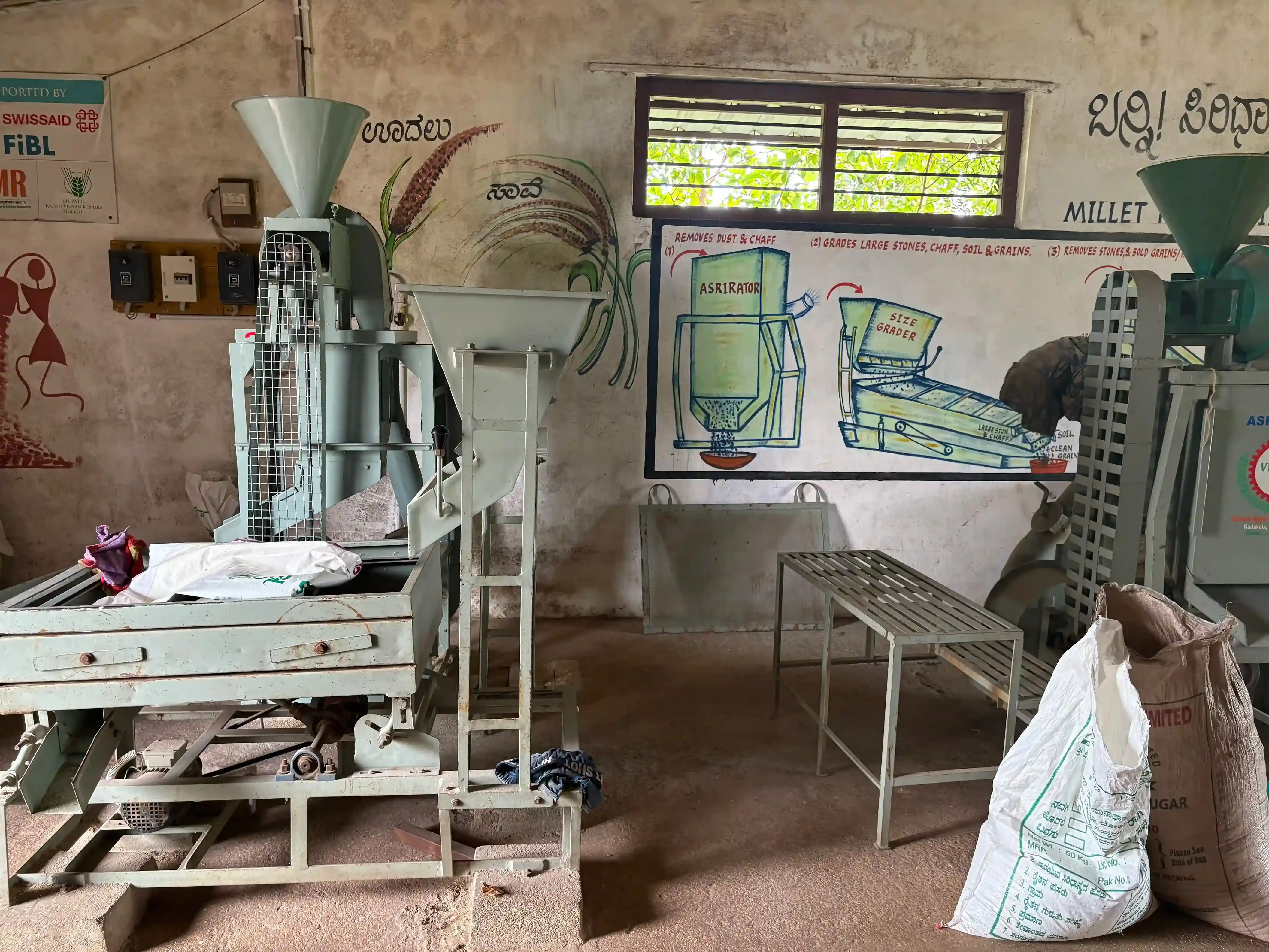
Farmers from about 15 villages get their grains processed at the SHG’s unit, where small quantities are undertaken for farmers’ consumption, as well as purchases in bulk for the market. In 2024, about 50 metric tons of millets were processed. The most palpable impact of this ease of processing is an increase in the household consumption of millets, Halemani says. “When we started, no one in our village was eating millets, but now at least 25% eat millet rice daily,” she adds.
To expand their reach, 53 SHGs came together in 2023 to form Devdanya Farmer Producer Company, a farmers' producer organisation (FPO) which is co-led by Halemani. About 500 individual farmers from the Kundagol and Shiggaon taluks are part of this initiative. In its first year, the FPO registered an annual turnover of Rs 58 lakh. After excluding all expenses and paying taxes, it made a profit of over Rs 1.4 lakh. “In 2024, our annual turnover increased to Rs. 1.5 crore,” Halemani shares.
While Devdanya was set up to promote millet products such as health drinks, sevai, and rice, it was also intended to remove the middlemen between farmers and markets. “The rate for millets is set by middlemen, and if these rates are too low, farmers are disincentivised from growing these crops. Through Devdanya, we buy the millets, help farmers process them, and ensure they have enough for household consumption.”
Also read: Babulal Dahiya makes every grain of rice count
Community seed bank to the rescue
Building a community seed bank has been a core project of the SHG since its very inception. When they were looking for a place to set it up, Halemani offered the space next to her house, which belongs to her family. “After about a year of creating awareness about sustainable farming and distributing Navdanya, we began to receive seeds in return. If we gave 10 kg of seeds, the farmer had to give us 20 kg back. That’s how the community seed bank started,” she says.
Initially, it received only millets, but as the harvests expanded, so did the seed bank. Today, it is home to 350 varieties of millets, oil seeds and pulses. These include 74 varieties of ragi, 10 of foxtail millet, 25 of little millet, two of proso and browntop, one of barnyard and pearl each, as well as 25 varieties of pulses and 80 of vegetables. Currently, the SHG recognises 30 farmers as seed producers.
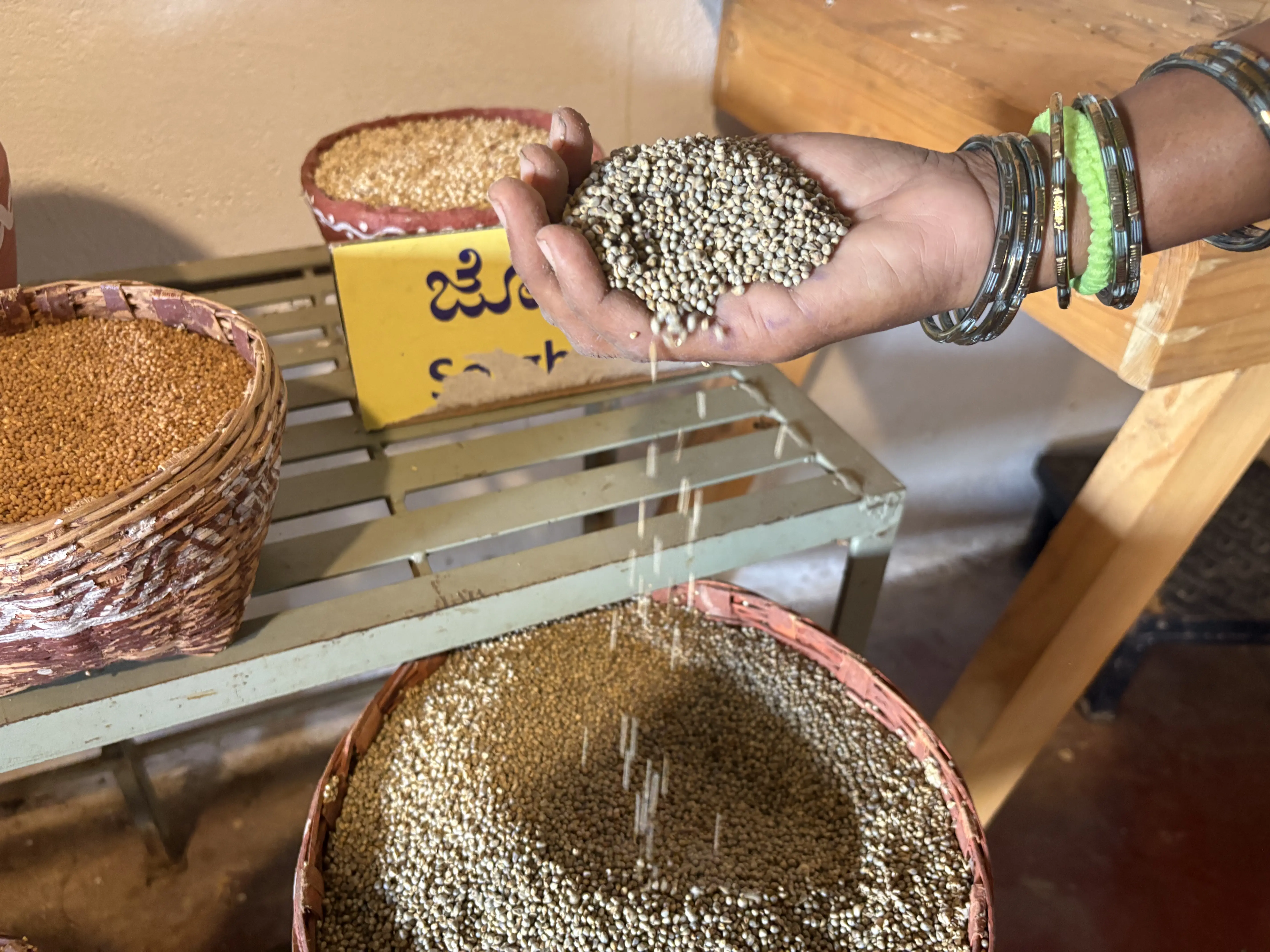
The core idea behind the seed bank, Halemani shares, has been to increase farmers’ access to indigenous varieties and provide them free of cost. They can usually find what they require here, depending on the season. With the climate crisis looming, the group has prioritised seeds which can withstand extreme environmental changes––mainly millets.
However, it hasn’t been an easy path for the SHG. Building a relationship with farmers was an exercise in time and patience. Sometimes, the SHG wouldn’t receive the seeds they had lent, and farmers would return millet seeds that wouldn’t germinate. “There were also times when we didn’t have the seeds that farmers needed, so we used our savings to buy them. There have been challenges, but isn’t that how life is?” says Halemani.
Though this may seem marginal, it is a triumph for a community-oriented seed bank in India, where farmers who run such institutions often rely on their own funds or meagre donations.
The community seed bank has been widely recognised for its focus on indigenous seeds, food security and the promotion of sustainable farming. “In 2024 we made transactions of up to Rs.14 lakhs, but in 2025, we made about Rs.10–11 lakhs because we faced some technical issues with the machines that processed millets ,” Halemani explains. They only make an estimated 10% of profit on their earnings, as they have to bear the cost of labour, rent and other expenses. Though this may seem marginal, it is a triumph for a community-oriented seed bank in India, where farmers who run such institutions often rely on their own funds or meagre donations.
Investing in women’s present and future
At around 1 PM, Halemani generously extends an invitation to join her family for lunch and refuses to hear anything other than yes. As we sit down, she first brings a plate of millet sevai, with milk and sugar on the side. It’s a simple, wholesome meal, popular in Uttara Kannada. The sugar is sprinkled on the sevai, and milk is poured on top. Then come rice, sambar and sandige (sun-dried fritters). “We eat jolada rotti (rotis made of sorghum), but I didn’t think they’d be familiar to you,” she says. As we dig in, another member of the SHG, who is also Halemani’s relative, joins us. “She was the first to be a part of the group,” Halemani explains, nodding towards Shehanajabi Halemani, 42.
Shehanajabi has made a living from tailoring for a long time, but considers working at the SHG as her first and primary job. “Since the SHG was established, there is some work or other which keeps us busy, so the opportunities to earn have increased.” Shehanajabi adds, “We also help farmers and the environment, so the work feels fulfilling.”
For many women in and around Teertha, dreams have felt like a luxury that they don’t have access to.
When asked if she had a dream for her life while growing up, Shehanajabi shrugs and smiles as she looks into the distance. For many women in and around Teertha, dreams have felt like a luxury that they don’t have access to.
As we make our way back to the seed bank after lunch, we are in the company of another SHG member: Prema Prabhakar Bollina, 28, who is with her two-year-old daughter. Bollina got married when she was a teenager and is now a mother to two children. “I wanted to study. I think I could have become a teacher,” she says, with a big smile that stubbornly stays on throughout the conversation. Before she joined the SHG in 2019 and began working at the seed bank, Bollina was a domestic worker. As one of the few women in the area who is educated, she largely works at the bank, undertaking administrative tasks like registering transactions. “Earning recognition has changed the way people look at us. It has also made us independent,” she says.
Earlier that day, Halemani proudly showed photographs of her children: a 20-year-old son, who is studying law, and an 18-year-old daughter, who is pursuing a paramedical degree. “Ever since they were children, I told them education is vital to make something of their life,” she says. Even as their own dreams may have been made inaccessible, Halemani, Bollina and other women in the SHG are fiercely protecting the aspirations of their children.
Edited by Neerja Deodhar and Anushka Mukherjee
Art by Jishnu Bandyopadhyay
{{quiz}}


Explore other topics
References