Urban heat islands: Sweaty cities made of rising skyscrapers, vanishing trees
Cities can be between 1-10°C warmer than surrounding rural areas, owing to the construction of tall buildings and use of concrete and asphalt


Welcome to the Good Food Movement’s Climate Crisis Dictionary—your online guide to environmental phenomena and the science behind them.
Urban Heat Island (noun)
Coined in: 1929
Coined by: Albert Peppler, German meteorologist (though amateur British meteorologist Luke Howard recorded the phenomenon as early as 1810)
TLDR: Urban areas in many parts of the world are becoming warmer than surrounding rural areas, because of the way urban infrastructure traps heat.
The longer explanation
The weather, or how hot it feels, is regulated by patterns of heat transfer within the Earth's atmosphere, largely through radiation and convection. It may help to know that everything, at all times, radiates heat (you included). What differs is how much heat is radiated, and in which direction. For instance, during the day, the heat coming from the sun is far stronger than heat emitted by the Earth’s surface. But during the night, the outgoing heat from the Earth's surface is greater, and warms the surrounding air. That's what keeps the Earth warm at night.
Convection transfers heat by directing the movement of air from warmer areas to cooler areas. Think back to the concepts of land breeze and sea breeze covered in geography class years ago—that is convection at work. The rising of warm air leads to cloud formation and rain. These clouds also intercept and reduce the radiation being received and emitted back by the Earth.
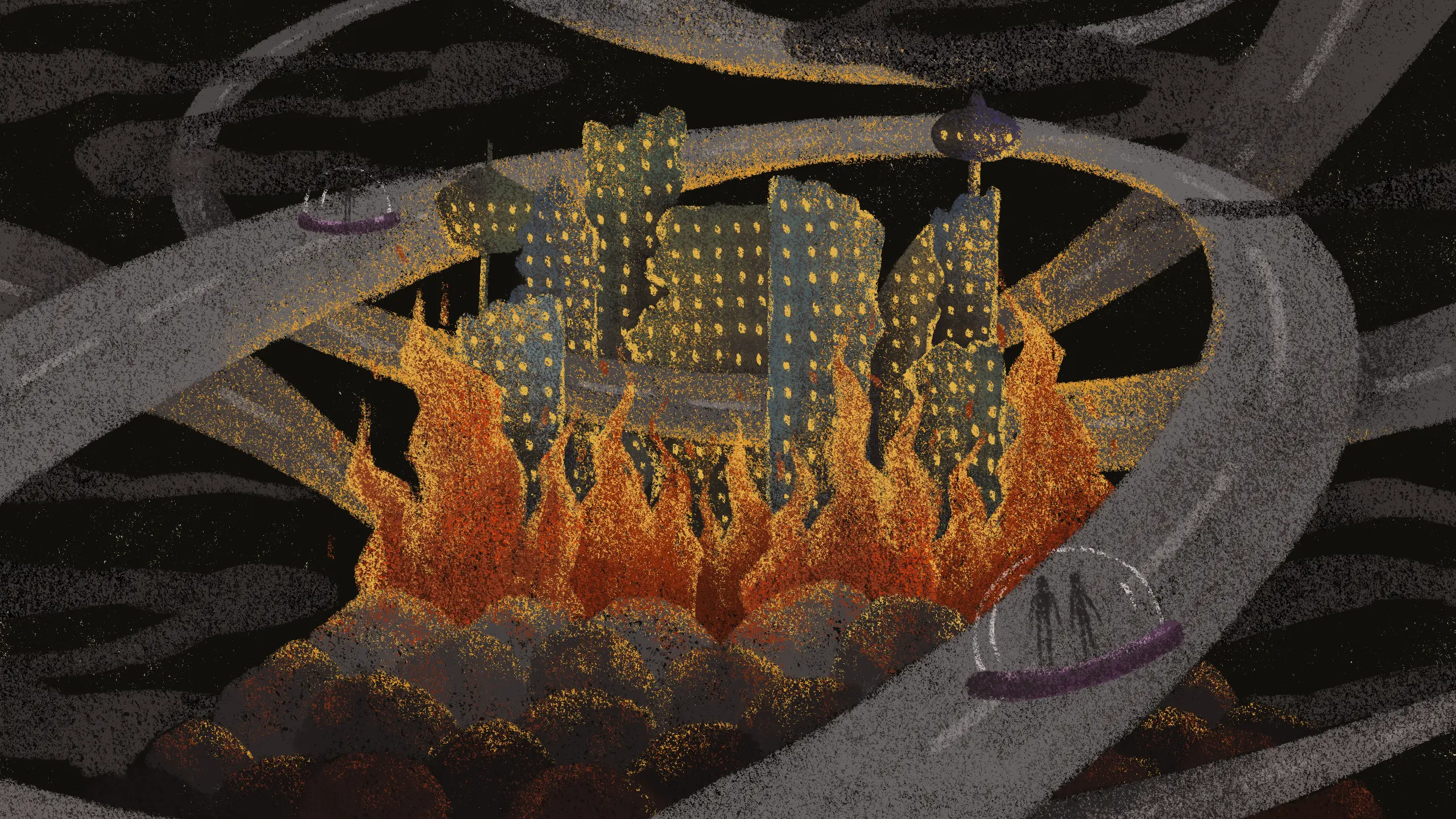
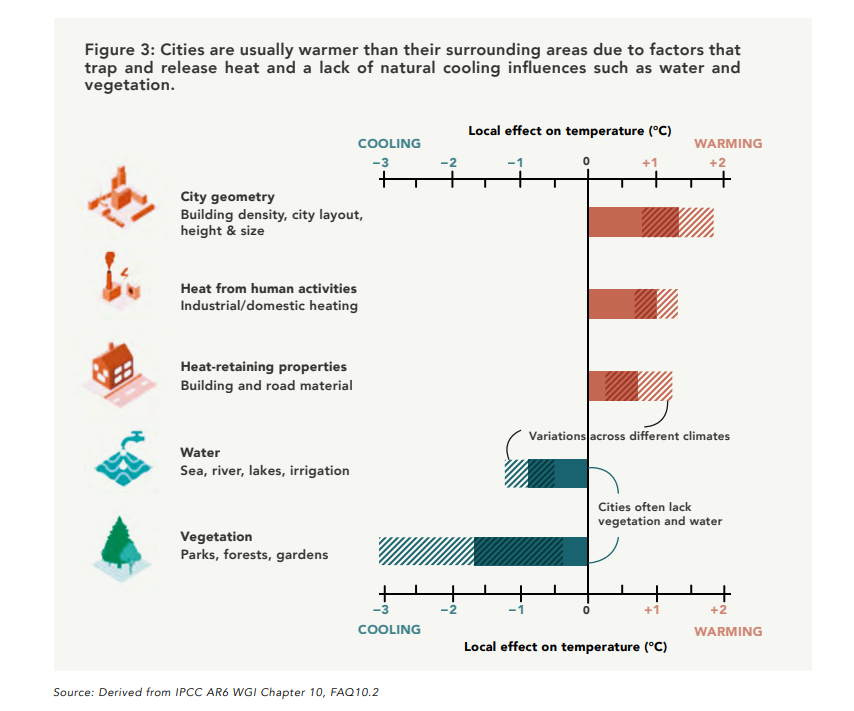
Our cities, through the ways in which they are built and the things they build over, upset these mechanisms. They increase the amount of heat absorbed and retained in the atmosphere, and curtail avenues for the city to cool itself.
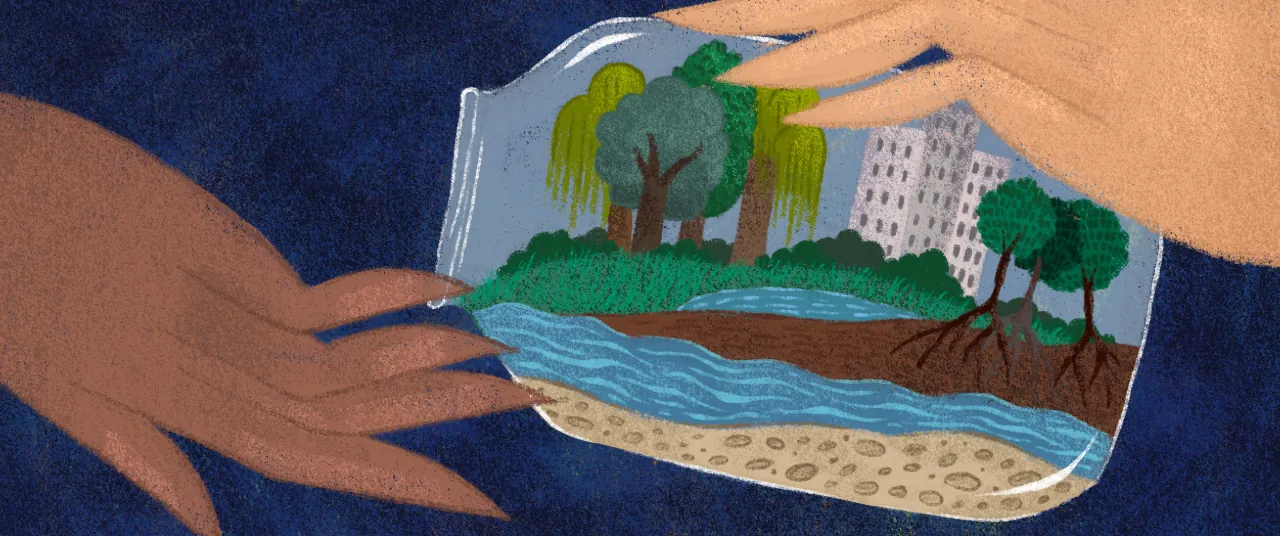
There are three major aspects of cityscapes that feed into this. First, natural resources like tree cover and water bodies are sacrificed in expanding cities. Green cover and water bodies play key roles in cooling the environment through mechanisms like evaporation and transpiration, and their absence robs us of a pleasant city to live in.
Second, the contribution of anthropogenic (human-caused) heat. Some of this is direct: the heat emitted by factories, air conditioners, and vehicle exhaust, to name a few. There is also an indirect contribution by the materials we use for buildings and roads (concrete and asphalt, respectively). These are dark surfaces that absorb enormous quantities of heat. To cloak our cities in concrete and asphalt is no different from wearing a full-sleeve black shirt on a hot summer day. Our roads and buildings absorb more sunlight than soil would, and re-radiate it into the air once night falls. The marked increase in nighttime temperatures that is observed in urban heat islands can be attributed to these building materials.
Third, tall buildings, a characteristic of most rising cities, block the cooling effect of winds. Helpfully termed as ‘urban canyons’, these parallel rows of skyscrapers direct both wind direction and speed. They are also additional surfaces for the heat to be absorbed and reflected.
To cloak our cities in concrete and asphalt is no different from wearing a full-sleeve black shirt on a hot summer day.
Together, these factors create a city that is anywhere between 1-10°C warmer than its surrounding rural areas. This touches our daily lives, and the ease with which we move through the city. It changes what it feels like to step out at noon: how much your eyes scrunch up when you're standing on the footpath, the temperature of the wind from the bus's window seat, and how tired you are by the time you reach your destination.
What this means for humans
A natural question to have is, 'is my city an urban heat island?'. The nuanced answer is, yes and no—every city is a heat island, but not every part of the city is part of the island. Cities have hotspots, or areas which are hotter, and cooler patches. A better question could be, 'is my neighbourhood an urban heat island?'.
Spotting these is intuitive if you understand how urban design is trapping heat. Densely packed areas, like industrial estates, will trap more heat. Parks and lakes bring down the temperature. A study quantifying this phenomenon in Chennai had astounding findings: at the same time that the Chennai airport was a merciless 43.3°C, the Guindy National Park was a pleasant 23°C.
It is this understanding that leads us to the 'ideal city', one that is liveable. Officially termed as 'blue-green infrastructure', it is the vision for a climate-friendly city that ensures natural drainage systems, adequate cooling, and clean air. The approach is to add adequate green and blue elements into the grey cities we have come to inhabit.
The implementation of these blue-green solutions is tricky, especially in India, where most cities grew organically and without prior urban planning. So, solutions have to be designed around existing infrastructure. Green roofs (growing plants on roofs) and cool roofs (applying reflective coatings to roofs) are examples of such interventions, with the latter being more cost-effective. Moving towards more liveable cities will mean realigning governance, shares Nidhi Bhatnagar, an urban designer based out of Bengaluru. This includes changing how much open space to mandate when construction is undertaken, streamlining monitoring mechanisms and ensuring accountability.
But Bhatnagar stresses that neither governments nor citizens can approach greener cities without empathy. Our cities hold multiple realities, and not everyone experiences the city in the same way. Some can afford to travel in air-conditioned vehicles on a hot afternoon or live in neighbourhoods lined with decade-old trees. Some depend on the bus and live in densely-packed informal settlements with tin roofs. Recognising this asymmetry in how heat touches people is central to solving for it—or we shall not be solving for those who need it the most.
Bhatnagar stresses that neither governments nor citizens can approach greener cities without empathy.
Amir Bazaz, a professor at the Indian Institute of Human Settlements (IIHS), also highlights the citizen's role in this movement. "No single entity can solve all problems," he says. We have to work through multiple avenues, build partnerships, and work from multiple fronts. To him, the problem is not that our cities are unplanned, it is that we have not nurtured a symbiotic relationship with them. If one is willing to live in the city for all that it offers—livelihood, freedom, and more—then one must be willing to give back to it. We have to, at a personal level, examine the impact of our choices and lifestyle on the city that supports us.
Illustrated by Jishnu Bandyopadhyay
{{quiz}}
.avif)

.avif)
Explore other topics
References