Sponge Cities: A solution to India’s annual flooding crises?
The design of these spaces helps to slow, absorb, filter and hold stormwater rather than channeling it away


Welcome to the Good Food Movement’s Climate Crisis Dictionary—your online guide to environmental phenomena and the science behind them.
Sponge City (noun)
Coined in: 2003
Coined by: Chinese landscape architect and urban planner Kongjian Yu (While it was formally introduced by Yu as an urban planning model in his home country, the concept draws inspiration from many water harvesting techniques around the world, like India’s stepwells and johads, and Water Sensitive Urban Design in Australia)
TLDR: Restoring our cities’ naturally ‘spongy’ blue-green infrastructure (like lakes, rivers, soil and mangroves) and creating more absorbent landscapes can help store, filter and reuse stormwater, and mitigate flood risk.
The longer explanation
By June 19, 2026, the seven lake reservoirs that supply drinking water to Mumbai had fallen to just 9.34% of their combined capacity. In other words, Mumbai had 40 days of water left. This prompted domestic and industrial water cuts across the metropolitan region.
Yet, when the first rains arrived in the last week of June after a long wait, Mumbai flooded overnight. Shrinking wetland cover and turbocharged concretisation mean the city can now scarcely absorb rainwater, which darts away as run-off.
Like Mumbai, India's other cities, too, are oscillating between floods and chronic water shortages. Globally, floods account for 35–40% of weather-related disaster occurrences, as per data from the United Nations Office for Disaster Risk Reduction. By the middle of this century, 4 out of every 5 people affected by a flooding-related disaster will live in Asia.
But why are cities more prone to flooding today, and why are they taking longer to recover from floods? Their surface area is covered with hard, impermeable surfaces. Just like our skin, our cities need pores. Asphalt and concrete seal those pores shut. Paved areas prevent rainwater from sinking into the ground.
A 2022 study conducted by the World Resources Institute–that examined India’s ten most populated cities–demonstrated that built-up area (land covered by human-made structures as opposed to open land) expanded by 52% between 2000 and 2015, with 44% of new development occurring on high or very high groundwater recharge zones—areas where rainwater seeps into the earth, replenishing groundwater reserves. This diverted nearly 300 billion litres of water annually away from aquifers, which could have met 20% of the water demand generated by a growing urban population.

The frequency and intensity of flood events in India make the image of Noah's Ark feel less like legend and more a modern parable. In this environment, sponge cities are emerging as a nature-based intervention of learning to live with water rather than fighting against it. Modern cities borrow water from the future, sponge cities try to pay it back.
As Kongjian Yu says, “When water has space, it slows down.” Conventional urban planning has long treated rainwater as a nuisance to be speedily redirected, especially away from the more gentrified areas of the city. Gutters, storm drains and concrete channels are designed to rush water away from where it falls. But this approach can simply move the problem downstream to other parts of the city, and especially increase flood risk elsewhere, like for informal settlements in low-lying areas.
Modern cities borrow water from the future, sponge cities try to pay it back.
Sponge cities, on the other hand, are rooted in the ancient wisdom of traditional water use and harvesting techniques. Cities have various natural drainage systems like lakes, waterways, open soil and vegetation, and marshlands. A space redesigned as a sponge city, such as playgrounds or parking lots, works with these aspects of the land to slow, absorb, filter and hold, and reuse stormwater rather than channeling it away through grey infrastructure like pipes and concrete channels.
Their framing as an urban development model was first integrated as part of China’s nationwide sustainability policy in 2013-14. Cities across the world, including Shanghai, Copenhagen and Auckland are also investing in nature-based engineering like permeable pavements, and building ponds and rain gardens that store excess rainfall in underground storage tanks and tunnels. By temporarily storing excess rainfall, cities can release it gradually once rivers and existing drainage systems have enough capacity to safely carry it.
In India, urban nature-based design and landscaping firm Sponge Collaborative has worked with the Greater Chennai Corporation (GCC) to restore a degraded wetland in Porur as the Dr. M. S. Swaminathan Wetland Eco Park, after the city experienced devastating floods in December 2015. Reflecting on the lessons learnt from working with this highly successful project, co-founder Manushi Jain says that identifying a location for a park is a data-driven approach, and not an arbitrary process of converting parks at random. What was the site’s historical ecology, and can that natural character be restored? Assessing its drainage patterns, soil type, hydrology and lithology (physical characteristics of the rocks) are as important. At Porur, rain is not treated as a nuisance, but invited to linger. Stormwater enters a chain of ponds, where gravity settles out any large particles and impurities. Native reeds and wetland plants cleanse the water and fix nitrogen and phosphorus. The restored wetlands and ponds hold this rain before releasing it downstream.
Sponge parks can thus also act like a city’s ‘savings account.’
Since its opening in 2025, the M. S. Swaminathan Park has reportedly managed over 20 million litres of stormwater during the height of monsoon; it has also been able to manage over 90% of stormwater runoff generated on-site rather than discharging it into the city's drains. In storing about 30 million litres of rainwater, it has eased the pressure on conventional drainage and mitigated flood risk in the city. Sponge parks can thus also act like a city’s ‘savings account.’
Thermal imaging has also mapped the area to be 10-15°C cooler than its surrounding built area.
More from our Climate Crisis Dictionary: Urban heat islands: Sweaty cities made of rising skyscrapers, vanishing trees
What this means for humans
Can sponge cities be imagined in India? What would they look like in the face of the country’s environmental governance? India has enthusiastically experimented with this model, with Chennai being the most visible testing ground; the GCC constructed 57 sponge parks across Chennai in 2023-24 alone. Others have mushroomed in cities like Mumbai, Kochi and Ahmedabad. However, the limitations of constructing sponge parks at scale have been stark. Large funds are siphoned away, only for construction to involve quick fixes. Pond bunds have been raised with cement and plastic, which risk polluting the aquifer. Stormwater drains have been linked directly with ponds, risking an intermingling with sewage.
We’re used to building concrete boxes as rainwater harvesting systems, says Jain. Governments believe that ‘landscape’ shouldn’t cost much and should maintain itself. Administrative red tape, departments functioning in silos, the nature of the sponge city not being standardised or included in policy, and political motivations to pseudo-adapt sustainable solutions at scale only result in flawed solutions and implementation.
There is no cookie cutter mechanism of designing a sponge park. It’s important to look at site-specific conditions—whether it has rocky, clayey or sandy soils, compacted ground, different aquifers and drainage patterns—and then decide on optimal interventions (like improving soil porosity and selecting appropriate vegetation).
These early experiments raise a larger question: what does an aspiring sponge city look like?
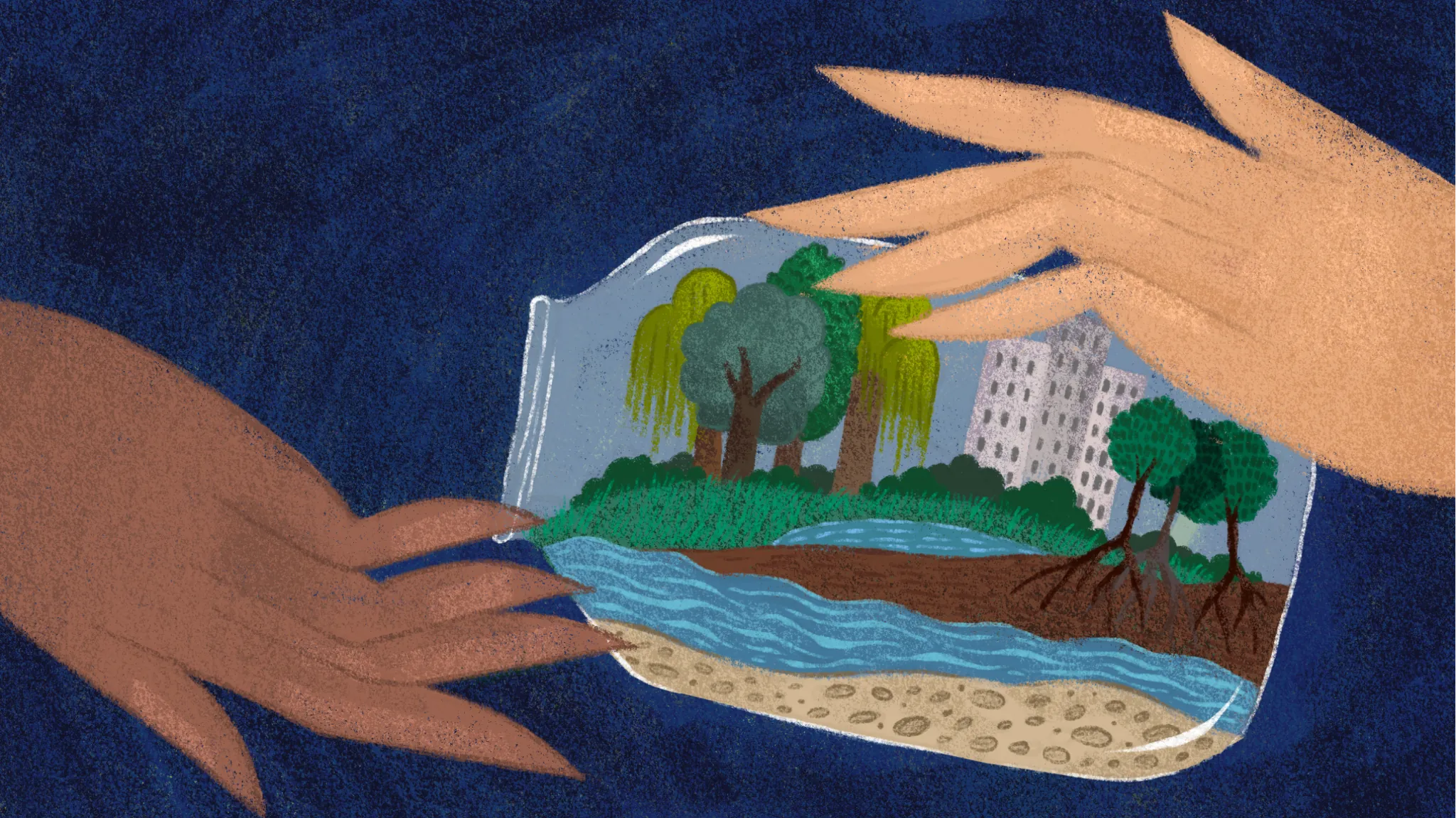
Sponge cities are not a hark back to what once was, but champion a sensitive development. The aim is to enhance the natural capacities of a region. What if we were to restore Bengaluru’s historic kaluves, a centuries-old network of interconnected man-made lakes and storm-water canals, which are now carriers of sewage? Or preserve Mumbai’s vast marshlands and mangroves, often deemed wasteland and up for grabs in the land reclamation battle, which have historically protected against sea level rise and the fierce monsoon? Dr. Hita Unnikrishnan, Sustainable Development Studies professor at University of Warwick, says that the focus of sponge cities should be on restoring what already exists, in a socially sensitive manner, before applying newer solutions.
“This is not just important from the perspective of reducing urban flooding and facilitating adequate drainage, but can also foster local biodiversity, improve local microclimate, as well provide water that recharges cities’ shallow aquifers,” she explains. “This will reduce dependency on deep underground reserves of groundwater—the depletion of which is one of the reasons regions like Bengaluru are constantly on the verge of running out of water supply.” Only when this isn’t possible, solutions that are in tandem with the character of the site can be engineered, she says.
Ultimately, even nature-based solutions have their limitations— including heavy investment in long-term sustainable returns (a newer position for India’s instant gratification-charged bureaucracy). In an extreme weather event, like a cloudburst, or a 25-year return storm event, even sponge cities may reach their threshold and collapse. China's experience illustrates that sponge cities are not a silver bullet—and work best in shepherding moderate rainfall, not eliminating flood risk altogether.
India is yet to standardise what the meaning and implementation of sponge cities would look like, which significantly complicates things.
In already built-up neighbourhoods, they can be created incrementally by replacing impermeable surfaces with permeable pavements, converting parking lots into rain gardens, installing bioswales along roads, creating green roofs, or redesigning public spaces to temporarily store stormwater. The idea is not always to create entirely new landscapes, but to make existing urban infrastructure work more like a sponge.
One of the biggest challenges was getting engineers and contractors to embrace unfamiliar materials and construction methods instead of defaulting to concrete, Jain says. Her team spent months on site, teaching contractors how to work with new materials. The hidden success of designing a sponge park was that engineers themselves understandood the value of nature-based solutions. Small steps on the ground propel change.
But India is yet to standardise what the meaning and implementation of sponge cities would look like, which significantly complicates things. Our cities are highly built-up, with fragmented land ownership and competing development pressures. Sponge cities also have their limitations: it might be difficult to retrofit existing neighbourhoods given the model’s initial expense. No less effortful is customising each sponge park, extending care and consideration for local micro-complexities and conditions. If sponge cities are going to be the next big buzzword in climate adaptation strategies, then it is very important that they steer clear of panacea approaches—what has worked elsewhere is not likely to guarantee the same success when transplanted into other contexts, Dr. Unnikrishnan says.
Another thing to consciously ensure is that sponge cities work especially for the most climate-vulnerable groups and not exacerbate existing inequalities. It’s easy for them to translate into interventions in certain neighbourhoods being prioritised over others. From what history tells us, this would then lead to further forms of gentrification. Neighbourhoods (and cities) that are economically well off, financially profitable and important to India’s global image may be singled out, which would also mean that an entire city might not function as a sponge city, but rather might give rise to ‘islands of sponges’ where change is concentrated, creating an illusion of climate resilience while the rest of the city still suffers climate risks.
Successful sponge parks are built with people, says Jain. Much depends on the people who live alongside them. Involving the community and making the sponge park a biodiversity haven as well as a social amenity is vital. Do people in the neighbourhood have a place of recreation; or are there schools and hospitals that could be flooded? Solutions shouldn’t be top-down but make use of this ecological knowledge suffused in that region, and make the most vulnerable members part of the planning process, says Dr. Unnikrishnan. That participatory approach not only leads to better designs, but also creates a sense of ownership, strengthens long-term stewardship and maintenance—and acknowledges that this is not another construction initiative, but a co-creation with people whose histories actually play out here.
Illustrated by Jishnu Bandyopadhyay
{{quiz}}


.avif)
Explore other topics
References