.jpg)
Decoding buffalo behaviour: Why the domesticated beast wallows in water
Water bodies help these hardy farm animals regulate their body temperatures in India’s hot summers


With crescent horns and a love for ponds, the domesticated water buffalo—Bubalus bubalis—is a familiar presence across India’s farms and floodplains. Yet, despite its ubiquity in Indian agriculture, one of its most distinctive traits is also the most misunderstood: its unwavering devotion to water.
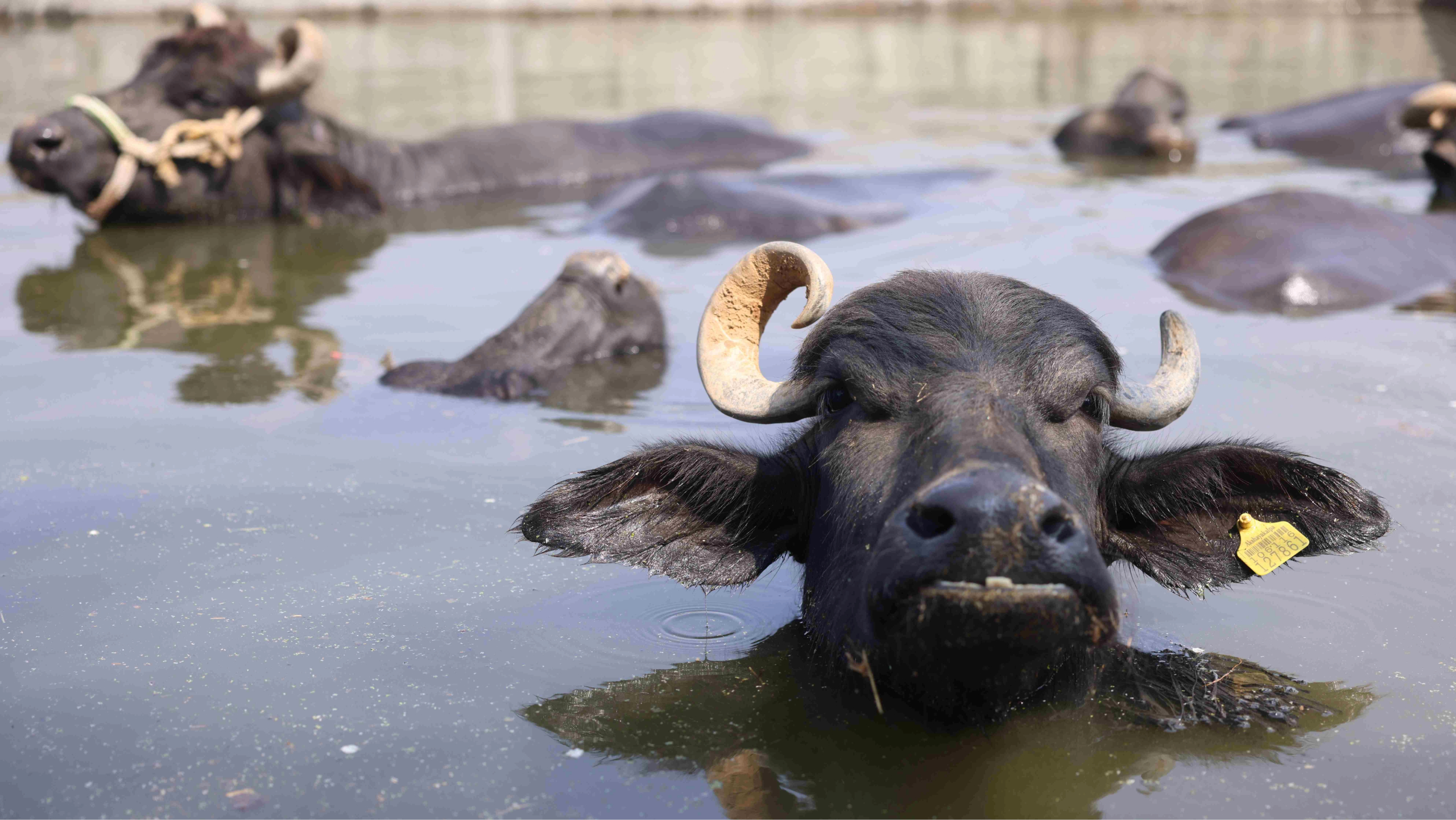
Buffaloes are often seen submerged in village tanks, irrigation canals, or muddy pits, eyes half-closed in apparent bliss. This is not laziness, nor mere habit. It is physiology: unlike cattle, buffaloes are built for heat differently—and that difference has shaped where they thrive, how they are managed, and why water access is central to their well-being.
Thermoregulation: Why buffaloes need water
India’s summer temperatures regularly cross 40°C. For large-bodied mammals, heat dissipation becomes a daily challenge. All warm-blooded animals must maintain a stable internal temperature; when environmental heat exceeds body temperature, the animal must actively shed heat or risk stress, reduced productivity, and even death.
Buffaloes face a structural disadvantage here. Compared to many cattle breeds, they have darker skin, sparse hair, and relatively fewer functional sweat glands. Dark skin absorbs more solar radiation. Sparse hair means lesser insulation from direct sunlight. And limited sweating reduces evaporative cooling—the primary method by which many mammals lower body temperature.
This is where water comes into the picture. When a buffalo submerges itself in water or mud, it uses conductive and evaporative cooling to regulate heat. Water, being cooler than the animal’s body, draws heat away through direct contact. Mud adds another layer of protection: as it dries on the skin, it continues to cool through slow evaporation while also forming a barrier against biting insects.
In effect, wallowing is a substitute for sweating and an adaptive behaviour. Buffaloes that lack access to wallowing sites show clear signs of heat stress: increased respiratory rate, reduced feed intake, lower milk yield, and altered reproductive cycles. Dairy studies have repeatedly demonstrated that buffalo milk production drops significantly during peak heat unless adequate cooling systems—ponds, showers, sprinklers, or shaded housing—are provided.
In effect, wallowing is a substitute for sweating and an adaptive behaviour.
This reliance on water also explains the geographical distribution of buffalo populations, which flourish in river basins, delta regions, and areas with irrigation infrastructure. Historically, their association with paddy cultivation in wetland ecosystems made ecological sense: fields, canals, and ponds doubled as thermoregulatory resources.
Also read: Water buffaloes: A historical look into their role in agriculture
Why don’t buffaloes sweat like cows?
At first glance, buffaloes and cattle appear similar enough to share identical coping mechanisms. But cattle (genus Bos) possess a higher density of active sweat glands, making sweating a more effective cooling strategy. Buffaloes, in contrast, have fewer sweat glands and lower sweating rates.
Research comparing the two shows that under equivalent heat stress, buffaloes exhibit higher skin temperatures, greater reliance on increased respiration (exhibited through panting) and a stronger behavioural drive to seek water. This reliance on water is not a liability. In fact, buffaloes are remarkably resilient in tropical climates where sweating alone would be inefficient. High humidity reduces the effectiveness of evaporative cooling. In such environments, access to water bodies for immersion can be more efficient than surface evaporation alone, and helps these creatures stay healthy.
Also read: Chicken manure is clucking good
The image of a buffalo immersed in a pond is not a pastoral cliché. Water is not just something the buffalo loves to paddle in. It has evolved alongside India’s wetlands, floodplains, and monsoon cycles. It is part of what allows this animal to endure Indian summers—and continue to power one of the world’s largest dairy economies.
{{quiz}}



Explore other topics
References