
In an age of food abundance, why does ‘hidden hunger’ hold India back?
A reminder that abundance alone does not guarantee nourishment; that full plates do not necessarily translate to healthy bodies.


Editor's Note: The planet we inherited as children is not the planet we will someday bid goodbye to. The orchestral call of cicadas in the evenings, the coinciding arrival of the monsoon with the start of the school year, and the predictability of natural cycles—things we thought to be unchanging are now at risk. An altered climate, declining biodiversity and warming oceans aren’t distant realities presented in news headlines; they affect us all in seen and unseen ways. In ‘Converging Currents’, marine conservationist and science communicator Phalguni Ranjan explores how the fine threads connecting people and nature are transforming with a changing planet.
We live in a world where supermarket aisles and grocery stores are completely stocked, and agricultural production is higher than ever before. A vast variety of food is now accessible to us at our fingertips, as is a huge body of diet- and health-related research. At the same time, we also live in a world with ever-deepening socio-economic divides that restrict people's access to not only to food, but to essential, nutritious food.
And this has cascading effects.
Hidden hunger, like the name suggests, is a form of silent malnutrition that often goes unnoticed. Unlike starvation—which is an inadequate intake of food (calories)—hidden hunger refers to deficiencies in micronutrients that can happen despite adequate calorie intake. People may eat enough, or even too much in terms of calories, but still lack the nutrients their bodies need to grow, develop, and function properly.
Unlike hunger, which can be felt, hidden hunger rarely has clear physical manifestations, even as it attacks the very systems that keep the body going.
Micronutrients include vitamins like A, B-group, C, D, E, and K, and minerals like iron, iodine, calcium, magnesium, and zinc. Our bodies need them in small amounts (milligrams or micrograms)—hence, micronutrients—but their absence can have disproportionately huge effects on our immunity, nerve function, heart function, cellular processes, bone health, metabolism, growth and development, and overall health. Severe deficiencies in one or more of these can result in cognitive impairment, poor immunity, impaired growth and neurological development, and in very severe cases, even death. Most of these micronutrients cannot be produced by the body (called essential micronutrients) and must be supplemented through diet.
Unlike hunger, which can be felt, hidden hunger rarely has clear physical manifestations, even as it attacks the very systems that keep the body going. But before action and intervention, one needs to understand the many interconnected causes at play.
India’s hidden hunger burden
Globally, around 800 million people suffer from chronic hunger. An estimated 2 billion people suffer from micronutrient deficiencies, of which, around 190 million are children of pre-school age. However, some of these figures are decades old and on-ground realities are likely to have changed, as deficiencies can remain undiagnosed. More recent estimates suggest that there may be as many as 372 million preschool-aged children and 1.2 billion non-pregnant women of reproductive age affected by one or more micronutrient deficiencies worldwide.
Over 80% of the Indian population—nearly half of the global hidden hunger burden—suffers from one or multiple micronutrient deficiencies, most commonly of calcium, iron, Vitamin D, folate (Vitamin B9), iodine, and Vitamins A and B12. This is despite being one of the world’s largest agricultural producers, renowned for culinary diversity. India is also home to the world’s largest number of undernourished children.
Vitamin D deficiency tops the chart, affecting 61% of the population. Iron deficiency affects around 54% of the population, especially pronounced among pregnant women, affecting 61% of this group. The National Family Health Survey-4 (NFHS-4) revealed that India has the highest burden of anaemia, globally: 58.6 % in children, 53.2 % in non-pregnant women and 50.4 % in pregnant women as recorded in 2016. Alarmingly, NFHS-5 data (2019-2020) revealed a worsening situation, especially among children.
Over 80% of the Indian population—nearly half of the global hidden hunger burden—suffers from one or multiple micronutrient deficiencies, most commonly of calcium, iron, Vitamin D, folate (Vitamin B9), iodine, and Vitamins A and B12.
Predictably, the burden of hidden hunger is not uniformly borne across India. Rural populations and economically disadvantaged groups often exhibit higher levels of deficiency due to limited access to nutritious foods, lower dietary diversity, lower awareness, and greater food insecurity—often determined by education, income, and occupation.
Cultural practices and gender norms—like the woman eating last in the family and often the least in certain households, or having restricted diets due to socially-determined ‘taboo’ foods—can further restrict access to nutritious foods. The resultant poor health is highly likely to impact education, work, and productivity across age groups, indirectly but consistently hindering the development of some groups more than others.
Hidden hunger can create a vicious self-perpetuating inter-generational cycle, where micronutrient-deficient mothers cannot pass on sufficient nutrient stores to their children, impairing growth, brain development, and long-term health. Girls are especially vulnerable, growing up with a nutrient deficit in such cases, as biological factors like menstruation increase nutrient needs while social norms may limit their access to nutritious food; making them more likely to enter pregnancy malnourished and continue the cycle into the next generation.
Also read: Omega-3 fatty acids: The hidden cost of 'health' to our seas
Why hidden hunger persists
The problem of hidden hunger presents a paradox. While food quantity has kept pace with and fed the growing global population, boosted by the Green Revolution through high-yielding varieties (HYV) and chemical inputs, the quality has not kept up. Modern-day varieties of crops have been found to contain lower concentrations of micronutrients compared to the nutrient-rich traditional varieties from a few decades ago; this is especially true for staple crops like wheat and rice.
Excessive use of synthetic fertilisers, chemicals, and pesticides have degraded the environment and soil to a large extent, affecting soil micronutrient availability. Post-Green Revolution, Indian soils have also become deficient in micronutrients due to poor replenishment, and repeated, high-intensity cultivation over subsequent decades. Indiscriminate chemical inputs have altered soil biochemistry—like pH, organic content, moisture, microbial activity—and these factors determine how the nutrients are made available or ‘locked’ for the plant to access.
However, the soil is not the only problem: even in cases where the soil is healthy, there has been a notable decline in the nutrient content of the grains. While HYVs were selectively bred for higher productivity and stress resistance, that genetic prioritising of yield indirectly resulted in the crops losing the ability to load up nutrients properly. Subsequently, with each round of hybridisation, grains have ended up with lower concentrations of essential nutrients compared to traditional varieties. Globally, wheat varieties today have around 20-30% lower concentrations of minerals such as zinc, iron, copper, and magnesium compared to older varieties, a decline that has been monitored over a 160-year period. Maize and rice show similar declines.
Another contributing factor is the shift from traditional, nutritionally rich whole grains to modern staples such as wheat, rice, and maize—foods that satisfy energy requirements but are less rich in micronutrients.
In India, the essential and micronutrient content of cultivated varieties (cultivars) of wheat and rice have declined by 44-47% over a 50-year period. This is especially concerning as these two staples provide over 50% of the daily energy needs for the population.
Climate change and global emissions have a role to play here, as well. A study looking at 43 crops found a correlation between increasing atmospheric carbon dioxide levels with decreasing concentrations of protein, micronutrients, and vitamins in the grain. Called the ‘dilution effect’, plants take up and metabolise more carbon dioxide, and the result is a higher-calorie carbohydrate concentration, resulting in nutrient decrease (in protein, iron, zinc, and B-group vitamins) of up to 38%.
Another contributing factor is the shift from traditional, nutritionally rich whole grains to modern staples such as wheat, rice, and maize—foods that satisfy energy requirements but are less rich in micronutrients.

Furthermore, taste, convenience, and price points have also pushed the world towards a more refined- and polished-grain diet compared to a traditionally whole- or coarse-grain diet which offers greater health benefits. Refining often strips the grain of the outer layers that contain a significant amount of dietary fibre, bioactive compounds, and nutrients, leaving mostly the energy-dense, starchy parts for consumption.
A connected core driver in low- to medium-income countries (LMICs) like India is monotonous dietary patterns characterised by heavy reliance on cereals and insufficient intake of micronutrient-rich foods like legumes, fruits, vegetables, and animal-derived foods. Poverty, access to quality food, and hunger are closely related. Poor diet quality is consistently linked with micronutrient deficiencies, regardless of calorie sufficiency, and women are more susceptible to it.
Hidden hunger cannot be eliminated solely by increasing food availability.
Yet another paradoxical factor is the internet, or more specifically, social media. While the internet can be a great tool for awareness and learning, studies find that social media exposure can negatively impact people’s diets. Peer influence, combined with influencer marketing and easier access to fast food have resulted in increased consumption of unhealthy foods, poor body image, and unhealthy eating behaviours, with children being especially vulnerable. Fad diets now promote low-calorie processed foods high in sugar- and salt-content but lacking in nutrients, and skipping meals or certain kinds of food, thereby promoting restrictive eating patterns and a less diverse plate.
The need of the hour: an integrated approach
Addressing hidden hunger in India requires both, immediate interventions and long-term systemic changes that include improving diet diversity, strengthening nutrition awareness, and ensuring access to nutrient-rich foods. Food security needs to go beyond talking about sufficient calorie intake to ensuring nutrient security as well.
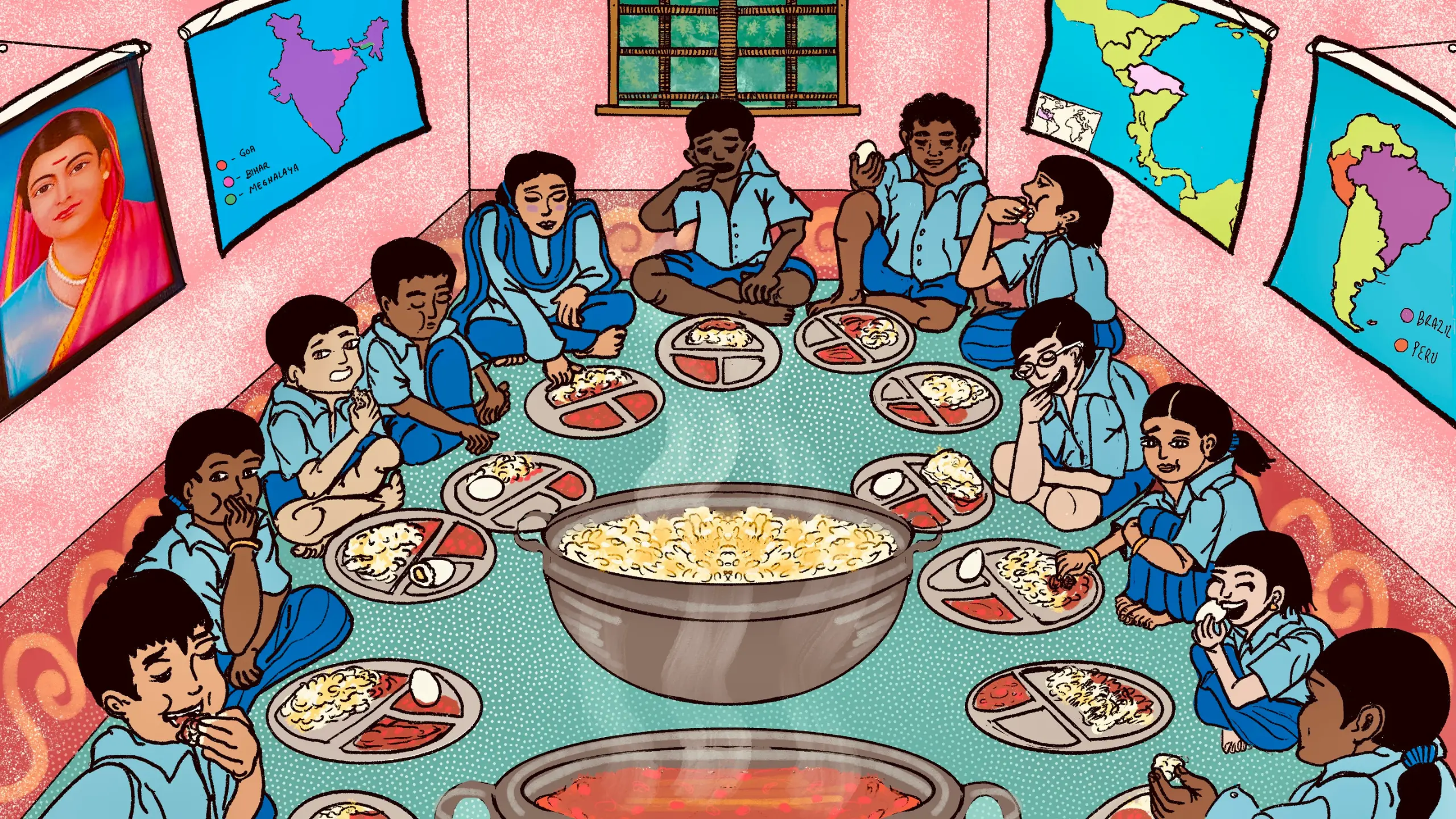
India has mostly viewed malnutrition as a food distribution or hunger problem, treating it through subsidies and meal programmes which do not address the real concern of deficiencies. The Mid-day Meal scheme, despite revisions, continues to offer a limited diversity of foods to students, limiting avenues for nutrient availability. Similarly, while the Indian Public Distribution System (PDS), one of the largest food security programmes in the world, has played a critical role in addressing hunger and undernutrition in general, major gaps in nutrient delivery remain, owing to the emphasis on subsidised ‘high-calorie’ staples.
The limited progress in reducing undernutrition can be partly attributed to governance challenges: the absence of a sustained, high-level national agenda to address malnutrition specifically, inadequate systems for regular monitoring through reliable data, and a fragmented understanding of malnutrition itself that is neither holistic nor complete.
Food fortification is a century-old strategy that has been widely adopted worldwide since the 1920s. India, too, has been taking steps to combat nutritional deficiencies with fortification since the 1950s: adding essential nutrients such as iron, folic acid, or vitamins A and D to commonly consumed foods. The FSSAI strongly mandates the fortification of ingredients like oils, salt, flours, rice, and milk, but the implementation remains largely voluntary. Around 11 states had rolled out a mandatory fortified rice programme, while private companies have chosen to fortify additional products like breads, biscuits, and butter. However, large-scale implementation in India has been uneven. Except for iodised salt, nationwide coverage remains limited. Additionally, in the case of iron-fortified rice, factors like packaging materials, storage conditions, moisture content, and temperature affect micronutrient levels deeply, leading to the recent suspension of the state scheme.
Several other recommendations have been made through multiple global studies. Improving agricultural practices through innovations, and the development of biofortified crops can help increase productivity while preserving soil health, and improving the nutrient content of crops. This would need to go hand in hand with encouraging the cultivation and consumption of a wider range of nutrient-dense foods, including fruits, vegetables, legumes, and animal products. Some emerging domestic initiatives are already working in this direction, seeking to fortify crops by developing cost-effective enriched biofertilisers.
Consumer demand also plays a role here, and it is often influenced by media and marketing. Public health campaigns that promote awareness about nutritious foods, balanced and diverse diets, and what is truly healthy, along with policies to limit misinformation, can help shift consumption, demand, and subsequently production, towards healthier alternatives.
Tying all this together would require a strong policy backing to ensure proper execution and implementation, drawing on robust science and successful global case studies. Recently, Indian experts recommended making Vitamin D fortification of edible oils mandatory, as the vitamin is fat soluble—something already in practice in several countries worldwide. Technically, this was already made mandatory, but implementation seems to have lagged behind with only 69% of all edible oil in country fortified in 2020-21.
India has mostly viewed malnutrition as a food distribution or hunger problem, treating it through subsidies and meal programmes which do not address the real concern of deficiencies.
Several countries have successfully tailored interventions to address the undernutrition problem. Guatemala successfully addressed night blindness in children by fortifying sugar with Vitamin A, Bangladesh and Peru have been rolling out fortified rice, and South Africa has mandated the fortification of maize.
Hidden hunger cannot be eliminated solely by increasing food availability. It remains a multi-system issue tied to agricultural policy, public health, food environments, education, and socioeconomic conditions. While the challenge itself is not unique, India’s scale, diversity, and complexity make it so, contextually. It requires a transformation of food systems that prioritises quality alongside quantity, while maintaining a very strong national-level plan for policy implementation.
Looking at these changes, I wonder if the narratives of dead soil and artificial food systems depicted in dystopian science fiction novels are all that far-fetched. In a world where food production has reached unprecedented levels, the persistence of hidden hunger is a reminder that abundance alone does not guarantee nourishment; that full plates do not necessarily translate to healthy bodies.
For many, our tummies are full, but our bodies are starving; for others, there’s not even that.
Also read: Food fortification 101: Can foods built in with nutrients, counter malnutrition, deficiencies?
Edited by Anushka Mukherjee and Neerja Deodhar
Cover Art by Pratik Bhide
{{quiz}}
.jpg)

Explore other topics
References