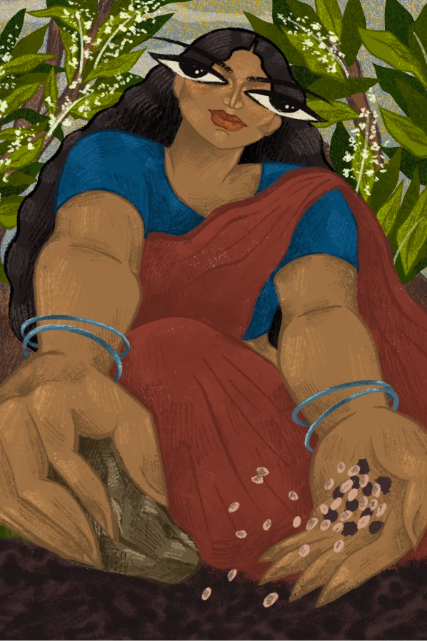
Their hands lovingly harvested chironji. Now its trees are out of reach
In rural Madhya Pradesh, dam-led displacement has deprived Adivasi communities of a reliable, nourishing forest produce


Every summer, Sumitra Rani waits for the chironji trees to grow heavy with fruit. Her family, which belongs to the Gond tribal community, sets out at dawn and ventures deep into the forest near Madhya Pradesh’s Pathapur to handpick the reddish-purple fruit from the achaar tree, as it is locally known in this region. Their meticulous collection continues into the heat of the afternoon. If 41-year-old Sumitra Rani is lucky, she and her relatives will return with baskets laden with a few kilos of chironji.
Chironji (Buchanania lanzan) grows abundantly in the dry deciduous forests of central India. Achaar aside, it has many names colloquially in the states of Madhya Pradesh, Uttar Pradesh, Jharkhand, Chhattisgarh and Maharashtra: char, charwa, charoli, and priyal. It can grow up to 15-18 m tall, with small greenish-white flowers that appear in clusters at the ends of its branches. The fruits contain a fleshy pulp surrounding a hard stone, within which lies the edible kernel that is sold as chironji. This popular dry fruit, which has an almond-like nutty quality, is used in a variety of sweets across India, including kheer, barfis and halwa.

Kunjan Devi and Pankaj Devi, two Gond women in their 30s, belonging to Gahdara and Koni respectively in Madhya Pradesh’s Panna district, recount similar rhythms of gathering chironji. However, these stories are from a time before they were forced to flee their native villages and forests, to make way for the Ken-Betwa Link Project (KBLP), a Rs. 44,605 crore-dam project that will reportedly supply drinking water and irrigation to large swathes of Bundelkhand. The Daudhan dam, which is the first instalment and centrepiece of the project, sits in the core reserve of the Panna National Park. Under its shadow, eight villages in Panna, and 14 in the neighbouring district of Chhatarpur, will either be submerged or acquired as compensatory afforestation. Their residents are now part of the displaced population that has set up camp on the fallow outskirts of Tara, another village in Panna. The sense of purpose that once shaped their days, of collecting firewood and foraging for wild vegetables and other forest produce, has given way to listlessness—with neither fertile land nor forests within reach.
The chironji tree, which has already fallen prey to deforestation, over-exploitation and urbanisation in Central India, now contends with a further threat from the State. The dam, which has shorn thousands of Adivasi farmers of their landholdings, is also reportedly poised to strike at the ancient forests to which these trees are indigenous, and which are at the heart of generational occupations in the region.
Fruit of a long summer
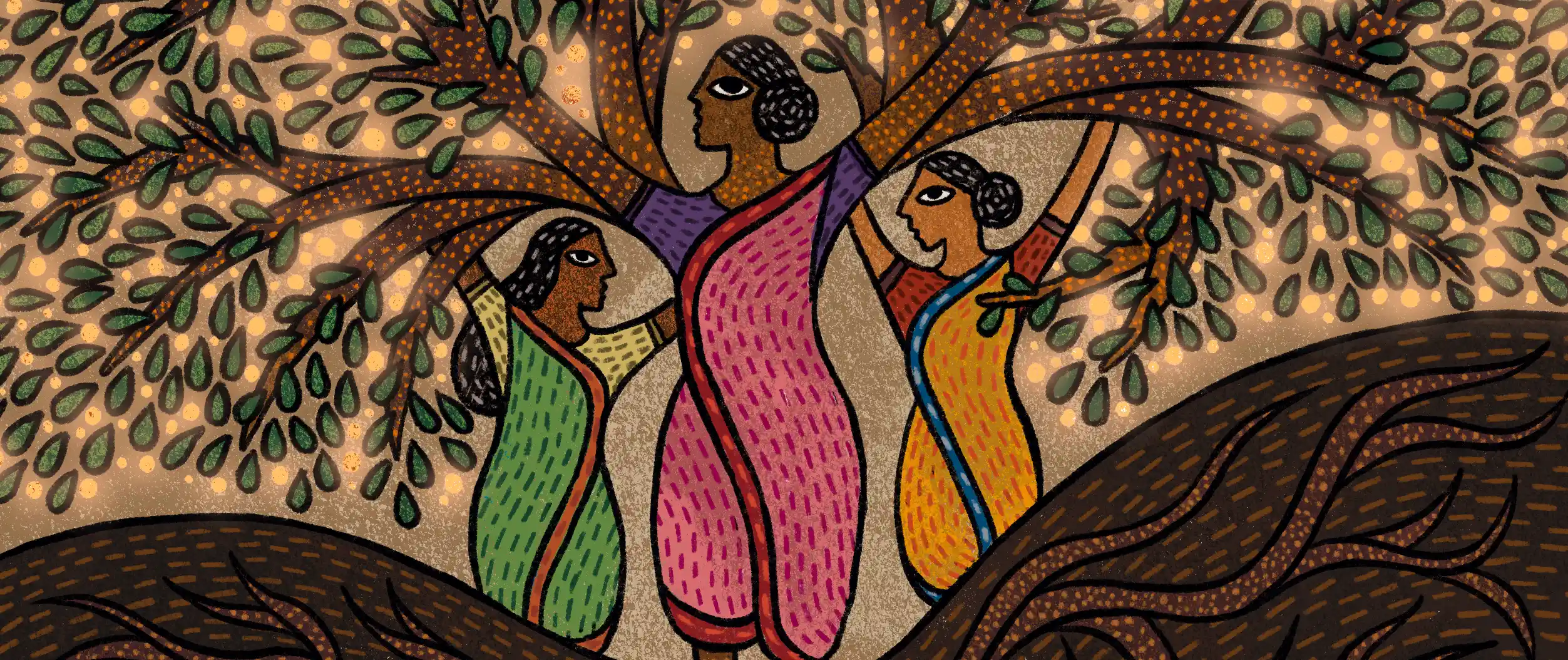
In Pathapur, the women lay out the spoils of the previous harvest season on the chabutara—a stone ledge underneath an ancient banyan tree which serves as a common meeting point and resting place.
“Flowering usually begins in December and January. The trees begin fruiting around March into tiny, green masses which are mildly tart. They swell as they ripen, and are ready to be collected when they turn dark purple. Collection goes on into May,” Sumitra Rani says. Bamboo grows abundantly in the expanse of forest and grassland surrounding Pathapur, and the women fashion long baskets of cane to collect the chironji fruit. They either pick it by hand, or lightly shake the tree’s branches such that a purple rain showers onto the saris spread on the ground underneath. “Charwa bahaut narm hot, zyaada chot lage, toh phoot jaavat [Chironji bruises easily, and this ensures that it does not burst],” Sumitra Rani explains.
The chironji tree, which has already fallen prey to deforestation, over-exploitation and urbanisation in Central India, now contends with a further threat from the State.
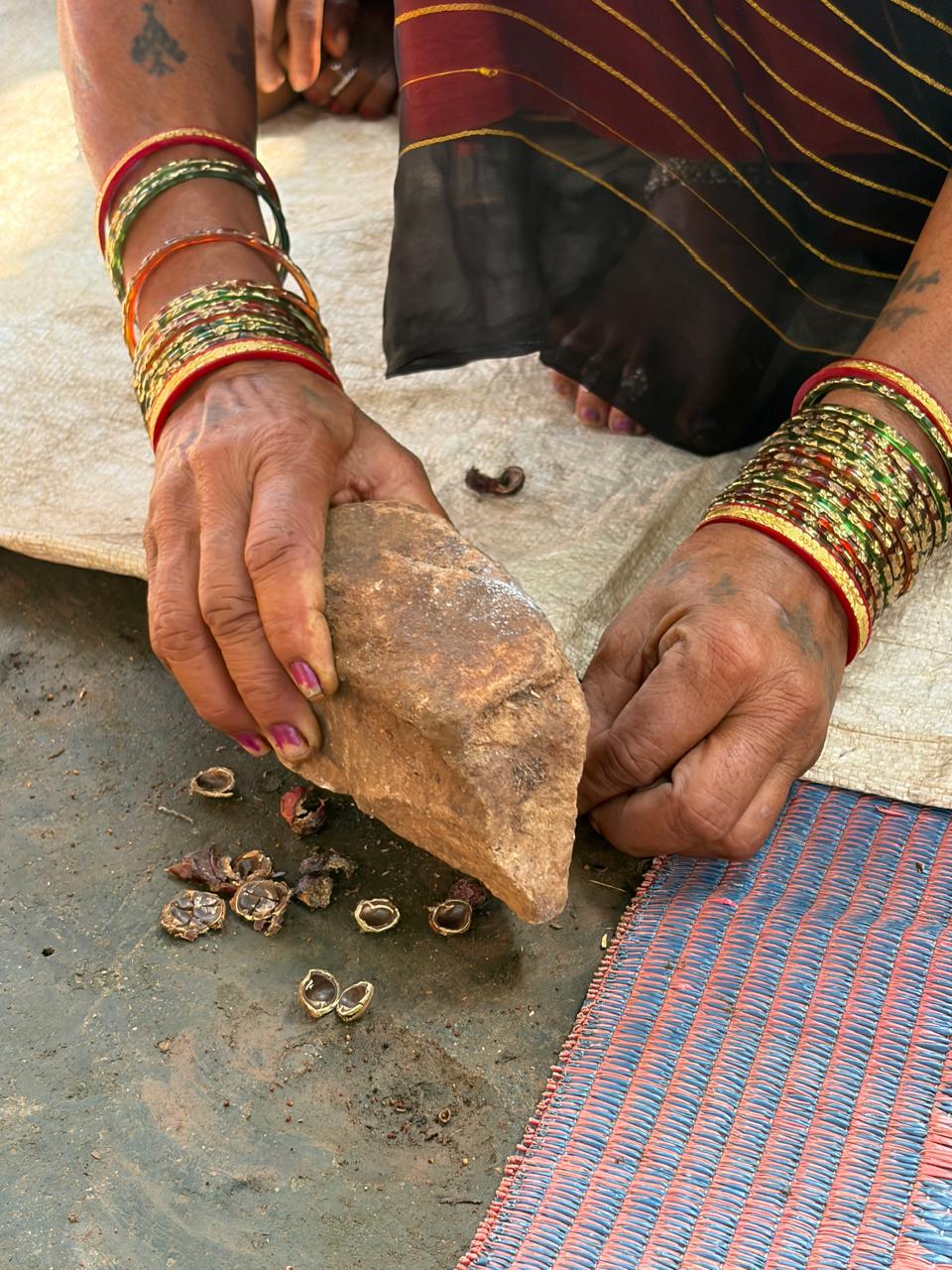
Kunjan Devi recalls how during peak season, each family was able to collect 2-3 kg every day. “We’d wash the fruit and then sun-dry it for about a week. About 4-5 kg of guthli [seeds] yields about one kilo of dana [chironji kernels],” she says. Her recollections about the fruit are punctuated by the sound of village matriarch Chand Rani pounding the dry, blackened chironji—a staccato of seeds splitting open and giving way to the kernel inside. She pours the fruits of her labour into my hands. “This is the snack we crush and pop into our mouths whenever us ladies gather. When else will you get to taste this jangli swaad [flavour of the forest]?” Chand Rani adds.
Data suggests that Central India contributes over half of India’s national chironji production. It is classified as minor forest produce (MFP), and its harvest is an important source of seasonal income for communities like the Gonds, who are forest-dwelling or live nearby. “We sell charwa for Rs. 100-150 a kilo,” says Pankaj Devi. “When combined with other forest produce, we are able to earn enough to buy provisions and finance weddings. Unlike mahua, charwa does not have a lot of cultural significance in our customs and traditions—but it is an important pillar of economic and food security in our families,” she continues. The dried guthli can also be stored for a few months and sold when the household needs cash, making the harvest a source of income during times when agricultural work and other ways of earning may be limited.
Kunjan Devi recalls how during peak season, each family was able to collect 2-3 kg every day.
The tree offers many gifts to the people living alongside it, including prized medicinal properties. The oil extracted from its kernels is used to treat rashes, while its leaves are used to dress wounds. “We also mix the sap from the tree’s bark with goat’s milk to cure diarrhoea,” says Pankaj Devi.
Also read: A life, undone: A dam leaves farmers bereft of home and identity
Dwindling returns
For the women who collect chironji, the work continues long after they have returned from the forest. The collection and processing of chironji is intensive and laborious, they say. Once collected, the reddish-purple fruit must be washed, dried and individually broken open to extract the tiny kernel inside. This is difficult work—each hard stone must be carefully pried apart by hand, so as to not damage the oily seed that lies enmeshed within.
“We don’t have processors in the village. We have to sell it to local traders who aggregate the produce, before selling them further in the larger wholesale mandis in the city. Even if we had the means of transportation, the mandi traders would refuse to conduct business with us,” says Shyam Lal Gond, a 52-year-old from Koni.
Socio-economic disparities and a limited access to resources turn the chironji supply chain into an extractive one. Mandi traders sell large batches of chironji to processing mills, where they are mechanically cleaned, dehulled and graded. From there, the dry fruit makes its way to urban centres where it is sold at a sizable markup. “Shehron mein jo log chironji khaat hain, hum jangal se been ke laat hain. Hamre bina hot ka? Bazaar mein dui hazaar rupaiya kilo tak bikat hai, lekin hamain tau kachu paisa nai milat. Kaahe se ki saari safai aur baaki kaam hamre ilaaka ke baahar hot hai [We are the original collectors of what people in the cities eat. Chironji sells for prices as high as Rs. 2,000 per kg. Yet, we receive only a fraction of this amount because all the processing happens outside our tribal belts],” Shyam Lal says.
The chironji trade in Bundelkhand operates through a largely semi-formal economy, where government procurement mechanisms coexist with an extensive network of private traders and intermediaries. Under the Ministry of Tribal Affairs' Minimum Support Price scheme for Minor Forest Produce, chironji pods have a notified MSP of Rs. 126 per kg. However, this does not necessarily translate into better prices for producers/harvesters.
Under the Ministry of Tribal Affairs' Minimum Support Price scheme for Minor Forest Produce, chironji pods have a notified MSP of Rs. 126 per kg.
The KBLP has exacerbated these inequalities, with the uncertainty surrounding displacement pushing villagers to sell their produce to traders at meagre prices. Fearing that they could be forced to leave their villages at short notice, many have been compelled to sell their harvest rather than risk losing it altogether, or holding out for a better price. Shyam Lal says, “We lived with the constant fear that we could be evicted at any moment. The traders knew we had no way of carrying our produce with us if we were forced to leave. We had no option but to sell at their dictated prices, which were as low as Rs. 30 a kilo.”
I had only encountered chironji in luminous glass jars in sweetmeat shops, its tiny kernels arranged in neat, glistening rows. The rows of containers gave an illusion of plenty. What appears in the shops as an abundant dry fruit is born in the forest as a seasonal harvest dependent on access to trees, family labour and generations of knowledge.
Also read: In Bundelkhand, century-old ties with mahua trees are being severed
An already vulnerable tree
During festivals, roasted mahua flowers and chironji kernels are used to make kheer and ladoos. Sesame, coconut and ghee are also folded in to make dense, fudgy preparations called murkha and dobhari. “We worship both these trees along with our livestock during festivals like Halchhat and Naagapanchami. Chironji kernels are also part of our offerings to Baradeo (the supreme creator in Gond cosmogony) when we celebrate our first harvest,” says Pankaj Devi. This relationship, however, is increasingly under strain.
The chironji tree was in decline and faced poor natural regeneration long before the KBLP brought with it the prospect of large-scale forest loss to Bundelkhand. Across its natural habitat, the demand for its fruit, coupled with the pressure on forest-dependent communities to make a living from it, has led to poor harvesting practices in some regions, like cutting branches, picking unripe fruit and overharvesting. Globally, the tree has been classified as vulnerable (VU) on the International Union for Conservation of Nature’s (IUCN) Red List of Threatened Species.
The chironji is a very delicate tree.
This decline is also tied to the erosion of customary systems that once regulated access to forest produce. According to Naresh Biswas, the founder of Nirman, an organisation that has worked on tribal land rights and preserving traditional agricultural methods and traditions in Madhya Pradesh, these arrangements helped prevent the unchecked extraction of produce from the same forest patches. He recounts a time when the tree grew and propagated plentifully in the region. “Village elders traditionally demarcated forest areas for each village, with individual families recognising rights to collect produce from particular portions of the forest. These boundaries were respected: families from other villages, or even other households, would not encroach on someone else’s collection area,” he says.
Over the past decade, however, rising demand for chironji has intensified competition among producers. As the fruit has become more valuable, these mutually understood, traditional arrangements have begun to fray, with more people vying for access to the same trees and forest patches.
“The chironji is a very delicate tree,” says Biswas. “It is easily afflicted with fungal and parasitic infections. The correct method of harvesting is to carefully handpick the fruit, so as to not damage the bark,” he continues. Today, some collectors lop branches to reach clusters of fruit hanging high in the canopy. Others pluck the fruit before it has ripened, fearing that someone else might get to it first. “This not only reduces the quality of the harvest, but also leaves fewer mature fruit to fall and produce new saplings. The tree's regeneration is already slow. Its hard seed coat makes germination difficult, and young plants struggle to establish themselves in degraded forest patches,” says Biswas. Less-than-ideal harvesting practices lead to further declining populations, in turn fuelling competition. ”The Adivasis are in a vicious tension with each other and the market,” Biswas notes.
Anxieties heightened in the months leading up to dam-led displacement. Both Kunjan Devi and Pankaj Devi recount how families frantically collected mahua and chironji during their flowering and fruiting season, fearing bad news. “More trees have infected barks now than in the past, and others have grown stunted. They bear smaller fruit. Earlier this year, we spent all day in the forests, trying to pick every fruit that we could. We knew that this could be our last time in the forest,” they say.
Even if new saplings are planted, they cannot replace the fruit-bearing trees that communities relied on for years, sometimes decades.
Chironji trees are slow to mature and bear fruit: trees grown from seed can take anywhere between 12 and 18 years to fruit for the first time, while grafted trees may begin bearing fruit in four to five years. This long wait makes the loss of mature trees particularly difficult to compensate for. Even if new saplings are planted, they cannot replace the fruit-bearing trees that communities relied on for years, sometimes decades.
These testimonies repeatedly affirmed the chironji trees as not an abstract forest resource, but the feature of a land they are profoundly familiar with, that these families may no longer be able to return to. For the Adivasis of Chhatarpur and Panna, the loss of the forest is also the loss of an occupation practised across generations. They were the trees’ protectors, developing an intimate knowledge of their seasonal cycles and ways of gathering fruit—knowledge that is at risk of being lost, as they migrate away from forests and towards daily wage labour. As forests are cleared, and the demand for chironji continues to increase, the trees risk being exploited and losing their custodians. The threat to chironji, then, is not only the loss of its habitat, but also the erosion of the relationship between the forest and the people who have sustained it.
Edited by Neerja Deodhar and Aathira Konikkara
Cover Art by Jishnu Bandyopadhyay
{{quiz}}


Explore other topics
References