In Bundelkhand, century-old ties with mahua trees are being severed
The Gond Adivasi community relies on mahua for its bark, flowers, fruits, seeds and leaves. A river-linking project threatens to displace them and their connection to the tree


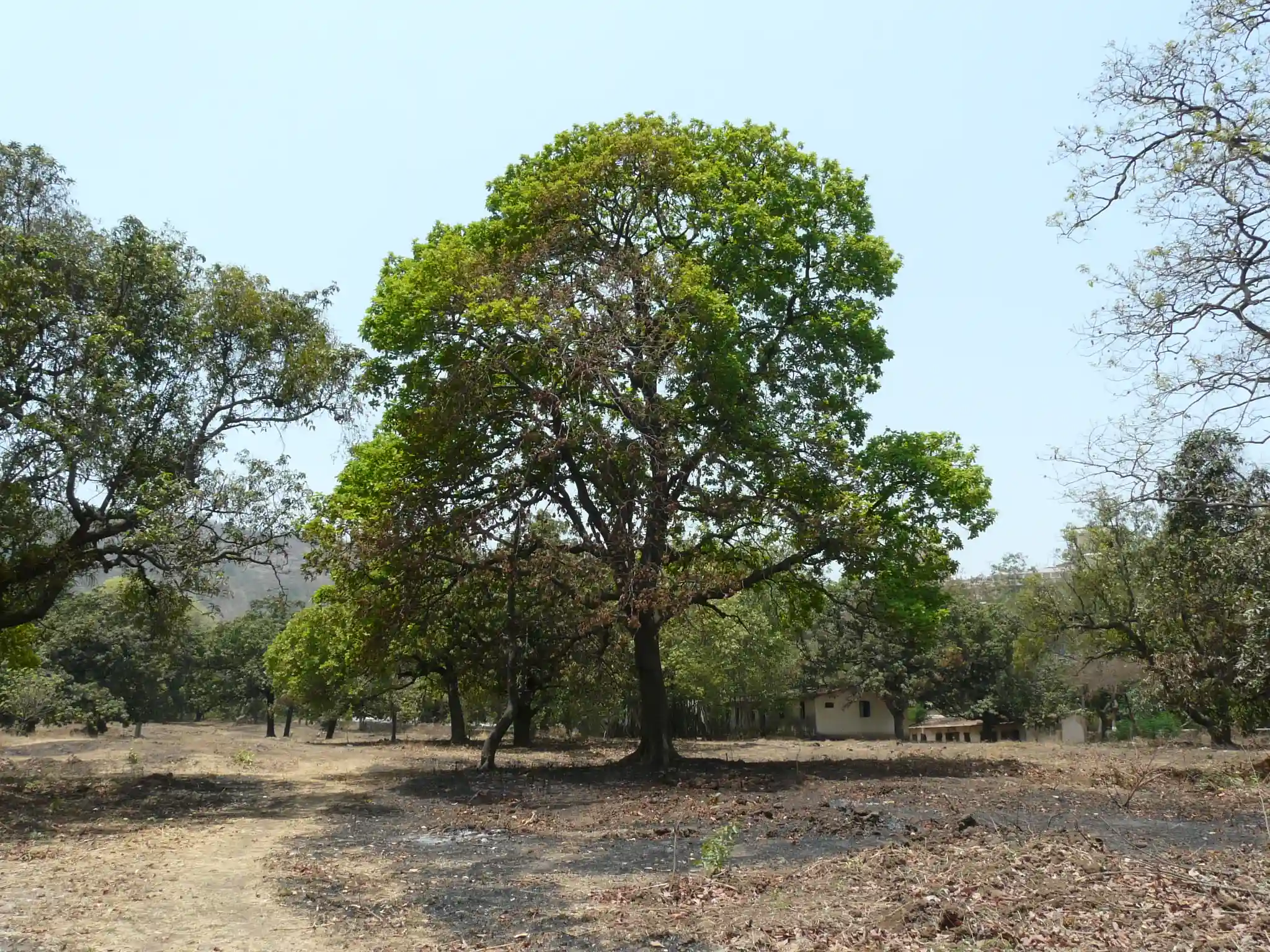
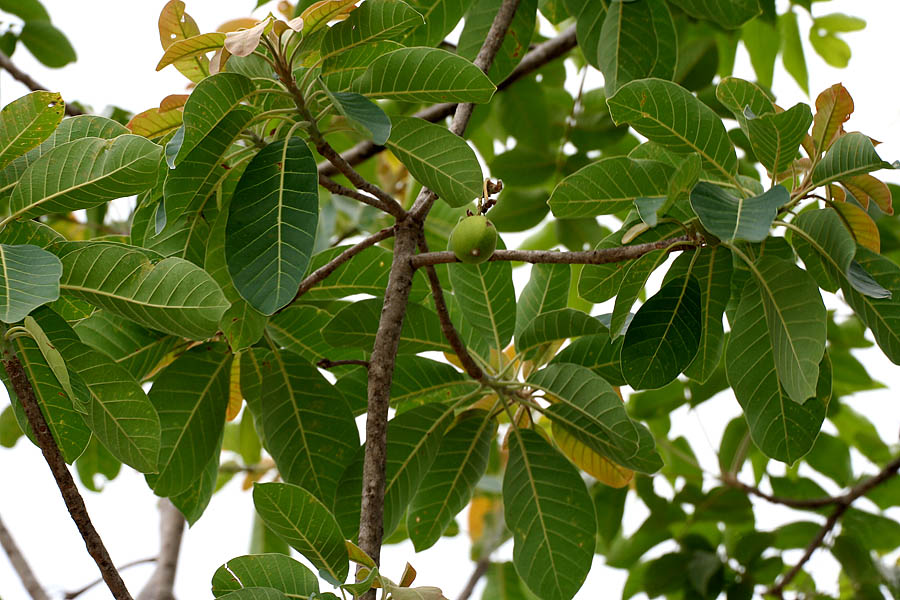
On a hot, humid day in September, the monsoon has enveloped the mountains and trees in Madhya Pradesh’s Chhatarpur district in a veil of green. After a bumpy climb up a mountain, the road to the village of Pathapur unfurls in an expanse of grassland and forest. Even through the heat-induced haze, the grey-brown-barked, wide-canopied mahua (Indian butter tree) is impossible to miss: rising like a sentinel from the tall grass, its crown and branches outstretched to the sky, the tree marks the landscape long before Pathapur comes into view.
This is not a sight unique to Chhatarpur. Mahua is a familiar presence across Central and Eastern India, where it is native. The deciduous tree is particularly abundant in the forest belts of southern Chhatarpur and eastern Panna (an adjoining district in Madhya Pradesh), which are home to the Panna Tiger Reserve, a critical wildlife sanctuary.
Even if you do not catch sight of the tree, you’re likely to encounter the fragrance of its flowers wafting towards you from a few feet away.
Even if you do not catch sight of the tree, you’re likely to encounter the fragrance of its flowers wafting towards you from a few feet away. During its flowering season, from March to April, it sheds most of its foliage, and blooms with fleshy, cream-white to pale gold blossoms clustered densely on bare or newly sprouting branches. These scatter to the ground overnight, filling the air with a honeyed sweetness. The flowers are collected at dawn, if langurs, monkeys, fruit bats and parakeets don’t get to them first. The early bird catches the shower of mahua petals. The tree then bears fruit between May and June.
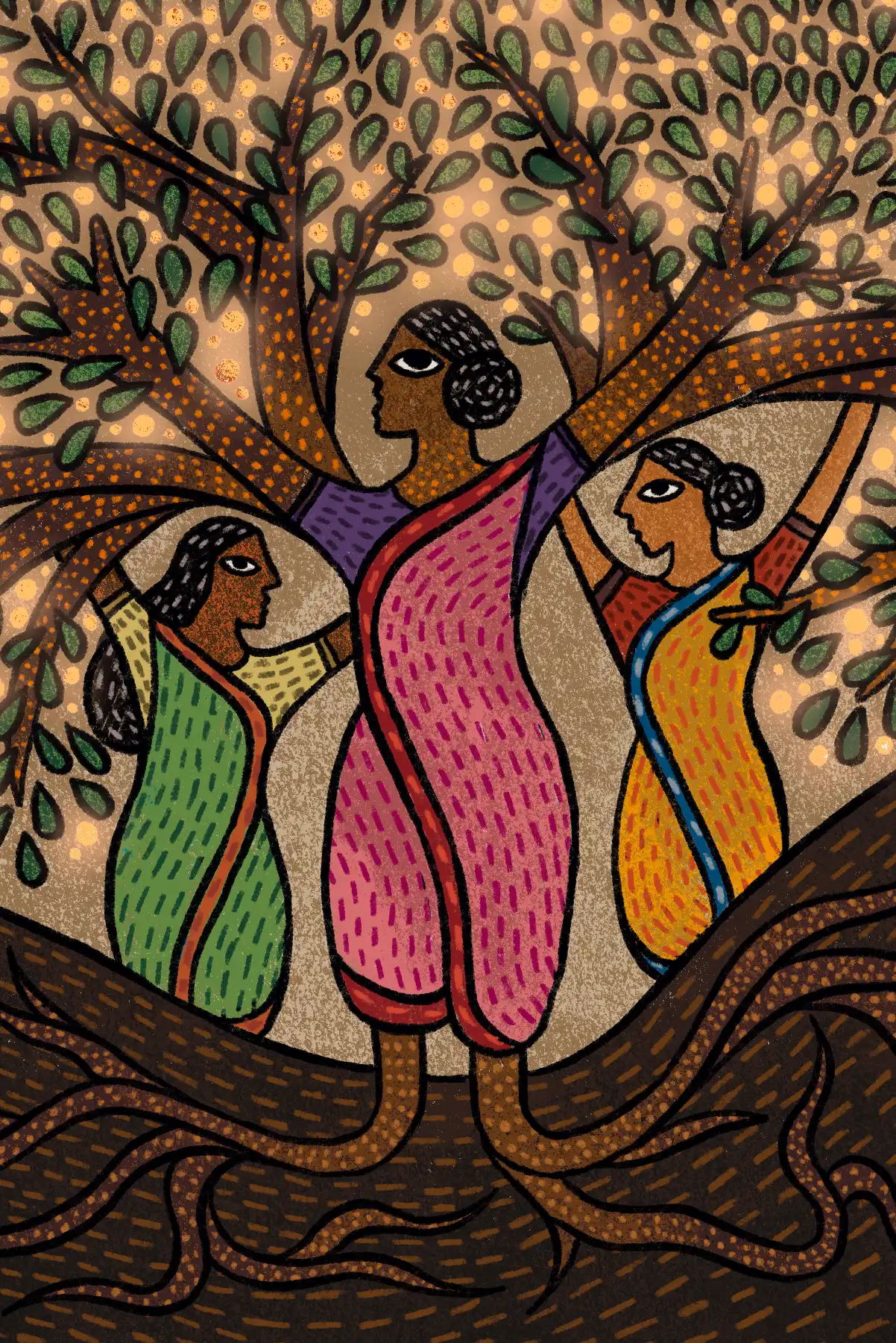
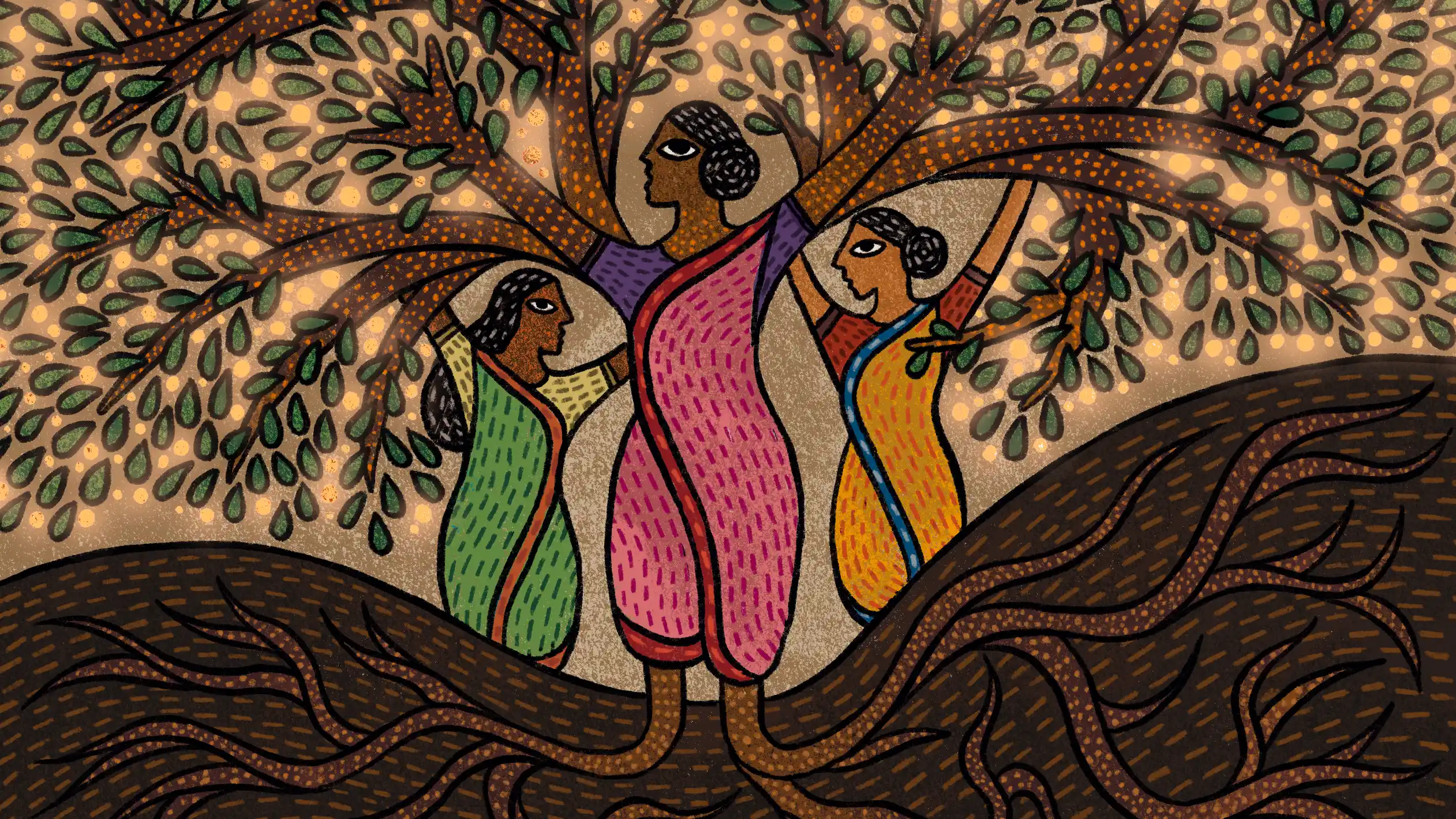
Mahua (Madhuca longifolia) has been likened to Central India’s kalpavriksha—the tree of life omnipresent in the livelihoods and culture of the Adivasi communities here, including the Gonds, Baigas, Murias, Mundas and Santhals. For them, mhowga (the consonants always softened in Bundeli) is not simply a tree. Nearly every part of it is sold, consumed or revered: its flowers are food and a source of income; its fruit is eaten and seeds are pressed for oil; its bark has medicinal properties; and the tree itself is woven into rituals, worship and everyday life.
This age-old relationship now hangs in the balance, as fear, rage and uncertainty loom large over Chhatarpur. Fourteen of its villages will be submerged over the next 8 years for the Ken-Betwa Link Project (KBLP). This controversial project, which was first proposed in 1995, has been pitched as a solution for water-stressed Bundelkhand which will reportedly transfer ‘surplus’ amounts of water from the Ken into the Betwa. These rivers are vital arteries of the region, and eventually drain into the Yamuna. Hydrologists have contested the effectiveness of the project and have pointed out its massive costs to ecology and local communities.
The ongoing story of imminent displacement in Chhatarpur and other districts like it is a tragic story of the disruption of ancestral livelihoods, and the loss of a kinship with this region’s land and forests, for trees like the mahua have sustained entire communities for centuries.
The infamous tree keeps bellies full
The census village of Pathapur, comprising almost entirely of the Adivasi Gond community, has neither piped gas nor water connections. Timber collected from the surrounding forests is sold and used as cooking fuel. Residual rainwater from the previous night’s downpour sluices off roofs fashioned from handmade flat bricks and tiles called khaprail.
This age-old relationship now hangs in the balance, as fear, rage and uncertainty loom large over Chhatarpur.
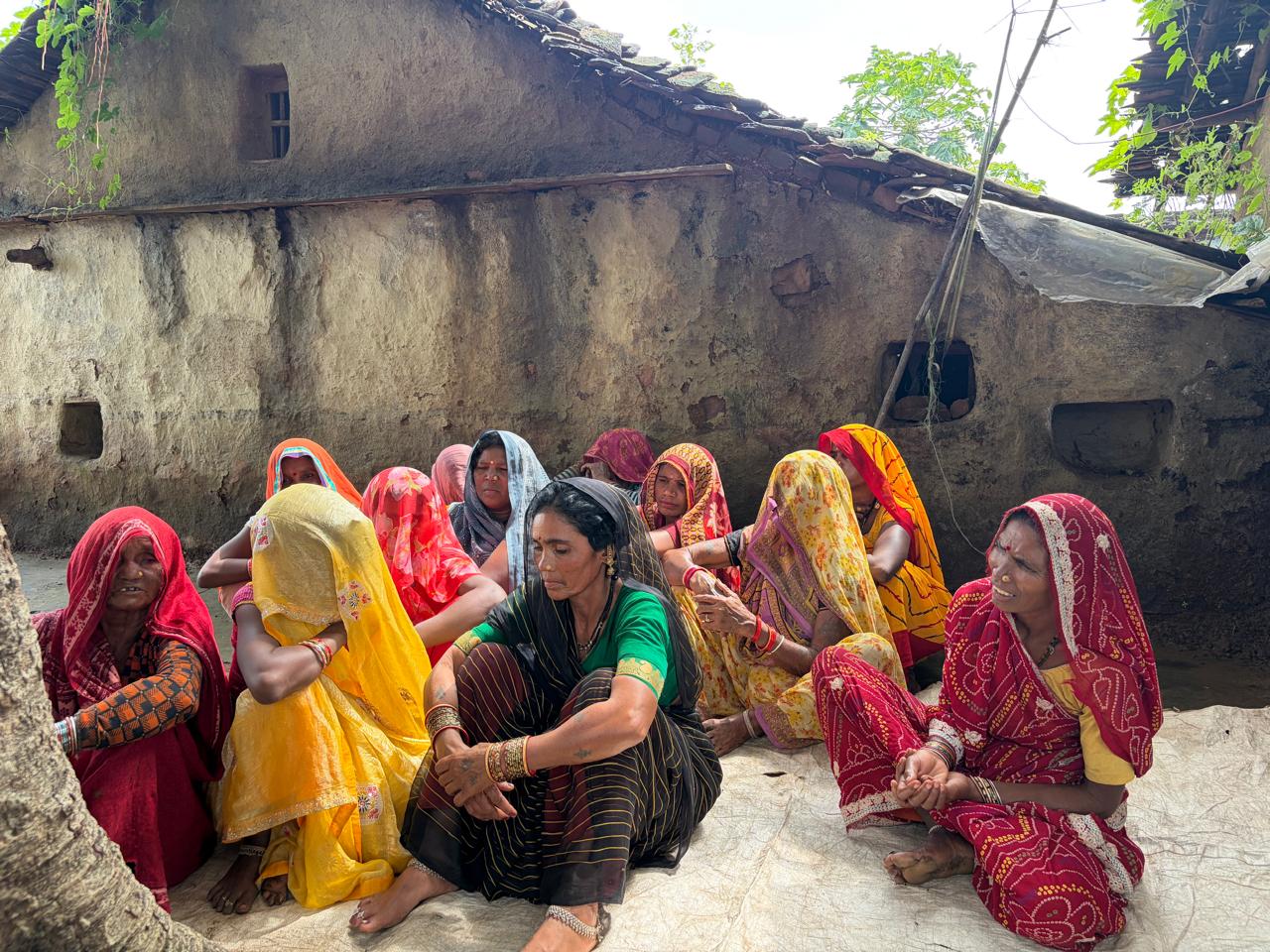
In the absence of roads, the women make their way through the slush with ease and gather at the chabutara—a raised platform built under a massive banyan tree—where villagers meet to worship, rest and discuss public matters. Today, they are visibly worried. “Jungle mein hamare paas sab kuch hai, didi. Mhowga hai, charwa hai. Ab yahan se bhag jaayen, toh kaa karenge batao?” (The jungle gives us everything we need and more. Mahua and chironji trees are plentiful. If we are forced to flee, what will we do?)
Outside tribal hamlets, mahua is perhaps best known for the eponymously named liquor brewed from its flowers. Until the late 1800s, the tree was considered as produce from the commons, and indigenous forest communities like the Gonds, Baigas, Bhils and Santhals were free to collect and store it. It was after the advent of the British that the tree was seen as a threat to public health and morality. The State deemed mahua to be a dangerously intoxicating ‘country liquor’ and imposed a crackdown on not only the spirit’s distillation, but also how and in what amount the tree’s produce could be harvested. The British Raj had a second ulterior motive hidden under the guise of what was ‘civilised’—to monopolise alcohol revenue and mahua trade. Criminalised at home, it began to be shipped to Europe.
While its colonial associations with infamy linger, the space it holds in the communities we met is very different. For generations, mahua has been lovingly harvested and ritually conserved in Madhya Pradesh. “In the month of Chaitra (March-April), we get up early and carry our baskets to the forest. We have to act fast, because the flowers start cascading at dawn. On a good day, we are able to bring back a few kilos,” Gyaan Rani, a woman in her 30s, says. “We did not plant these trees, we inherited them from our parents and grandparents. They are at least 150-200 years old. This is our peoples’ work, and our ancestors have been doing this for as long as we can remember,” she adds.
We did not plant these trees, we inherited them from our parents and grandparents. They are at least 150-200 years old.
Over 75 lakh Adivasi people are engaged in the trade of mahua, which is classified as a minor forest produce (MFP). Pathapur is surrounded by forest land, and its people rely on the adjacent village of Kharyani for land ownership and farming rights. They sow a variety of crops, including wheat, chana, urad dal, arhar dal, sesame and mustard. Ordinarily, they sell the mahua flowers to local traders for Rs. 150–200 a kilo, earning each household a few lakhs over the season. Most flowers are sold to intermediary traders who aggregate the mahua and take it onward to larger markets, for distilling into local wines and alcohol. These earnings enable them to prepare their fields for the kharif season, and pool savings for important occasions like a birth or a forthcoming marriage.
News of the displacement has come as a shock to Pathapur. Chand Rani, who is only in her 50s, but who appears to be a village matriarch, has been rocking her grandchild, quiet all this time. A question about whether they have been compensated as is required under Right to Fair Compensation and Transparency in Land Acquisition, Rehabilitation and Resettlement Act, 2013 sets her off. Until 2025, she alleges the villagers had only been notified of Kharyani going underwater. “We were devastated that our fields would be washed away, but also relieved that our forests, at least, would not be taken from us.” That relief was short-lived; a few months ago, she claims, officials arrived at Pathapur to notify them that it, too, would be taken over by the government. The result is that multiple sources of income have been shorn simultaneously, with the people left to unsuccessfully seek recourse at the nearest panchayat of Kupi, which is 25 km away.
From being rooted, to rootless
Mahua has tided communities over during long famines and droughts. Historian Vinita Damodaran writes about what was once the Chotanagpur plateau (modern-day Jharkhand, Chhatisgarh, Bihar, Odisha and West Bengal): “Not only were the fruits made use of as articles of food, but the fleshy corolla constituted a staple article of diet for the poor for several months of the year.”
Many people sought refuge in Panna district’s Tara village after their homes were bulldozed in Dondi, Khamri, Marha, Majhauli, Koni, Kathari Bilhata, Gahdara and Kudan. Their land has been reportedly acquired as compensatory afforestation for the near 8000 hectares of the Panna Tiger Reserve’s core and buffer zones which will be swallowed by the dam.
It is part of the food reserve that allows households to ride out a bad harvest—the dependable friend who never leaves your side.
These displaced individuals reminisce about the many gifts bestowed upon them by the forests that surrounded their villages. Mahua is never absent during conversations like these. It is part of the food reserve that allows households to ride out a bad harvest—the dependable friend who never leaves your side. “Temperamental monsoons and pest attacks would dramatically influence crop yields during some years,” says Harbai Adivasi, a 56-year old Gond woman from Gahdara. “We would always make sure to stock up on mahua produce. Boiled flowers and gulli [seeds] would fill our bellies during these times,” she adds.
Unripe mahua fruits are sauteed and eaten as a vegetable. Their seeds are pressed to extract oil, used for cooking and lighting lamps, and to relieve aches and illnesses. The flowers are also mixed with wheat, jowar and rice flour to make chapatis, puris and porridges. The women talk over each other, rattling off a long list, and yet the many uses of the miracle-tree don’t end.
Mahua trees have outlived generations of people who depended on them, making the loss of a tree difficult to measure in the language of compensation. For them, neither is the KBLP an abstract water-transfer scheme, nor their relationship with the forests quantifiable on the yardstick of ‘dependence.’
Mahua reproduces naturally, its seeds easily dispersed by the wind, birds and insects. However, it takes nearly three decades for a newly planted tree to bear its first flowers. For this reason, trees usually remain rooted to their native clusters, and cannot be easily transplanted elsewhere. “What use will it be by then? We’ll already have been forced to migrate to a city or become daily wage earners. The trees gave us so much, and it is now in this foreign land that we feel their absence more,” says Pirwa Rani, a 27-year old Gond woman from Gahdara.
“Our forest is our god”
Back under the banyan in Pathapur, the women light up when I ask to see the mahua flowers. They bring large fistfuls of the blossoms and chironji (Buchanania lanzan)—another important forest produce, used as a dry fruit in traditional Indian sweets like kheer and halwa. The mahua flowers, sun-dried and shrunken in size, are velvety and have a faint, heady aroma. Gyaan Rani chuckles and swats my hand away when I try to taste one “Arre, you can’t eat them right now! We still need to roast them to preserve and use them further.”
We go into the forests and pray to the mahua and chironji trees on this day. We also pray to our cows and buffaloes. These are our providers, our gods
Chand Rani, who was, until a half hour ago, in the vulture grip of a fever, energetically starts pounding the chironji with a large rock. The dried purple-black shells split open to reveal tiny seeds which taste mildly nutty. Our profuse requests asking them to stop feeding us are only met with a “Kha lo beta, Amma ke haath ka phir kab milega?” (Eat to your heart’s content, when else will you get to eat something made by an old woman like me?) “This is the snack we crush and pop into our mouths whenever us ladies gather. Our hands are used to the rhythm now!” Chand Rani adds. The traditional Gondi godna on their hands—tattoos which depict different flowers, plants and animals–catch my eye.
Forest produce like mahua and chironji routinely find their way into Gond festivities. One such Bundelkhandi festival is Halchhat, celebrated two days before Janmashtami. “We go into the forests and pray to the mahua and chironji trees on this day. We also pray to our cows and buffaloes. These are our providers, our gods,” Mugdha Rani, 46, says.
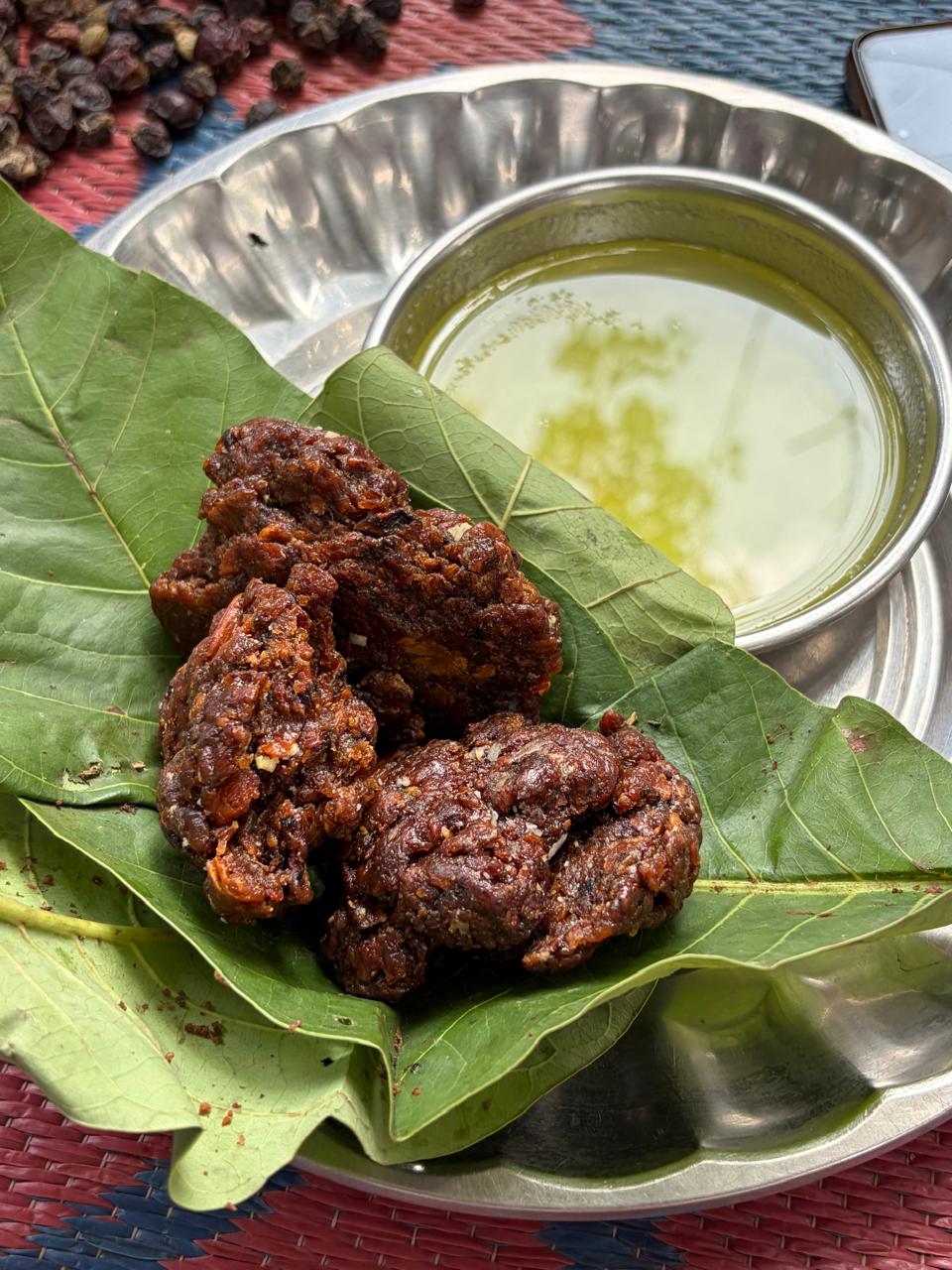
Pathapur’s women offer us a traditional delicacy prepared on Halchhat called ‘murkha’, made by roasting mahua, chironji, sesame, coconut and ghee, served in a bowl stitched from mahua leaves and twigs. It is deliciously fudgy. In my naivette, I ask whether they used sugar or jaggery. “We don’t keep either in our homes! Mahua is a natural sweetener which we use in everything, from tea to sweets,” Gyaan Rani says with a chuckle.
Mahua is also inextricably tied to other occasions in the ritual calendar—including birth, marriage, death, harvest, village worship and relationships with ancestors. “We offer the first mahua flowers of the season to the forest before venturing inside to forage,” says Sumitra Rani, a 74-year old Gond of Kudan village, Panna. “[The tree] is with us from the time a child is born. When the umbilical cord is cut, we preserve it in mahua [liquor] and then bury it. We also apply the liquor to the newborn’s navel—it acts as an antiseptic and heals the wound. We carry the leaves when we take a marriage proposal to the groom’s house,” she says.
The forest is also the place where all the women from the village used to gather and rest after a long day in the fields. “While keeping a look out for wild animals, of course!” Sumitra Rani adds. “We don’t know if we’ll ever be able to go back to our forests again. I don’t want to accept that that was the last time.”
In a bid to protect the status of mahua as an indigenous tree, the Madhya Pradesh government declared it a ‘heritage liquor’ in 2021. Modern brands, chefs and entrepreneurs are reinventing it—incorporating it into cocktails, foods and deserts, or positioning it as an ‘artisanal superfood’ and premium craft spirit. But for Adivasi communities, the problem is increasingly more basic: access. Across mahua-growing regions, collectors who need immediate cash or lack storage infrastructure and access to markets can be forced to sell their harvest cheaply, only to buy the same flowers back later at a higher price.
The forest has nourished us like her children. We don’t have to buy anything except salt and the clothes on our backs.
Adivasis have historically had to give up their land to make space for the industrial development nexus, from dams to mining projects. What does it mean for an ingredient rooted in Adivasi economies and labour to become more valuable elsewhere while the people who have sustained those traditions are increasingly unable to reach it? The threat to the mahua and the communities it nourishes is manifold. One of these threats is that climate extremes are accelerating—such as untimely rains which rot the delicate flowers, or temperature variations which alter its phenology (flowering schedule).
Gyaan Rani grows misty-eyed as she shares how, amid the hardship of having to collect water and firewood every single day, they feel most themselves in the forests. They have already had to bid goodbye to the homes of their birth in another village. Does another separation await them? This time from the forest that has raised them, fed them and held their lives in its fold? “Mahua-charwa mein hi palat rahe hai didi. Namak aur kapda, bas itna hi khareedna padta hai. Yahan azaad lagta hai. Sheher mein mar jaayenge.” (The forest has nourished us like her children. We don’t have to buy anything except salt and the clothes on our backs. This is where we feel free—we won’t be able to survive in the city.)
Additional edits by Aathira Konikkara
{{quiz}}


.avif)
Explore other topics
References



_W_IMG_0242.jpg)