Makarashankranthi at a forest farm: Local lore, bovine power and sesame offerings
Rituals rooted in the value of essentials like cow dung and beneficial plants herald a fresh start for farmers


Editor’s note: To know Rama Ranee is to learn about the power of regenerative practices. The yoga therapist, author and biodynamic farmer spent three decades restoring land in Karnataka, envisioning it as a forest farm in harmony with nature. In ‘The Anemane Dispatch’, a monthly column, she shares tales from the fields, reflections on the realities of farming in an unusual terrain, and stories about local ecology gathered through observation, bird watching—and being.
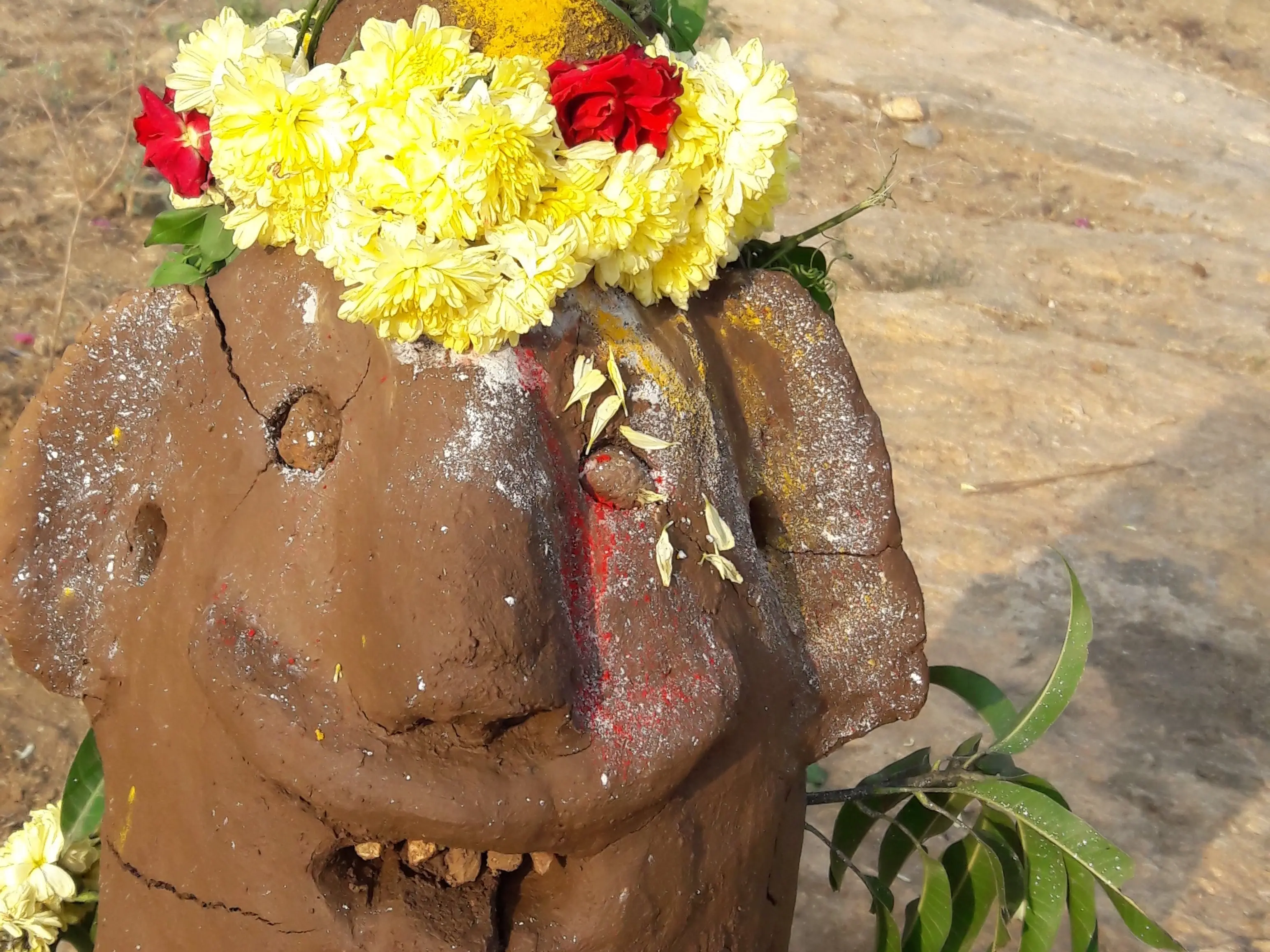
He stood in his cloak of flowers and vines, the wreathe of Ugani Hambu (Oval-leaved Silverweed, or Argyreia elliptica) awry, the Olle Tangadi (Tanner's Cassia, or Senna auriculata) flowers bright yellow, and Unnunni (Konkan Kalanchoe, or Kalanchoe bhidei) flowers catching the breeze like feathers. His eyes stared into the distant east as they had done from this hilltop for the last three decades, perhaps even longer, casting a protective spell over his domain. The gaze was the same but the eyes were different, renewed each year by the hands that shaped him out of clay—at times clear marbles, and sometimes just two round stones.
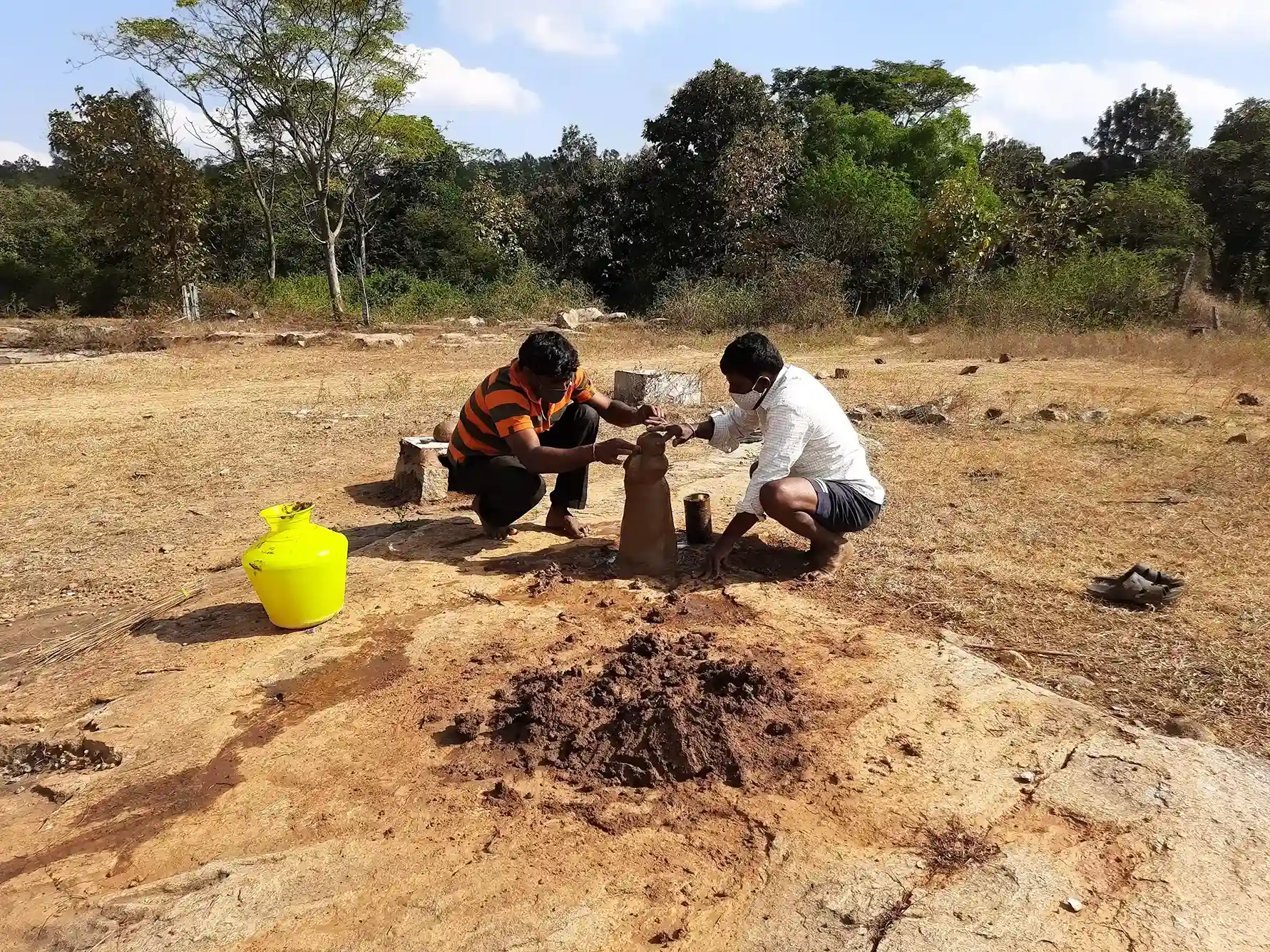
The previous day, Rajappa and Chikkanna (the staff at Anemane) had put together a physical form for the spirit of ‘Kaatamabaraya’, a folk deity of the region. The clay was brought from a vegetable bed, cleaned and kneaded into smooth balls—two large ones for the lower body, one for the torso, and the fourth for the head, shaped into a humanoid. Then came the teeth of stones and the eyes of pebbles or marbles, the nose, and the ears. Kaatamabaraya was endowed with all the senses and much more; he was, after all, the lord of the forests and the wilderness.
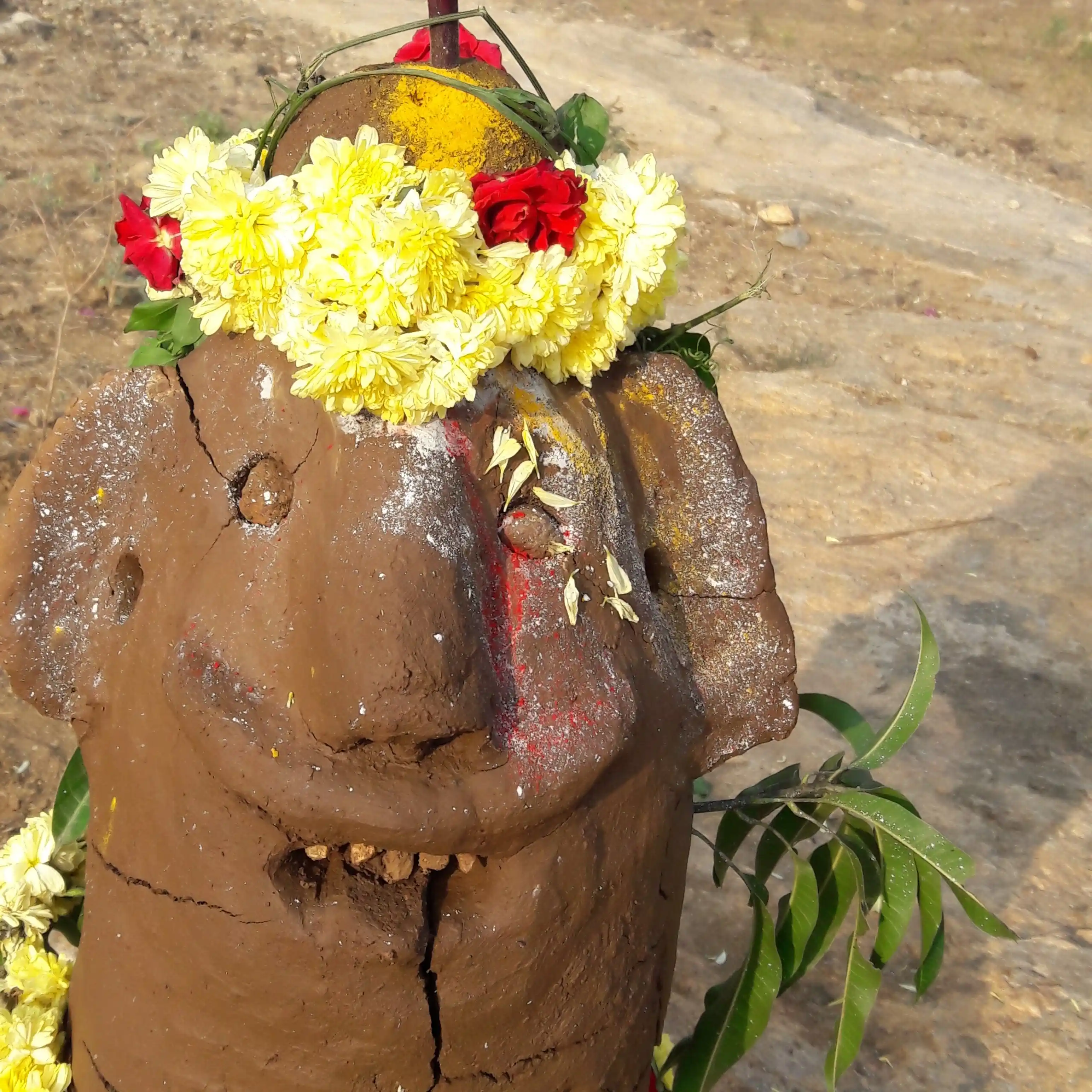
Outwardly, he mirrored the person who shaped him. Earlier it used to be our legendary Lakshmaiah, the original cowherd with an imposing physique, a handlebar moustache and a formidable presence that could counter any threat from leopards. He feared neither elephant nor man, well-attuned to the world of Kaatamabaraya. Since Lakshmaiah’s passing, the face that gazed upon us also changed.
The previous evening’s festivities had wound up as the sun set behind his back, after the last calf had leapt over the bonfire and all the cattle—his wards—had been housed in the cow shed and the gate firmly locked. It was a celebration of Uttarayana, the sun’s transition (Sankramana) from the southern to the northern hemisphere, on the northward journey from the Tropic of Capricorn, entering the constellation of Capricorn or Makara. Hence the name of the festival, ‘Makarashankranthi’. It indicated the end of winter and conclusion of the previous growing season, culminating in harvests, ushering a new cycle of longer days and the promise of fresh beginnings. Giving thanks to the sun for bountiful harvests and sharing the bounties with neighbours are central to the rituals associated with the festival (Bhogi habba, as it is known in Karnataka).
Also read: In forest bathing, an invitation to heal by being one with nature
Fertility and abundance
The esoteric significance of this celestial event is embedded in the rituals. About two thousand years ago, Makarashankranthi might have indeed coincided with the winter solstice of the northern hemisphere, making the day the shortest in the year, and night the longest. The sun was a universal deity among ancient cultures, which considered the winter solstice as a period of renewal and rebirth, auspicious for realigning with cosmic rhythms, for self-reflection and purification—reminiscent of Shankranthi.
In present times, it is celebrated on January 14 or 15, following a period of transition that occurs around mid-December and is considered a twilight zone, affecting earthly beings—particularly the vulnerable—and vitiating health conditions. This period calls for crossing from dormancy to awakening, darkness to light, the cosmic rhythm of breathing in to breathing out.
The offering and sharing of sesame seeds—tempered by jaggery—between neighbours, relatives, and friends, during this festival has spiritual connotations: other than being a symbol of abundance, the sesame stands for immortality and is ritually valued for its ability to absorb subtle impurities and negativity. The transformation of the sesame seed from its dark, unhulled state to its inner, white purified core may be viewed as a metaphor for the inner spiritual process. As a child, I saw and learnt how laboriously and cathartically black sesame was soaked overnight and rubbed the whole day long on fine white cloth till the dark skin peeled back and the white kernel revealed itself. Looking back, I realise that my participation in the process as a child under my grandmother’s strict eye conveyed the transformation much more effectively than any theory.
Unhulled seeds are dark, potent, and sacred to Shani or Saturn, the son of the Sun God who rules the zodiac sign of Capricorn. Therefore, to ward off his negative planetary influences, sesame seeds are offered. They are seen as receptacles of solar energy due to their nutritional value and warming properties. The association of the seed with both these cosmic forces makes it special.
Cattle are preeminent icons of fertility, abundance, and prosperity in most rural communities in south India. The cow is a symbol of Kamadhenu, the mythical wish-fulfilling cow who holds within her being the entire cosmos and 330 million deities. The unique capacity of the cow to digest plant material and convert it into soil-enriching manure is attributed to billions of microorganisms which populate the stomach, rather like the deities contained within Kamadhenu! In biodynamics, a cow’s horns are perceived to be of huge functional and spiritual importance, with a subtle influence on the digestive system and as ‘antennae’ that harness cosmic energies. She is the mediator between the cosmic forces and the earth.
{{marquee}}
Prior to the festival, the cattle sheds are thoroughly cleaned, the cattle bathed and their horns smeared with indigo or red clay to protect them from heat. Worn out tethering ropes are discarded for new ones. Cow bells adorn the necks and tips of horns.
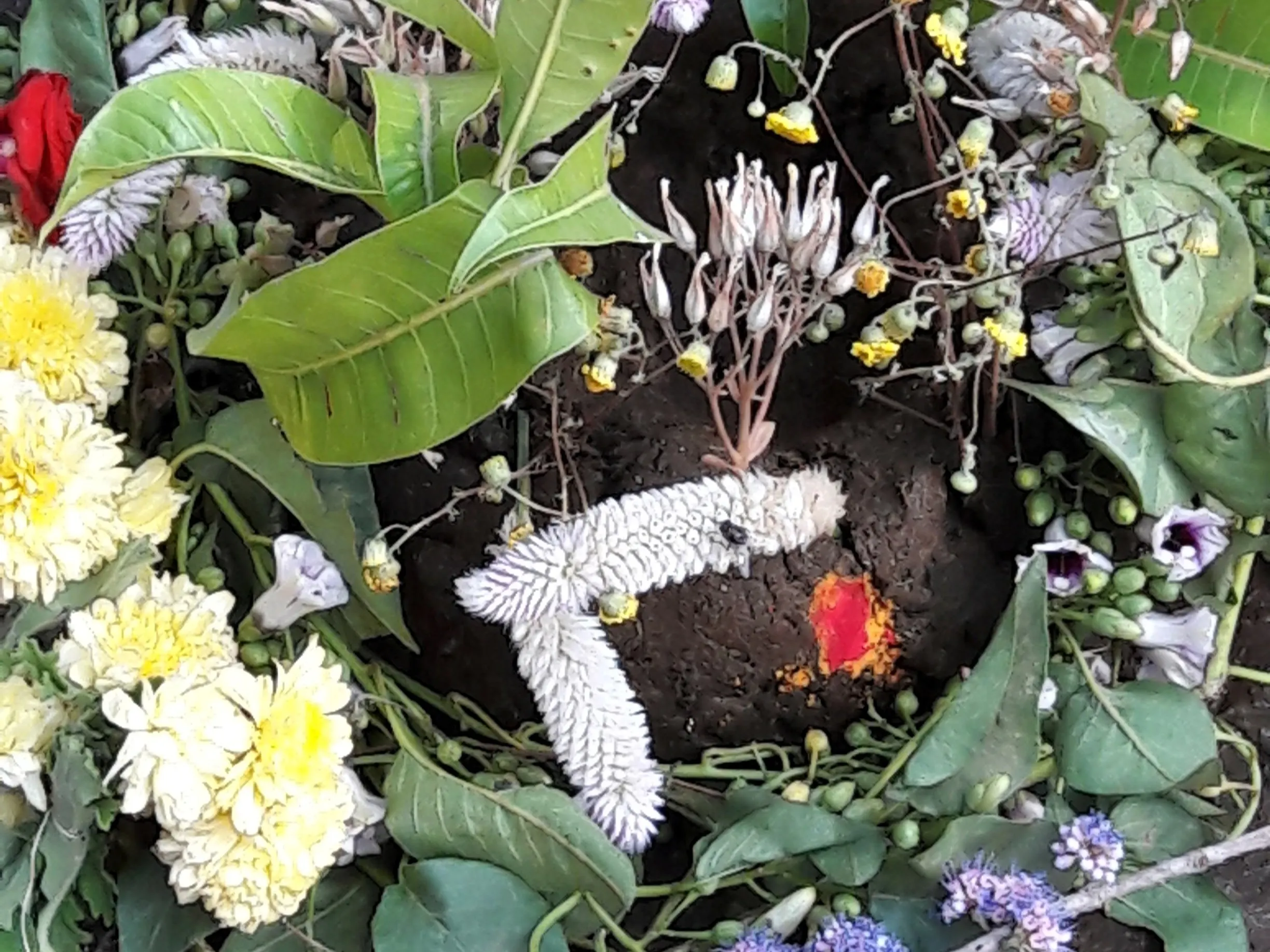
The ceremonies begin with Doddi puje, the worship of a cow dung heap as the embodiment of life force. A lump of fresh dung is placed in front of the cattle shed encircled by a rangoli and decked in flowers. The lump of dung ceases to be just that and transforms magically into a being bearing the essence of the archetypical cow when adorned with certain species of flowers and plants, evoking the formative forces of vital organs which they represent.
The yellow flowers of Tangadi are eyes, the winding creeper Ugani Hambu the intestines, the Unnunni represents the liver, and Bheemana Bande Kayi (Spreading Caper, or Capparis divaricate) the kidneys. Anne soppu (Silver Cockscomb, or Celosia argentea) crowns the top, but its association is unclear.
The rest of the puja follows as per convention with offerings of incense, fruit, and coconut, with an additional item—curd rice. If a girl child partakes of the offering first, the herd will be blessed with a female calf; if it is a boy, then a bull will be born. After distributing some of the prasad among the devout, the rest is left at the Doddi covered in a basket. On the following day the contents are added to a compost heap.
Local lore, a talent of senior staffer Rajappa, illustrates the association of these plants with cows: there was once a farmer who had many cows. Their coats of varying hues and shades were a matter of pride. The one thing that the farmer did not possess and coveted was a green cow. So, he prayed to God, who—pleased by his devotion—granted him the boon. “I grant you a green cow, but you must follow my orders. Go home… the cow will follow you, but do not turn back, no matter what.” The farmer began to walk homeward but there was no sign of the cow. After a long while, he began to worry. Slowly he turned and peeped over his shoulder. A magnificent green cow was emerging from a termite mound, its head, front hooves, and upper body visible. Alas! The moment he looked behind, it shattered.
The head turned into Kamadhenu Tale Gida, a plant whose seed resembles the cow’s skull; horns into Beppale (Pala Indigo, or Wrightia tinctoria); intestines into Ugani Hambu; eyes into Tangadi; kidneys into Bheemana Bande Kayi and liver into Unnunni.
It is unsurprising that all these plants are beneficial in many ways, possessing healing properties, from being anti-inflammatory and immune-supporting, to aiding digestive health, being used topically in skin care and the treatment of wounds and mastitis, valued in local health traditions for humans as well as livestock. Some like Anne soppu are a good source of nutrition for humans and cows. The farmer will never own a green cow, but he can invoke it and imbue the dung with its potency, transmit it to compost, and thence to the soil, enriching their value.
The voice of Rajappa’s ancestor keeps this story alive. Encoding local knowledge in myth and ritual gives biodiversity a lease of life. Local issues of health and nutrition are addressed effectively with plant diversity and the knowledge to use them appropriately. Agricultural landscapes traditionally included hedges, old trees and, groves, meadows with access to open spaces, and not merely fields for crops. Farm ecosystems serve various functions, from enriching the soil, to pest management, and the preservation of wild species of plants. Today, the survival of the sacred plants associated with the green cow hinges upon the existence of so-called wastelands and interspaces—the areas they are confined to.
Also read: Friends of the soil: A farmer’s key allies hide backstage and underground
Protector of cattle and farmer
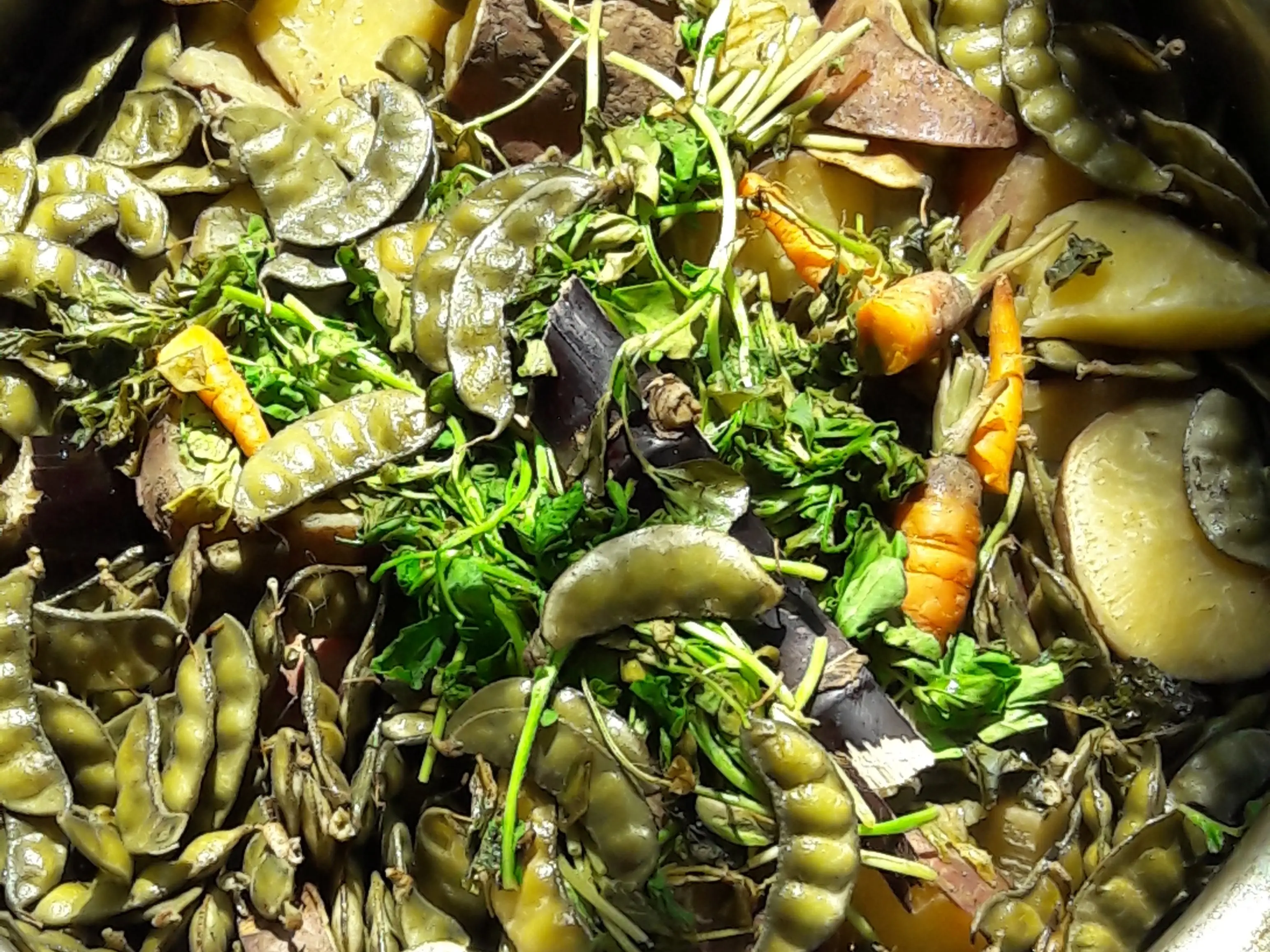
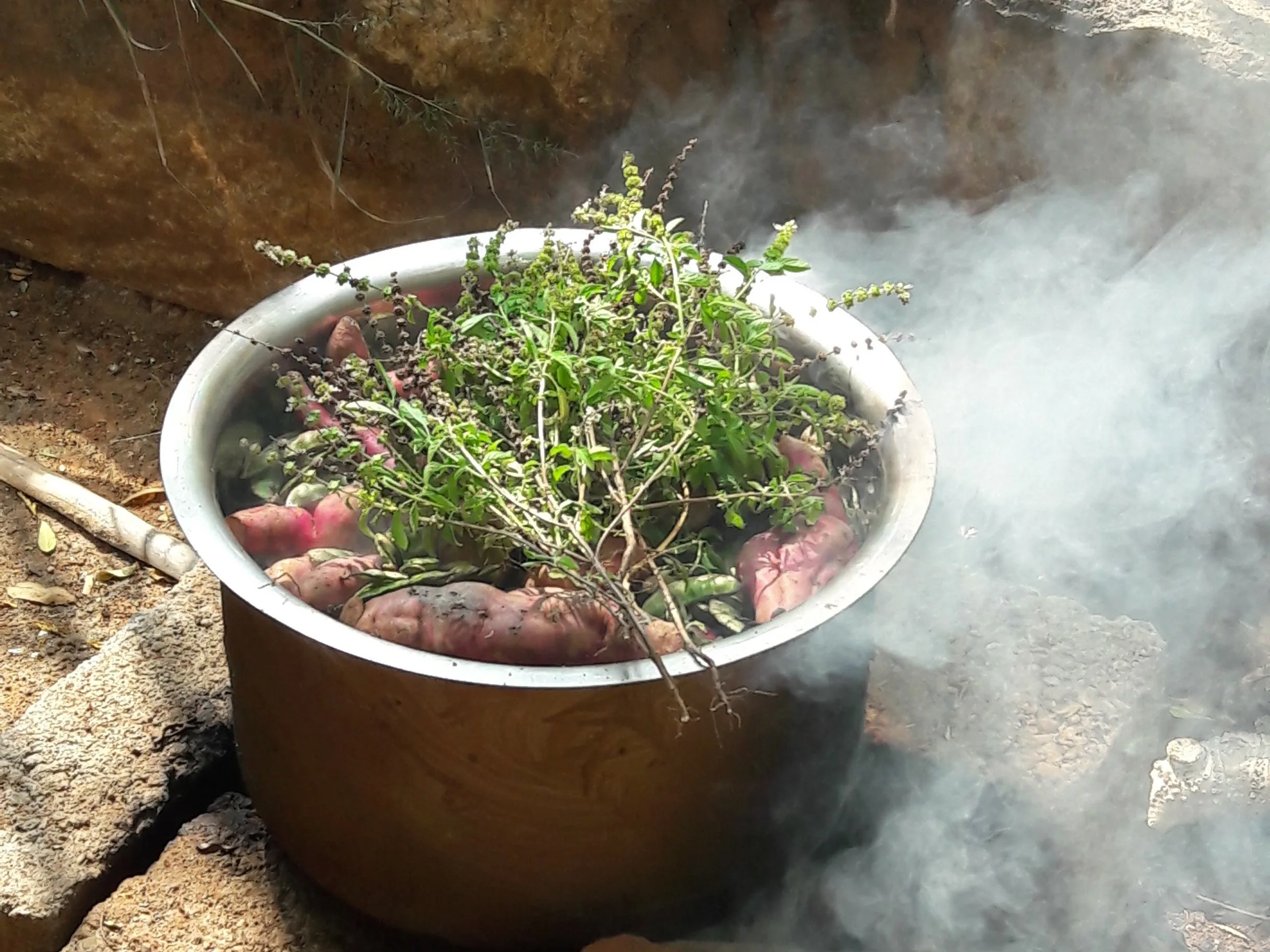
While a special festival lunch of Avarekai-huggi, a mildly spiced dish of Hyacinth beans, and rice, and Sihi-pongal, a sweet dish of rice, split green gram and jaggery, cooks in the kitchen, an outdoor firewood stove with a large pot of festival fare for the cows is tended to. A medley of fresh avarekai (Hyacinth bean) sweet potatoes, groundnut, sweet pumpkin and other gourds or freshly harvested produce, and chopped sugar cane is slow-cooked with aromatic herbs like Naayi Tulsi (Wild Basil, or Ocimum americanum) till tender, after which it is fed to the cattle.
Evening is the time to show gratitude to Kaatamabaraya, seeking his blessings and protection for livestock, especially cattle—a reminder of the not-so-distant past when livestock grazed in village commons or in forests, just as ours did. In a forest the hazards of grazing are many, from leopard attacks, to hostile elephants, bad weather or even errant bulls escaping the herd who require constant vigil. Kaata-ambara-raya (‘The lord who is clothed in forests’, as I understand it) provides protection not only from the dangers of the wilderness but also disease and uncertainty during the period of transition, ensuring safety.
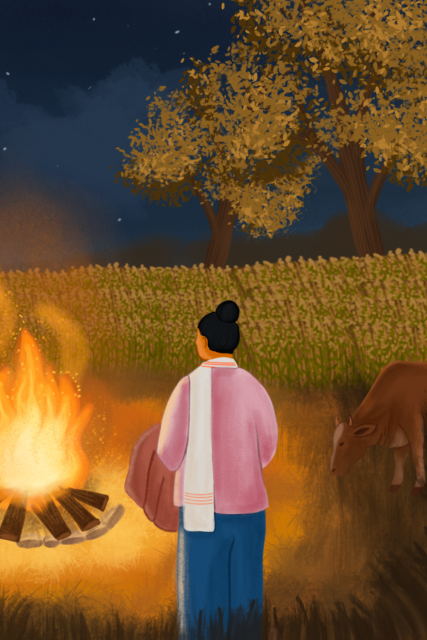
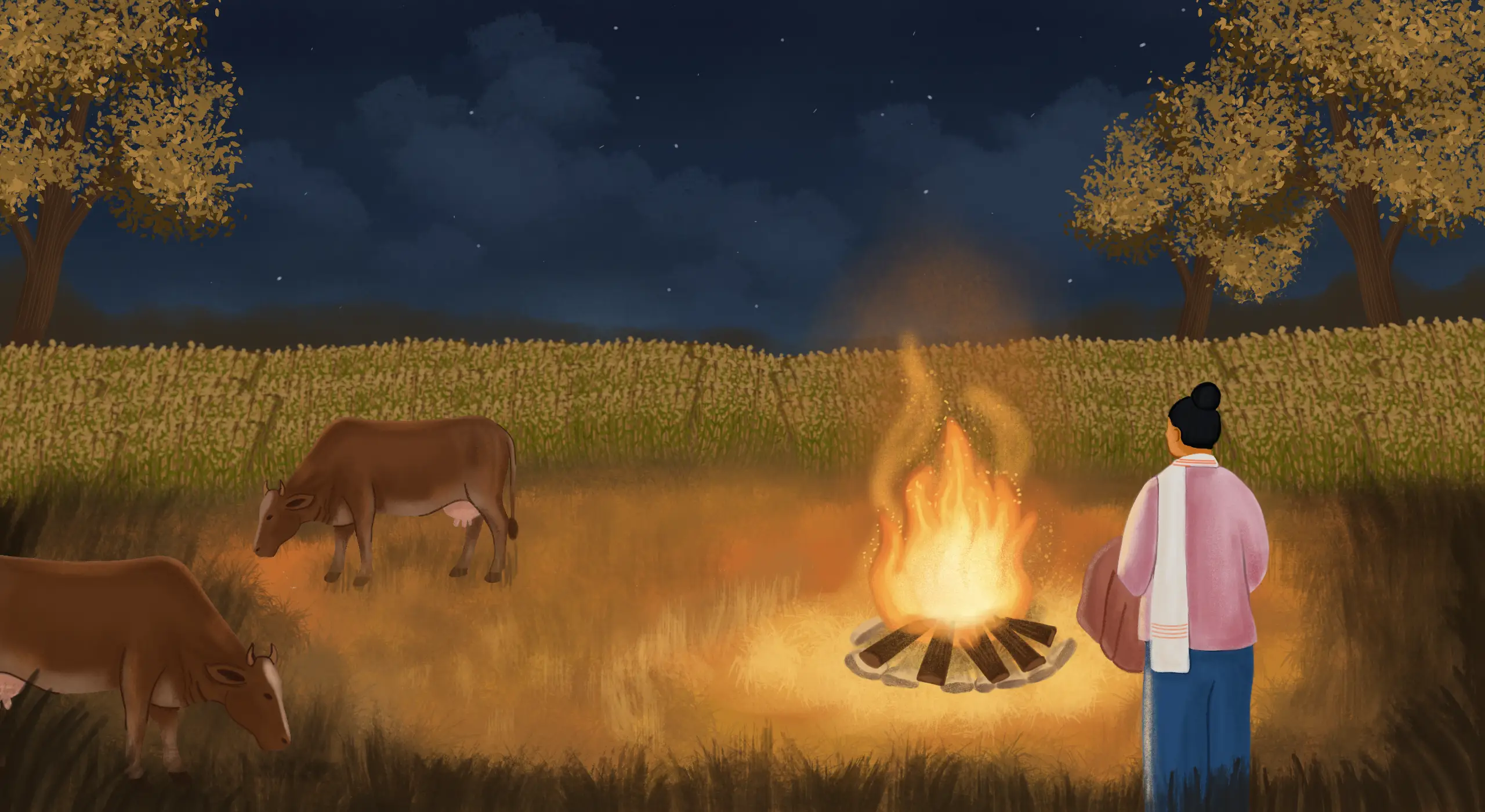
As the sun begins to descend, humans and cattle with flower garlands around their necks and horns mill around Kaatamabaraya. The cowherd conducts the ceremony, offering fruits, coconut, incense and aarathi, the ritual of waving lit wicks or incense sticks in front of the deity to the accompaniment of prayers. A mix of sesame, jaggery and groundnut, sugar cane, sugar candy or ‘Acchu’ and bananas are distributed, and all of us—including the cattle—enjoy the sugarcane. The ceremonies conclude as the sky turns red and gold. A bonfire is lit across the path for the cattle to jump over one by one—probably to rid their coats of ticks and sanitise them—to reach the safety of the cowshed. Forest edge pastoralists may construe this as a desensitisation strategy for coping with forest fires.
Under the dome of the heavens, Kaatamabaraya will guard plant and cow, so long as he reigns as a free spirit over wild spaces, unfettered.
Also read: Farming under the elephant’s nose: Lessons in crop choices
Artwork by Khyati K
{{quiz}}
.jpg)

.avif)
Explore other topics
References

What did the farmer from the folktale pray for?

.png)